

Domiciliary Care Compliance UK: A Strategic Guide to Operational Excellence in 2026
- Mara

- May 12
- 12 min read
What if your next CQC inspection wasn't a source of anxiety, but a validation of your agency's operational architecture? For many providers, domiciliary care compliance uk feels like a relentless cycle of reactive firefighting rather than a strategic asset. We recognize the weight of maintaining a "Well-Led" rating while navigating manager burnout and a volatile workforce. You shouldn't have to choose between regulatory safety and your leadership team's sanity.
This guide provides a roadmap to master the complexities of the 2026 landscape by transforming reactive habits into a proactive, inspection-ready narrative. We'll explore the strategic shift from static policy folders to a living operational culture that thrives under the Single Assessment Framework. From mastering the nuances of remote safety to leveraging 24/7 triage for long-term growth, you'll learn how to build a service that is as resilient as it is compliant.
Key Takeaways
Redefine your regulatory approach by treating compliance as a continuous operational narrative that isn't just a one-off registration event.
Discover how to master domiciliary care compliance uk by evidencing safety and leadership within the fluid, high-stakes environment of lone working.
Evaluate the "Burnout Model" of 24/7 in-house management against strategic triage support to protect your leadership team's capacity for growth.
Implement five operational pillars, including dynamic rota management, to ensure your service remains resilient during staff sickness or sudden crises.
Secure your "Outstanding" rating by building a data-driven evidence trail that satisfies the CQC's Single Assessment Framework requirements for 2026.
Table of Contents
The Landscape of Domiciliary Care Compliance UK in 2026
By May 2026, the regulatory horizon for domiciliary care compliance uk has shifted from episodic inspections to a model of perpetual scrutiny. The Care Quality Commission (CQC) has moved away from the traditional "snapshot" approach. Instead, they've embraced a system of continuous data monitoring that demands an ongoing operational narrative. Success in this environment requires more than just a polished business plan or a one-time registration fee of £1,522. It requires operational resilience, a structural ability to maintain high standards even when staff sickness spikes or recruitment gaps appear. Compliance is no longer a folder on a shelf; it's the pulse of your agency's daily life.
Understanding the 2026 Single Assessment Framework
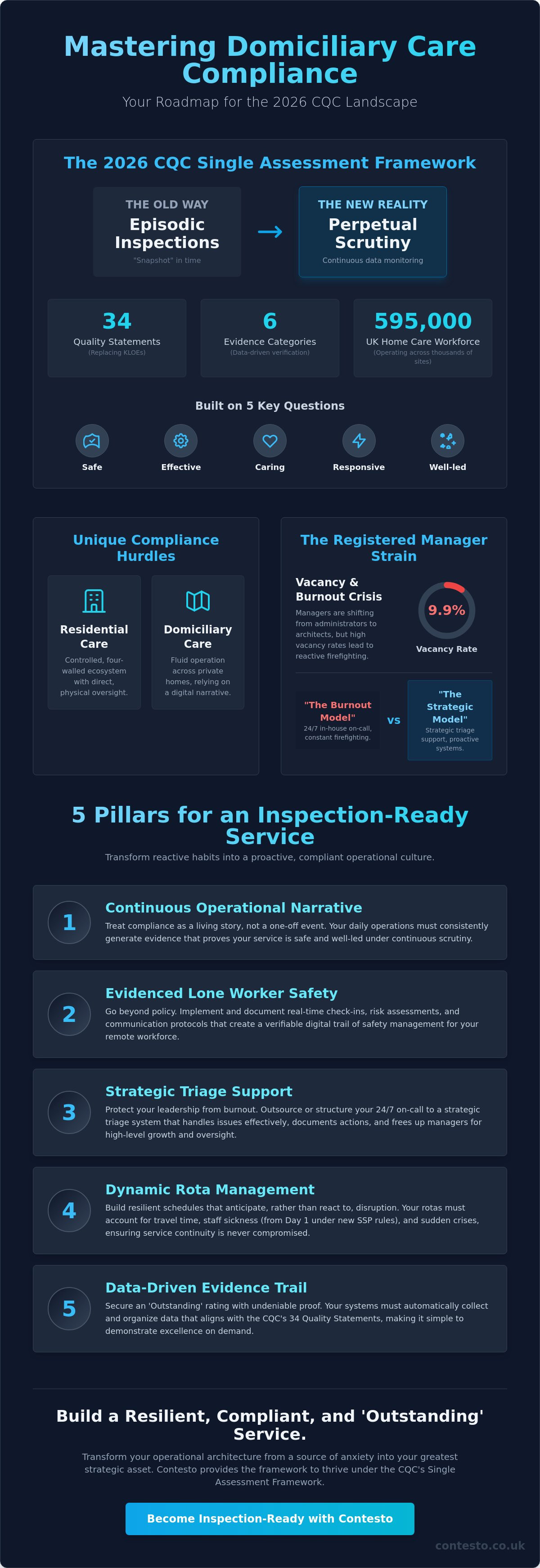
The Single Assessment Framework is built on 34 Quality Statements. These replace the old Key Lines of Enquiry (KLOEs) and are categorized under the five key questions: Safe, Effective, Caring, Responsive, and Well-led. CQC now utilizes six Evidence Categories to verify your claims, ranging from people's experiences to direct observation and feedback from staff. This data-driven approach ensures that providers can't simply "perform" for an inspector; the evidence must be baked into daily life. This is particularly vital in the diverse sector of Home care in the United Kingdom, where the workforce of approximately 595,000 people operates across thousands of private residences daily. To succeed, your data must tell a story of reliability, safety, and person-centered care that matches the CQC's real-time monitoring metrics.
The Evolving Role of the Registered Manager
Registered Managers have transitioned from administrators to operational architects. Under the Health and Social Care Act, the legal weight of this role is immense, particularly as the "Well-Led" rating becomes the hardest to maintain. With a 9.9% vacancy rate and new legislation like the abolition of the three-day waiting period for Statutory Sick Pay in April 2026, managers are often caught in a cycle of firefighting. The Employment Rights Act 2026 adds further complexity with new protections against last-minute shift cancellations. True compliance requires a strategic shift. It's about building an architecture that manages rota volatility and 24/7 triage without burning out the leadership team. A manager who is constantly on-call cannot be the strategic visionary the CQC expects. They need support systems that monitor compliance in real-time, ensuring every decision is documented, defensible, and aligned with the brand's long-term health.
Domiciliary vs. Residential: Unique Compliance Hurdles
Residential care operates within a controlled, four-walled ecosystem where oversight is a matter of walking down a corridor. In contrast, domiciliary care is a fluid operation that spans hundreds of private residences and miles of public roads. This lack of physical oversight creates a unique burden of evidence when managing domiciliary care compliance uk. While a care home manager can observe staff directly, a domiciliary leader must rely on a digital and operational narrative to prove their service is safe, responsive, and well-led. The statutory bedrock for this remains The Domiciliary Care Agencies Regulations 2002, which dictates how providers must conduct their business. However, the CQC’s 2026 assessment model looks far beyond basic adherence to these regulations.
Inspectors now examine how your agency handles variables that residential care simply doesn't face. Traffic congestion, unpredictable travel times, and the inherent isolation of lone working are no longer just logistical headaches; they are compliance metrics. If your operational data doesn't account for these environmental factors, your evidence for being "Safe" and "Responsive" will likely fall short during a Single Assessment Framework review.
Staffing and Rota Resilience
The CQC evaluates "Safe Staffing" in a domiciliary setting by looking for resilience, not just numbers. With a national job vacancy rate of 9.9% in England as of 2026, the temptation to create "paper-thin" rotas is significant. However, a schedule that fails to include realistic travel time or ignores the impact of the new Statutory Sick Pay rules, which now apply from day one of illness, is a major red flag. To remain cqc inspection ready, you must demonstrate that your rotas can withstand sudden sickness spikes without compromising service user safety. This requires a shift from static scheduling to dynamic rota management that proactively addresses gaps before they become compliance failures.
Managing Lone Worker Safety and Triage
Lone working increases the stakes for the "Safe" and "Well-Led" categories. If a carer encounters a medical emergency or a safety threat in a service user's home at midnight, your agency’s response time is the metric of your success. The CQC requires clear evidence of how staff are supported during these remote emergencies. An unresponsive on-call manager, or one who is too exhausted to make sound clinical decisions, represents a single point of failure. Modern domiciliary care compliance uk demands a robust 24/7 triage system. By ensuring that every call is answered by a trained professional, you mitigate the risks associated with remote care and provide the CQC with the high-level evidence of leadership they expect to see in an "Outstanding" service.
In-House vs. Strategic Outsourcing: The Compliance Impact
Many providers believe that keeping every operational lever in-house is the only way to guarantee domiciliary care compliance uk. They view outsourcing as a loss of control. In reality, the "Burnout Model" of 24/7 in-house management is often the greatest risk to a "Well-Led" rating. When a Registered Manager is juggling daytime strategy with midnight triage, decision-making quality inevitably erodes. Strategic outsourcing isn't about offloading responsibility. It's about professionalizing the response. By integrating specialized partners, you move from a fragile, hero-led culture to a resilient, systems-led operation.
The CQC's Single Assessment Framework evaluates how leadership ensures high-quality care at all times, not just during office hours. If your management team is the single point of failure for every out-of-hours crisis, you're not building a sustainable business; you're managing a ticking clock. Transitioning to a strategic support model allows your leadership to step back from the tactical weeds. This shift enables them to focus on the long-term narrative of excellence that inspectors expect to see in 2026.
The Cost of Manager Burnout
Fatigue isn't just a wellness issue; it's a regulatory liability. CQC inspectors are trained to identify signs of systemic stress. If a manager is perpetually exhausted, they're more likely to miss subtle patterns in staff sickness or fail to update risk assessments after a late-night incident. High turnover at the management level is a major red flag for CQC instability. Learning how to scale a care business uk requires a clean break from this cycle. By delegating the heavy lifting of out-of-hours triage and staff sickness management, you protect the person responsible for your agency's legal standing. A rested manager is a strategic manager, capable of driving the "Well-Led" improvements that secure an "Outstanding" rating.
Evidence of Consistent Leadership
The Single Assessment Framework prizes consistency over individual effort. While an in-house manager might handle a 2 AM call perfectly, the documentation often suffers when they're back in the office at 9 AM. Strategic triage partners provide a continuous, high-fidelity audit log of every decision made. This creates a robust, 24/7 paper trail for the "Responsive" and "Safe" categories. Contesto acts as the architect of this operational consistency, functioning as a white-labelled extension of your own team. We don't just answer phones. We monitor compliance through meticulous rota management and real-time operational support. This ensures that when the CQC asks for evidence of leadership during a crisis, you don't just have a memory; you have a data-driven narrative of professional excellence that is always inspection-ready.
5 Operational Pillars for an Inspection-Ready Service
Mastering domiciliary care compliance uk requires a shift from viewing regulations as a static folder of policies to treating them as an active, operational rhythm. By 2026, the CQC's Single Assessment Framework prizes the "how" and the "why" of your daily choices over the mere existence of a procedure. In this context, these five pillars form the skeletal structure of a service that doesn't just survive an inspection but defines the standard for it.
Dynamic Rota Management: Moving beyond just filling gaps to ensure that every visit is strategically planned, accounting for travel time and staff competency.
Robust 24/7 Triage: Creating a safety net where every call is answered and every incident is triaged by a professional, ensuring no risk goes unmanaged.
Continuous Audit Cycles: Using your operational data to identify trends, closing the loop on recurring issues before they impact care quality.
Staff Wellbeing and Support: Providing a framework that manages sickness and burnout, directly evidencing the "Well-Led" criteria through a supported workforce.
Transparent Incident Reporting: Building a culture where near-misses are documented and learned from, turning potential failures into strategic improvements.
From Firefighting to Rota Resilience
Safe staffing is the intersection of availability and competence. In an era where the National Living Wage has reached £12.71 and the job vacancy rate remains at 9.9%, your rota is your most significant compliance asset. A resilient rota doesn't just manage the present; it anticipates the future. By utilizing proactive rota management and staff sickness management, you can significantly reduce agency spend while proving to the CQC that your service remains safe even during peak illness periods. This level of oversight transforms your scheduling from a daily battle into a defensible record of safe staffing levels.
Mastering the Audit Narrative
The transition from "doing audits" to "learning from audits" is where "Good" agencies become "Outstanding." An audit shouldn't be a box-ticking exercise; it should be a diagnostic tool that informs your next strategic move. You can find a detailed framework for this in our care home audit checklist, which applies equally to the rigorous standards of domiciliary care. By presenting your 24/7 triage logs and compliance monitoring data as evidence, you show the CQC a proactive narrative of risk management. It's about proving that you don't just see problems; you have the architectural support to solve them in real-time. If you're ready to professionalize your operational response, explore how our compliance monitoring and triage services can secure your agency's future.
Contesto: The Strategic Architect of Your Compliance
Achieving excellence in domiciliary care compliance uk isn't a destination; it's a state of operational grace. We've explored how the landscape of 2026 demands a continuous, data-driven narrative of safety and leadership. Contesto acts as the strategic architect of this narrative, building the systems that allow your agency to thrive under CQC scrutiny. By removing the single point of failure, specifically the exhausted manager handling midnight crises, we ensure your operational pulse remains steady. Our support is entirely white-labelled. We operate as a seamless extension of your brand, providing high-level expertise while you maintain the primary client relationship.
The ROI of this approach extends beyond a simple "Good" or "Outstanding" rating. It manifests in the stability of your workforce, the scalability of your operations, and the peace of mind that comes from knowing every risk is managed. When compliance is baked into your infrastructure, it ceases to be a source of anxiety and becomes a competitive advantage. You're no longer just providing care; you're building a resilient, defensible brand that is ready for the future of the UK care sector.
Why Software is Only Half the Solution
Digital care management systems are essential tools, but a tool is only as effective as the hand that wields it. Software can flag a missed visit, but it cannot negotiate with a sick staff member at 5 AM or offer clinical reassurance to a distressed family. This is the difference between a static tool and a strategic partner. Contesto maximizes the ROI of your existing technology by providing the human intelligence needed to act on its data. We ensure 24/7 operational continuity, allowing you to compete for high-value contracts with the confidence that your service never sleeps. This resilience is what transforms a standard provider into a market leader.
Your Next Steps to a Well-Led Rating
Reframing your on-call strategy from a necessary burden to a compliance asset is the first step toward an "Outstanding" rating. When you integrate outsourced triage and rota management, you aren't just buying time; you're buying a defensible evidence portfolio. Every call we handle and every shift we cover adds to your audit trail of proactive risk management. To prepare for your next engagement with inspectors, we recommend reviewing our guide on cqc inspection questions. This will help you articulate how your strategic partnership with Contesto secures the "Well-Led" pillar of your service. True peace of mind comes from knowing your agency is inspection-ready every hour of every day.
Secure Your Legacy of Operational Excellence
Mastering domiciliary care compliance uk requires more than just meeting minimum standards; it's about building an architecture of reliability. The 2026 Single Assessment Framework prizes continuous evidence over snapshot inspections, making your daily operational narrative the most valuable asset you own. Success now hinges on your ability to protect your management team from burnout while maintaining absolute operational continuity. By shifting from a reactive "burnout model" to a strategic support system, you transform compliance from a source of anxiety into a narrative of strength.
Contesto provides the structural integrity your agency needs to achieve an "Outstanding" rating. Our dedicated 24/7 UK-based triage team offers white-labelled operational continuity that functions as a seamless extension of your own brand. We deliver CQC inspection-ready support that ensures your service remains safe, responsive, and well-led, even during the most challenging sickness spikes. Discover how Contesto’s 24/7 Triage transforms your compliance narrative and allows you to lead with confidence. Your journey toward operational excellence begins with a single strategic choice. We're ready to help you build it.
Frequently Asked Questions
What are the main CQC requirements for domiciliary care in 2026?
The primary requirements for domiciliary care compliance uk in 2026 revolve around the 34 Quality Statements within the Single Assessment Framework. Providers must demonstrate active, ongoing adherence to the five key questions: Safe, Effective, Caring, Responsive, and Well-led. While the foundational registration process remains, the CQC now prioritizes continuous evidence of high-quality, person-centered care. This requires a shift from episodic preparation to a state of perpetual inspection readiness through robust data monitoring.
How does the CQC define "Safe Staffing" for home care agencies?
Safe staffing is defined as the strategic alignment of staff availability with specific competence levels. The CQC expects you to prove that you have enough qualified personnel to meet service users' needs safely, even during unexpected sickness spikes. This requires more than just a full rota; you must demonstrate that travel times are realistic and that staff aren't overworked. Fatigue is viewed as a significant risk factor that directly compromises the safety of care delivery.
Can I outsource my out-of-hours on-call and still be CQC compliant?
You can certainly outsource your out-of-hours triage while remaining fully compliant. In many cases, the CQC views professional triage support as a sign of a "Well-Led" organization because it prevents manager burnout and ensures 24/7 responsiveness. The key is ensuring your partner is fully integrated into your governance structure. You must be able to produce audit logs of every incident handled, demonstrating that your service remains safe every hour of the day.
What is the Single Assessment Framework and how does it affect home care?
The Single Assessment Framework is the CQC’s unified model for evaluating all health and social care providers. It replaces the old KLOEs with 34 Quality Statements and relies on six Evidence Categories to verify claims. For home care, this means your domiciliary care compliance uk narrative must be supported by real-time data, staff feedback, and service user experiences. It effectively shifts the burden of proof from a single inspection day to a continuous cycle of evidence collection.
How often should a domiciliary care agency conduct internal compliance audits?
Domiciliary care agencies should move away from traditional monthly audits and embrace continuous internal monitoring. While formal governance reviews might occur quarterly, operational audits of rotas and triage logs should be a weekly or even daily occurrence. High-performing agencies use their daily data to identify trends in staff sickness or missed visits. This proactive approach allows you to correct course before small issues escalate into significant regulatory breaches.
What evidence does the CQC look for in the "Well-Led" category for home care?
For the "Well-Led" category, the CQC looks for evidence of strong leadership, a positive culture, and robust risk management. They want to see how you support your staff and ensure operational continuity. Providing logs of 24/7 triage and evidence of proactive staff sickness management demonstrates that your leadership isn't just reactive. It shows you've built a resilient system that protects both service users and your management team's mental health.
How do I manage staff sickness without breaching compliance standards?
Managing staff sickness without breaching compliance requires a dynamic approach to rota management. The abolition of the three-day waiting period for Statutory Sick Pay in 2026 means providers must be even more agile. You should maintain a strategic "buffer" in your staffing levels and use professional support services to manage sudden gaps. The goal is to ensure that service users never experience a drop in care quality due to staff absence.
Is it better to use in-house staff or an agency for out-of-hours triage?
While in-house staff offer familiarity, a professional triage partner removes the "single point of failure" inherent in an overstretched manager. Using a dedicated UK-based triage team ensures that every call is answered with professional precision and documented for audit purposes. This strategic support allows your Registered Manager to focus on growth and quality improvement during the day. It provides a level of operational resilience that's difficult to achieve with a tired internal team.


Comments