

Strategic Home Care Rota Management Services: A Guide for UK Providers
- Cosmo - Chief Guardian

- May 21
- 5 min read

Table of Contents
The Operational Reality of Domiciliary Care Rota Management
In the UK's domiciliary care sector, rota management is a complex balancing act between compliance, cost, and continuity of care. Unlike a residential setting, it involves coordinating a mobile workforce across multiple locations, factoring in travel time, and responding to client needs in real-time. This logistical pressure often leads to a 'rota crisis', where manual spreadsheets and basic scheduling apps collapse under the strain of daily operational demands.
The consequences of poor rostering are immediate and severe. They directly impact client outcomes through missed or late visits, erode staff retention as carers face unpredictable schedules, and create a significant financial drain from over-reliance on agency staff, particularly during periods of high sickness. (Employee scheduling software)
Why Traditional Rostering Methods Fall Short
The static nature of spreadsheets is fundamentally unsuited to the dynamic, 24/7 environment of home care. A simple instance of traffic or a client emergency can disrupt an entire day's schedule, a problem a spreadsheet cannot solve. This is compounded by fragmented communication—text messages, emails, and phone calls—which often leads to missed shifts, confusion, and carers feeling unsupported. Furthermore, the hidden administrative cost of managers chasing staff on their days off to fill gaps represents a significant and unsustainable drain on senior resources.
The Link Between Rota Stability and Staff Burnout
When managers are constantly reacting to last-minute gaps, their role shifts from leading care quality to perpetual problem-solving. This relentless pressure exhausts management teams and creates a stressful work environment. For carers, inconsistent or unfair rotas have a profound psychological impact, undermining morale and job satisfaction. Rota-induced burnout, defined by the chronic stress of managing unpredictable schedules and last-minute changes, is a primary driver for manager turnover in the care sector.
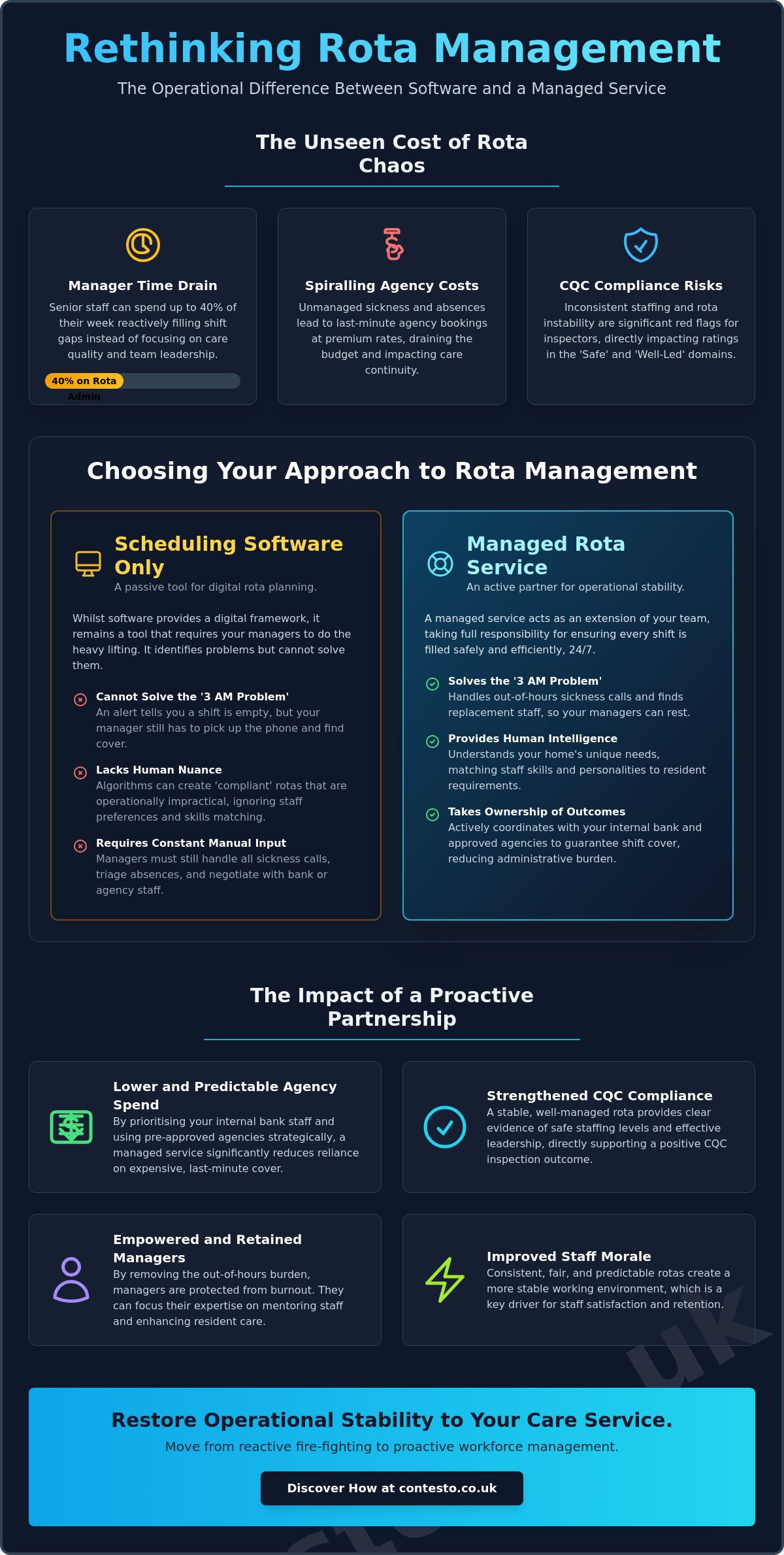
Software vs. Managed Rota Management Services
It is crucial to distinguish between a tool (software) and a partner (a managed service). Domiciliary care management software is an essential foundation for organising visit schedules and client data, but it is not a complete solution. The software provides the grid, but it cannot manage the human complexities that arise outside of office hours. This raises the '3 AM problem': when a carer calls in sick for a 6 AM vulnerable client visit, a software dashboard offers no practical help. A managed service, however, provides the experienced personnel to handle that emergency.
Whilst the logistical demands of domiciliary care—coordinating travel and lone workers—present unique hurdles, the fundamental pressures mirror those in residential settings. In fact, many principles from effective care home rota management services can be adapted to strengthen home care operations, focusing on the shared goals of reducing agency spend and ensuring CQC readiness. The return on investment becomes clear when comparing the cost of a managed service against the high hourly cost of a registered manager performing administrative tasks instead of focusing on care quality. (NHS Long Term Workforce Plan)
The Limits of Automated Scheduling
Automated scheduling algorithms can propose efficient routes, but they lack the human nuance required for high-quality care. They cannot easily match a carer’s specific skills or personality to a client with complex needs, nor can they navigate the 'grey areas' of a carer's availability or preferences. This can lead to rotas that are compliant on paper but impractical or undesirable in reality. A managed service provides the essential human oversight to interpret these nuances, ensuring schedules are both efficient and effective.
Managed Services as an Extension of Your Team
A professional managed service acts as a seamless, white-labelled extension of your own operation. With 24/7 on-call triage, they provide the operational continuity needed to manage any issue, at any time, maintaining your brand's standards and identity in all communications with staff. When calculating the true cost of care rota management, factoring in the time senior leaders spend on scheduling reveals the strategic value of an expert partner who can handle these pressures for you.
Essential Features of Professional Rota Management Services
Effective rota management services offer far more than simple scheduling. They provide a robust operational backbone designed to enhance stability, control costs, and ensure compliance. Key features for domiciliary care providers include:
Real-time coordination: Immediate management of staff sickness, travel delays, and emergency visit cover to ensure clients are never left without care.
Active agency reduction: Strategic utilisation of your internal bank staff first, significantly reducing costly reliance on external agencies.
Compliance monitoring: Proactive oversight of Working Time Regulations, including travel time and rest breaks, alongside checks for mandatory training and qualifications.
Seamless integration: The ability to work with your existing care management software to ensure a single source of truth for all operational data.
Compliance and Regulatory Oversight
A professional service ensures every visit is allocated to a carer with the correct skill mix and training, protecting both your clients and your CQC rating. By automatically tracking working hours and mandatory rest breaks, they help safeguard staff wellbeing and prevent fatigue. This systematic approach is vital for avoiding the common rota gaps that risk compliance and demonstrating robust governance to inspectors. (CQC Regulation 18 on Staffing)
Financial Control and Agency Spend
The primary mechanism for financial control is an 'internal first' approach to filling shifts. Before resorting to an agency, a managed service will offer open visits to your own part-time and bank staff, keeping resources within your business. Combined with real-time reporting on labour costs versus budget, this gives you the visibility and control needed to make informed financial decisions. Proactive rota management, focused on maximising internal capacity, can reduce agency spend by up to 30%.
How Managed Support Protects Your CQC Rating
Your rota is one of the most critical pieces of evidence you can present during a CQC inspection, directly supporting the 'Well-Led' and 'Safe' domains. Consistent staffing patterns, managed by a professional service, lead to better continuity of care, which in turn improves client outcomes and strengthens your 'Caring' score. Having a professional audit trail for every sickness event, shift change, and resolution demonstrates a well-managed, resilient, and safe service.
Evidencing Safe Staffing Levels
A managed service provides inspectors with clear, auditable data on staffing ratios, skill mixes, and visit completion rates. It demonstrates a proactive strategy for managing workforce capacity and mitigating the risks of staff fatigue. Using outsourced rota management also serves as powerful evidence of your business continuity planning, proving you have a resilient system in place to handle unexpected operational challenges without compromising client safety.
The Contesto Solution for UK Providers
Contesto delivers specialised 24/7 on-call triage and managed rota support tailored to the unique demands of the UK domiciliary care sector. Our UK-based team acts as a dedicated partner, integrating with your operations and adhering to your specific policies and procedures. We handle the out-of-hours pressure, coordinate sickness cover, and optimise your rota, freeing your managers to focus on what they do best: delivering outstanding care. Discover how Contesto can stabilise your care operations today.


Comments