

How to Calculate the Cost of Using Agency Staff in the UK: A Strategic Guide for Care Providers
- Mara

- May 11
- 12 min read
Updated: May 12
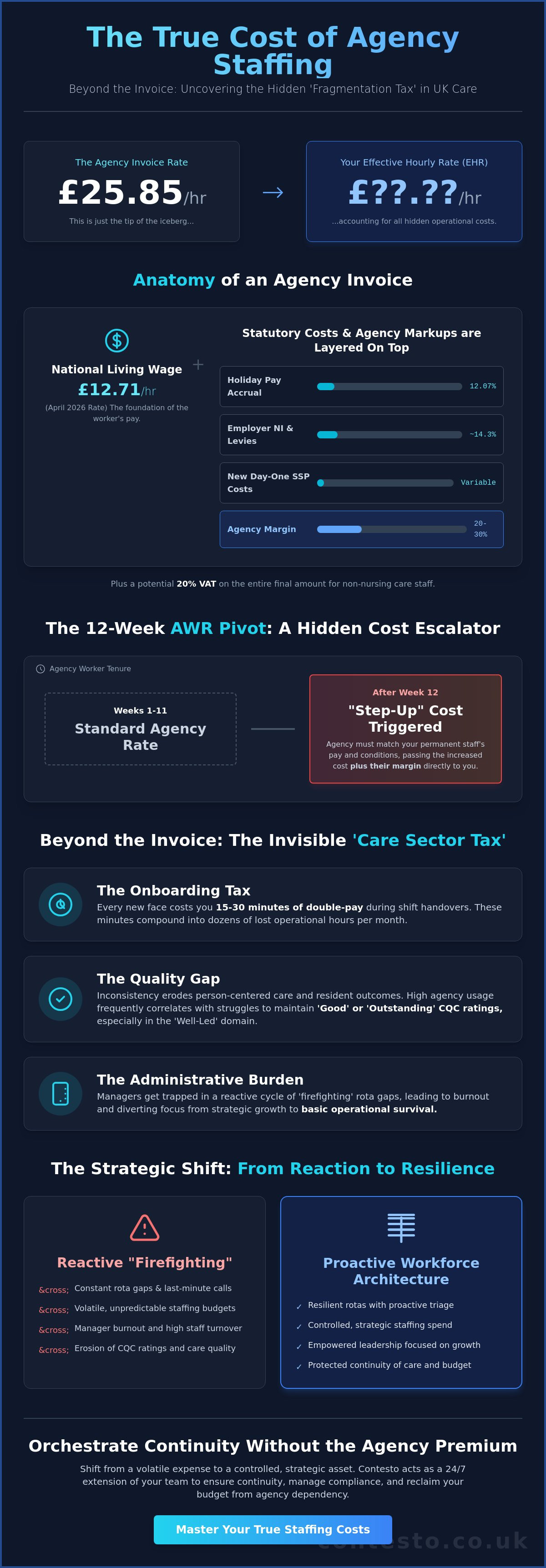
What if the figures on your monthly invoices are actually a fragmentation tax paid for reactive management? For many care providers, the £25.85 average hourly rate for an agency nurse in May 2026 is only the beginning of the story. Understanding how to calculate cost of using agency staff uk requires looking past the surface to see how statutory shifts, like the April 2026 National Living Wage increase to £12.71, ripple through your entire operational budget. This isn't just about paying for a shift; it's about the cost of lost continuity, administrative friction, and the quiet erosion of your culture.
You likely feel the weight of administrative burnout from managing constant gaps and the persistent anxiety of maintaining a Well-Led CQC rating with inconsistent personnel. We're here to help you master the true mathematics of your agency spend. By applying a strategic framework to your staffing data, you'll discover how to reduce reliance on external providers, manage the new day-one Statutory Sick Pay regulations, and reclaim your budget for long-term growth. This guide breaks down the specific formulas, regulatory shifts, and operational pivots needed to turn staffing from a volatile expense into a controlled, strategic asset.
Key Takeaways
Deconstruct the "Charge Rate" by identifying the specific margins, National Insurance contributions, and pension levies that inflate your baseline expenditure.
Uncover the "Onboarding Tax" and the true price of administrative friction that pulls senior managers away from resident care.
Master the Effective Hourly Rate (EHR) model to understand exactly how to calculate cost of using agency staff uk by accounting for management time and statutory overheads.
Shift from reactive "firefighting" to workforce architecture by implementing proactive rota management and sickness triage to protect your operational budget.
Discover how 24/7 on-call triage and compliance monitoring act as a strategic extension of your team to ensure continuity without the agency premium.
Table of Contents
The Anatomy of an Agency Invoice: Decoding the Markup
The first step in mastering your budget is looking past the "Charge Rate" on your weekly invoice. Many care providers mistake this headline figure for the actual cost of labor, but it's a composite number layered with statutory obligations and commercial margins. When you look at how to calculate cost of using agency staff uk, you must distinguish between the "Pay Rate" (the amount the worker receives) and the "Charge Rate" (the total you pay the agency). In May 2026, with the National Living Wage set at £12.71, the gap between these two figures has never been more significant.
A standard invoice is built on four pillars. First is the gross pay, which serves as the foundation. Added to this are the statutory employer contributions, including National Insurance and pension. Then comes the holiday pay accrual, typically calculated at 12.07% of the pay rate. Finally, the agency adds their margin; this is the profit they retain after all other costs are cleared. For a nurse charging £25.85 per hour, that margin might represent 20% to 30% of the total bill, depending on the agency's overheads and recruitment specialism.
Understanding Statutory Contributions and VAT
Statutory costs are non-negotiable and often invisible to the untrained eye. Employer National Insurance contributions, usually 13.8% above the secondary threshold, inflate the base rate before the agency even considers its own profit. You'll also find the Apprenticeship Levy (0.5%) and the newly updated Statutory Sick Pay (SSP) costs, which as of April 2026, are payable from day one of absence. VAT adds another layer of complexity. While many nursing services fall under the "Nursing Agency Concession" and are exempt from VAT, the supply of general care workers often attracts the standard 20% rate on the full invoice amount, significantly increasing the effective cost for providers who cannot reclaim it.
The 12-Week AWR Pivot Point
The legal framework defined by British agency worker law ensures that after 12 weeks in the same role, agency staff gain the right to the same basic employment and working conditions as your permanent employees. This "AWR Pivot" often triggers a sudden "Step-Up" cost that many providers fail to budget for. If your internal staff receive a higher hourly rate or better overtime premiums than the agency's base pay, the agency is legally required to match those terms and will pass that cost, plus their percentage margin, directly to you. It's why long-term agency use isn't just a management headache; it's the most expensive staffing strategy in the UK market today.
Beyond the Hourly Rate: The Invisible Costs of Agency Dependency
Most providers stop their analysis at the invoice line item, missing what we call the "Care Sector Tax." When you analyze how to calculate cost of using agency staff uk, you must account for the friction of onboarding. Every time a new face walks through your doors, you're paying an "Onboarding Tax." This includes the 15 to 30 minutes of double-pay during a shift handover where your permanent staff must orient the newcomer to your specific policies. Over a month of heavy agency reliance, these minutes compound into dozens of lost operational hours that never appear on a standard ledger.
Inconsistency is the enemy of excellence. When staffing is fragmented, resident outcomes suffer because the nuanced, person-centered knowledge held by permanent teams is lost. This "Quality Gap" manifests in missed cues, slower response times, and a general decline in the atmosphere of the home. Inspectors look for the stability of your workforce as a primary indicator of leadership quality. Evidence suggests a clear correlation: services with high agency usage frequently struggle to maintain "Good" or "Outstanding" CQC ratings, particularly within the Well-Led domain.
The Administrative Burden of Rota Gaps
Managers often find themselves trapped in a cycle of emergency shift reallocation. This care manager administrative burden doesn't just exhaust your leadership; it actively stalls business growth by diverting focus from strategic improvements to basic survival. The psychological cost of "on-call" burnout is a silent drain on your retention rates. It frequently leads to the loss of your most experienced senior staff, who find the constant pressure of filling gaps unsustainable. This turnover then creates a secondary wave of recruitment costs, further destabilizing your budget.
Compliance and Risk Mitigation
Compliance remains a high-stakes variable that requires constant vigilance. Auditing agency files to ensure they're "inspection-ready" consumes significant administrative resources, from verifying DBS checks to confirming training alignment with your specific requirements. According to Care England, the sector faces immense recruitment and retention costs, totaling approximately £3 billion annually. High agency dependency is frequently cited in CQC reports as a risk factor, as inconsistent staffing correlates directly with lower inspection outcomes. Utilizing a bespoke on-call triage strategy can help mitigate these risks by stabilizing your internal response and protecting your compliance record before you reach for the agency phone.
The Effective Cost Formula: Calculating Your True Agency Spend
Moving from qualitative pain to quantitative precision is where strategy takes root. To understand how to calculate cost of using agency staff uk, you must adopt the Effective Hourly Rate (EHR) model. This metric accounts for both the visible invoice and the invisible overheads that erode your margins. While a standard internal staff member carries a statutory burden of roughly 30% above their base pay, an agency worker carries that same burden plus a commercial margin and what we define as the "Management Multiplier."
Visualizing the "Agency Premium" as a percentage of your total operational budget is essential for long term health. When you compare an agency worker to an internal bank staff member, the disparity is often stark. Internal bank staff may cost more than permanent employees due to holiday pay and NI, but they lack the 20% to 30% agency markup and the high onboarding friction. By isolating these variables, you can see that agency spend is not just a high cost; it is a premium paid for the failure of rota resilience.
A Step-by-Step Calculation for UK Care Providers
Start by gathering your data from the last 30 days. You need your total agency invoices, payroll software reports for internal staff, and a realistic estimate of management time spent on staffing. Apply a "Management Multiplier" of 10% to 15% to your agency total. This percentage represents the cost of your leadership team's time spent booking, supervising, and auditing agency personnel. For a typical 12-hour care shift in the UK with an agency rate of £18.00 per hour, your invoice is £216.00. Once you add a 12% Management Multiplier (£25.92), your true cost is £241.92, or £20.16 per hour. This is the figure you must use for accurate budgeting.
Benchmarking Your Performance
In the current UK market, a healthy agency spend usually sits below 8% of your total payroll expenditure. When this figure exceeds the 15% "Tipping Point," agency use is no longer a temporary fix; it has become a structural risk to your business solvency and CQC standing. If your metrics consistently hit this threshold, it's time to build a business case for outsourced care management. Using these formulas allows you to move away from emotional reactions to invoices and toward a data-driven strategy that protects your residents and your bottom line.
Strategic Mitigation: Reducing Reliance Through Rota Resilience
Once you've mastered how to calculate cost of using agency staff uk, the next strategic move is to dismantle the dependency itself. Many providers view agency spend as a fixed, inevitable line item; it isn't. It is a symptom of a fragile workforce architecture. Transitioning from reactive firefighting to proactive management requires a "Resilient Rota" that can absorb shocks without external intervention. This involves optimizing your internal bank, refining your rota management, and building a buffer that protects your margins. By treating your rota as a strategic asset rather than a weekly puzzle, you reclaim control over your operational narrative. You move from a state of constant anxiety to one of quiet confidence, knowing your team is built to endure.
Managing Staff Sickness with Precision
The first 30 minutes of a sickness call determine your agency spend for the week. In a reactive model, a 6:00 AM absence leads directly to an agency booking by 6:15 AM. A resilient system uses a triage approach that prioritizes continuity over convenience. This exhausts internal bank options, reorganizes existing shift patterns, and utilizes on-call support to fill the gap internally. Professional out-of-hours management protects your budget by providing the analytical distance needed to solve a staffing crisis without immediately reaching for the most expensive tool in the box. It's about precision, speed, and a deep knowledge of your internal workforce capacity. When you manage sickness with this level of detail, you prevent the "onboarding tax" and "quality gap" discussed earlier from ever occurring.
The ROI of Operational Support
Efficiency pays dividends that compound over time. Reducing your agency reliance by just 20% can save a mid-sized care home thousands of pounds per month, funds that are better diverted toward staff development or facility improvements. Real strategic growth in the care sector is funded by this type of operational efficiency. A stable, internal workforce doesn't just lower your Effective Hourly Rate; it improves resident outcomes, boosts staff morale, and secures your CQC standing. Every shift filled internally is a victory for your bottom line and your brand's authenticity. If you're ready to move beyond the chaos of agency dependency, explore how our bespoke operational support can stabilize your staffing architecture today.
Contesto: Orchestrating Continuity Without the Agency Premium
Contesto functions as a sophisticated, white-labelled extension of your leadership team, designed to bridge the gap between data and operational art. We don't provide the staff; we provide the strategic architecture that ensures you rarely need to look for them elsewhere. Understanding how to calculate cost of using agency staff uk is the first step in a larger journey toward financial autonomy. Once you've identified the "Management Multiplier" and the "Onboarding Tax" eroding your margins, the solution lies in a partner that can manage these variables with precision and commercial pragmatism.
We move your business from a state of perpetual staffing crisis to a culture of operational excellence. By integrating our 24/7 on-call triage and professional rota management, you reclaim the hours previously lost to administrative friction. This shift doesn't just improve your bottom line; it reinforces your CQC readiness by demonstrating a robust, well-led approach to workforce stability. We treat your brand's visibility as a fundamental right, protecting it from the reputational damage that inconsistent staffing can cause.
Professional Triage as a Financial Strategy
Our 24/7 on-call triage is the guardian of your staffing budget. When a sickness call arrives at 5:00 AM, our team handles the response in real-time, adhering strictly to your internal policies and exhausting every bank staff option before an agency is even considered. This proactive sickness management eliminates the "firefighting" that leads to expensive, last-minute bookings. We act as a meticulous filter, ensuring that every staffing decision is made with an eye on your ROI and long-term continuity. By managing these emergencies externally, we eliminate the burnout of your internal managers, allowing them to focus on resident outcomes rather than phone calls to agencies.
Ready to Reclaim Your Budget?
Transitioning to a resilient workforce model doesn't happen overnight, but the results are immediate. Integrating Contesto into your daily operations provides 24/7 peace of mind for care owners and managers alike. You gain a partner invested in your long-term success, one that rejects one-size-fits-all templates in favor of a bespoke strategy tailored to your specific care setting. As we move through 2026, the providers who master their operational efficiency will be the ones who thrive in a crowded marketplace. It's time to stop paying the fragmentation tax and start investing in your own growth. Discover how Contesto reduces agency reliance for UK care providers and helps you master the true mathematics of your staffing spend.
Reclaiming Your Operational Narrative
Mastering how to calculate cost of using agency staff uk is more than a budgeting exercise; it is a declaration of operational independence. You've moved beyond surface-level charge rates to identify the compounding impact of the 12.07% holiday pay accrual, the 13.8% Employer NI, and the invisible management multiplier. By shifting from reactive firefighting to a resilient rota architecture, you protect your CQC Well-Led rating and your bottom line simultaneously. These strategic pivots ensure that your budget serves your residents rather than subsidizing external margins.
This transformation requires a partner who understands the nuances of the UK care sector. Contesto serves as a white-labelled extension of your management team, providing the 24/7 on-call triage expertise needed to filter out unnecessary agency spend before it hits your ledger. We handle the administrative friction of sickness management so your leaders can focus on resident authenticity and care quality. Scale your care business with strategic operational support from Contesto and turn your staffing challenges into a sustainable competitive advantage. You have the data and the framework; it's time to build a more resilient future.
Frequently Asked Questions
What is the average agency markup for care staff in the UK?
The standard commercial markup typically ranges from 25% to 75% of the worker's gross pay rate. This margin covers the agency's recruitment overheads, screening processes, and profit after statutory costs like National Insurance are paid. When you examine how to calculate cost of using agency staff uk, it's vital to isolate this margin to understand the true premium you're paying for external flexibility.
Do I have to pay VAT on agency staff in healthcare?
VAT is usually applicable at the standard 20% rate for the supply of general care workers. However, the "Nursing Agency Concession" allows for a VAT exemption when the agency supplies registered nurses or certain medical professionals. Providers who aren't VAT-registered should be particularly careful, as this 20% uplift on non-nursing invoices can significantly inflate the effective hourly rate.
How do the Agency Worker Regulations (AWR) affect my costs?
The AWR mandate that agency workers receive the same basic pay and working conditions as your permanent staff after a 12-week qualifying period. This often triggers a "step-up" cost where the hourly rate increases by 10% to 15% to match your internal benefits and overtime premiums. It's a primary reason why using the same agency worker for more than three months becomes the most expensive staffing strategy in the UK.
Is it cheaper to hire permanent staff or use an agency for short-term gaps?
Permanent staff are significantly more cost-effective on an hourly basis, even when you account for a 30% statutory burden for pensions and National Insurance. While agency staff offer immediate relief for short-term gaps, they carry a premium that can be 200% higher than an internal bank shift. The goal for any provider should be to use agency staff only as a last resort rather than a primary rota solution.
How much management time is typically spent on agency administration?
Care managers often lose 10% to 15% of their working week to the administrative friction of managing agency staff and filling rota gaps. This "Management Multiplier" includes the time spent on emergency phone calls, auditing compliance files, and processing complex invoices. This is a hidden drain on your leadership's capacity that prevents them from focusing on resident outcomes and strategic growth.
Can better rota management really eliminate the need for agency staff?
Professional rota management can reduce agency reliance by 20% or more by maximizing the utilization of your internal bank. While it might not eliminate agency use entirely during extreme crises, it builds a "Resilient Rota" that absorbs most sickness and absence shocks internally. This proactive architecture ensures that agency spend remains a controlled, occasional expense rather than a structural necessity.
What are the hidden costs of using agency workers in a care home?
The most significant hidden costs are the 15 to 30 minutes of double-pay during shift handovers and the "Onboarding Tax" of orienting new personnel to your policies. Beyond the financial ledger, the "Quality Gap" created by inconsistent staffing can lead to lower CQC "Well-Led" ratings. These factors represent a fragmentation tax that erodes both your budget and your service's reputation over time.
How do I calculate the ROI of outsourcing my on-call triage?
You calculate ROI by comparing the cost of the triage service against the total margins saved from prevented agency shifts. If a professional triage system prevents just two high-premium agency bookings per week, the recovered budget and the reduction in management burnout often provide a three-to-one return on investment. You can master how to calculate cost of using agency staff uk by tracking these recovered margins over a 90-day period.



Comments