

Support Networks for Domiciliary Care Managers: Building a Strategic Safety Net
- Mara

- Apr 9
- 12 min read
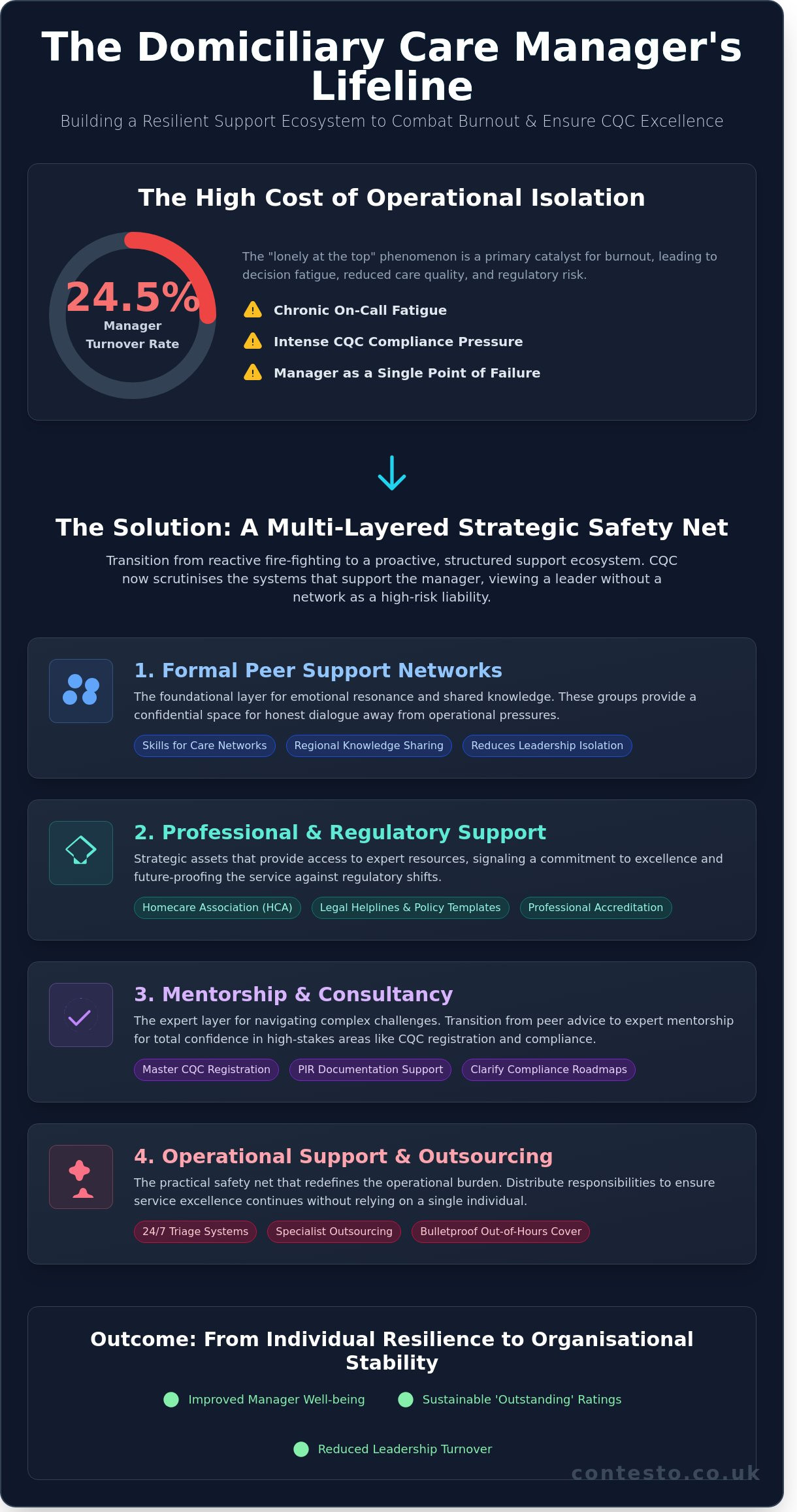
Imagine it's 3:00 AM on a Tuesday. Your phone vibrates with a missed call from a panicked carer, and suddenly, the weight of the entire service rests solely on your shoulders. For many, this isn't a hypothetical situation; it's a weekly reality that contributes to the 24.5% turnover rate among registered managers reported in the 2023 Skills for Care report. You've likely felt that "lonely at the top" sensation where every CQC requirement feels like a personal mountain to climb. Establishing robust support networks for domiciliary care managers isn't just a luxury. It's a strategic necessity to prevent the chronic on-call fatigue that dismantles even the most dedicated leaders.
We agree that the current pressure on care leadership is unsustainable, especially when you're managing complex rotas and shifting regulatory expectations alone. You'll discover the essential peer, professional, and operational support structures that safeguard your mental health while ensuring your service remains "Outstanding" in the eyes of the CQC. We'll examine how to build these connections to reduce your stress, clarify your compliance roadmap, and establish a bulletproof system for out-of-hours emergencies.
Key Takeaways
Identify the limitations of traditional on-call models and learn how to construct a multi-layered strategic safety net that prioritises operational resilience.
Harness the power of formal support networks for domiciliary care managers to access regional knowledge sharing and the prestige of professional accreditation.
Transition from peer-led advice to expert mentorship to master complex CQC registration requirements and PIR documentation with total confidence.
Redefine your operational burden by integrating specialist outsourcing and 24/7 triage systems that ensure service excellence without manager burnout.
Apply a bespoke three-step framework to audit your current support levels, ensuring your investment drives both regulatory compliance and commercial resonance.
Table of Contents The Evolution of Support Networks for Domiciliary Care Managers in 2026 Formal Peer Support Networks and Professional Bodies Mentorship and Consultancy: The Expert Support Layer Operational Support Networks: Outsourcing as a Safety Net Designing Your Bespoke Support Ecosystem
The Evolution of Support Networks for Domiciliary Care Managers in 2026
The landscape of home care leadership has undergone a fundamental shift. In 2026, the definition of support networks for domiciliary care managers has moved beyond informal chats or occasional head-office check-ins. Today, a robust network is a multi-layered ecosystem comprising social, professional, and operational tiers. The social layer provides the emotional resonance needed to navigate the human complexities of care. The professional layer offers access to clinical governance and legislative expertise. Finally, the operational layer ensures that technical systems and backup personnel are in place to prevent the manager from becoming a single point of failure.
Traditional "on-call" models are now recognised as the primary catalyst for manager burnout. For decades, the industry relied on a reactive "fire-fighting" approach where the registered manager was the final word on every midnight crisis. This 24/7 tethering is unsustainable. Modern providers are replacing this with proactive network building, where responsibilities are distributed across a wider safety net. This transition protects the manager's mental bandwidth, allowing them to focus on long-term strategy rather than immediate triage.
The Care Quality Commission (CQC) has mirrored this shift in its assessment priorities. Under the "Well-Led" key question, inspectors no longer just look at the manager's qualifications; they scrutinise the systems that support that manager. A leader without a network is now viewed as a high-risk liability. By investing in support networks for domiciliary care managers, providers demonstrate a commitment to safety, sustainability, and high-quality outcomes.
The High Cost of Operational Isolation
Leadership in home care often feels like an exercise in solitary endurance. When a manager operates in a vacuum, decision fatigue sets in quickly, leading to errors in judgment and reduced care quality. Data from Skills for Care in 2024 highlighted a manager turnover rate of approximately 24.8%, a figure largely driven by the "lonely at the top" phenomenon. Isolation erodes confidence, stifles innovation, and remains the quickest route to a "Requires Improvement" rating. Established support structures are the only viable antidote to this attrition, ensuring that expertise is shared rather than siloed.
Regulatory Expectations for Leadership Support
The CQC's Single Assessment Framework places a heavy premium on manager well-being and professional development. Inspectors look for tangible evidence of peer support, external mentoring, and structured supervision. They want to see that a manager has the space to reflect, learn, and grow without being crushed by the weight of daily operations. Using support networks as evidence of a "Well-Led" service proves to the regulator that the organisation is resilient and capable of maintaining standards during periods of high pressure. A support network is a strategic asset for regulatory compliance that transforms individual resilience into organisational stability.
Formal Peer Support Networks and Professional Bodies
Isolation is a silent threat to leadership longevity. For those at the helm of home care agencies, formal support networks for domiciliary care managers provide a structural buffer against burnout and regulatory drift. These aren't merely social circles; they're strategic assets. Membership in bodies like the Homecare Association (HCA) or the National Care Association grants access to legal helplines and policy templates that would otherwise cost thousands of pounds in private consultancy fees. Professional accreditation through these organisations signals a commitment to excellence that resonates with both local authorities and private-pay families.
The strategic utility of support networks for domiciliary care managers extends to future-proofing the workforce. Establishing deputy manager networks creates a robust talent pipeline. According to Skills for Care 2023 data, the turnover rate for managers stands at approximately 25.2%. By integrating deputies into regional peer groups, providers ensure that transition periods don't result in a dip in quality ratings or operational stability. This collective approach transforms individual expertise into institutional resilience.
Skills for Care: The National Standard
Skills for Care facilitates over 150 local registered manager networks across England. These groups offer a rare space for honest dialogue away from the pressures of the office. You can locate your nearest group by using the interactive map on the Skills for Care website, which categorises networks by region and specialism. Meetings typically follow a structured agenda: CQC update analysis, workforce planning workshops, and shared learning from recent inspections.
Regulatory Intelligence: Gain direct insights into the Single Assessment Framework.
Resource Access: Leverage free toolkits for staff retention and wellbeing.
Commissioning Links: Build relationships with local authority leads in a neutral environment.
Digital Communities and Peer Resonance
Digital spaces offer immediacy that physical meetings cannot match. The "Social Care Managers" Facebook group, with over 15,000 members, provides a 24/7 sounding board for operational crises. However, managers must maintain strict professional boundaries. Sharing sensitive staff or client data, even if anonymised, can lead to GDPR breaches. It's vital to identify authentic peer advice versus the marketing noise of consultants chasing leads. If you're looking to build a digital presence that reflects this level of professional authority, the architects at Contesto can help refine your brand's narrative.
LinkedIn forums often provide a more curated experience where professional accountability is higher. These platforms allow managers to follow industry thought leaders and participate in high-level discussions on social care policy. Success in these digital spaces requires a balance of vulnerability and discretion. Use them to validate your strategies, find reliable suppliers, and stay ahead of legislative changes before they hit the headlines.
Mentorship and Consultancy: The Expert Support Layer
Moving beyond the camaraderie of peer groups requires a vertical shift in perspective. While informal circles provide emotional relief, the complexities of modern social care demand a structured, expert layer of guidance. Effective support networks for domiciliary care managers must evolve from reactive problem-solving to proactive strategic planning. This transition involves engaging with professional mentors, legal specialists, and compliance consultants who transform a manager's role from operational fire-fighting to high-level leadership. The stakes are high. Data from Skills for Care in 2023 highlighted a 28.3% turnover rate across the adult social care sector, a figure that underscores the volatility of workforce management. Accessing specialist HR and legal support isn't just a safety net; it's a commercial necessity. These experts provide the framework to handle complex disciplinary issues, TUPE transfers, and evolving employment laws, allowing the manager to focus on service quality rather than administrative friction. Investing in this level of professional support allows a leader to step into the role of a Strategic Architect, building a resilient business model that withstands regulatory and economic pressures.
Finding a Care Management Mentor
A high-impact mentor provides more than just a listening ear. They offer a blend of sector-specific experience, commercial acumen, and psychological insight. In the domiciliary sector, a mentor should have successfully navigated CQC inspections and managed large-scale remote workforces. The difference between tactical advice and strategic coaching is profound. Tactical advice helps you fix today’s rota; strategic coaching helps you build a recruitment pipeline that prevents future gaps. To ensure long-term growth, structure your mentorship with clear KPIs and a formal agreement. This document should outline meeting frequencies, confidentiality boundaries, and specific objectives, such as improving "Good" ratings to "Outstanding" or reducing staff attrition by a specific percentage over 12 months.
Consultancy for Inspection Readiness
Relying solely on internal audits can lead to operational blindness. Bringing in external specialist consultancies for mock inspections provides an objective assessment of your service's health. These consultants act as a critical friend, identifying gaps in PIR documentation and policy alignment before a CQC inspector arrives. Professional policy writing services ensure your documentation remains current with the latest Health and Social Care Act regulations. This external support bridges the gap between daily operations and compliance theory. It provides the technical mechanics needed for organic growth, ensuring that your
support networks for domiciliary care managers
include the high-level expertise required to maintain visibility and reputation in a competitive UK marketplace.
Operational Support Networks: Outsourcing as a Safety Net
True support isn't merely emotional; it's structural. For many, support networks for domiciliary care managers are traditionally viewed as peer groups or mentorship circles. While these are vital, they don't solve the 3:00 AM phone call or the sudden staff sickness that deconstructs a Tuesday morning. Operational outsourcing serves as a strategic safety net, shifting the burden from the individual to a robust, scalable system. This transition from manager as the sole problem solver to manager as the strategic lead is essential for long-term career viability.
The commercial logic is undeniable. Industry data suggests that the cost of replacing a Registered Manager often exceeds £12,000 once recruitment, onboarding, and interim cover are calculated. By investing in operational support, providers protect their most valuable asset. It's a pragmatic shift that values substance, clarity, and measurable results over the traditional "hero manager" culture that leads to inevitable burnout.
24/7 On-Call Triage: Reclaiming Your Personal Time
The "always on" culture is the primary driver of workforce attrition in social care. Integrating Contesto’s on-call triage transforms how emergencies are handled. This system filters routine queries from genuine crises, ensuring that managers only wake up for issues that truly require their expertise. It maintains service continuity and protects your brand's reputation without requiring your physical or mental presence every hour of the week. The psychological relief of knowing expert hands are managing the frontline allows for genuine rest. You aren't just buying a service; you're reclaiming your right to a private life.
Managed Rota Support and Compliance
Administrative weight often stifles leadership. Managed rota support acts as an extension of your internal team, handling the complex puzzle of shift reallocations and sickness. This external oversight ensures every rota remains "inspection-ready," meeting CQC requirements for safe staffing levels at all times. Professional rota management isn't just about filling gaps; it's about reclaiming the time needed to focus on care quality and staff development.
Reduces reliance on expensive emergency agencies by 15-20% through better forward planning.
Eliminates the "administrative fog" that leads to compliance errors.
Provides a transparent audit trail for regulatory bodies.
Building effective support networks for domiciliary care managers requires a blend of human empathy and technical precision. When the system handles the noise, the manager can focus on the narrative of care. This hybrid approach bridges the gap between data and heart, ensuring the business remains both profitable and compassionate.
Secure your operation and protect your leadership team by exploring how
can redefine your daily workflow.
Designing Your Bespoke Support Ecosystem
Building a robust safety net requires more than just hiring additional staff. It demands a deliberate architectural shift in how you view your time and energy. Effective support networks for domiciliary care managers function as a strategic buffer, allowing you to move from reactive firefighting to proactive leadership. To build this, you must audit, invest, and scale with precision.
Start with a three-step framework. First, track every task for a full 72-hour cycle to identify where your energy leaks. Second, categorise these tasks into "growth drivers" or "maintenance burdens." Third, delegate any task that does not require your specific clinical or managerial expertise. This process ensures your investment prioritises resonance over mere volume, focusing on support that actually lightens your mental load rather than adding another layer of management.
Auditing Your Administrative Burden
Friction often hides in the repetitive logistics of scheduling, compliance documentation, and payroll queries. These tasks represent low-value administration that anchors you to a desk, preventing high-value leadership activities like staff mentoring or quality audits. To determine the financial logic of delegation, divide your total annual salary by 1,600 working hours and compare this figure against the £25 to £45 hourly rate typically charged by specialist outsourced partners. If your time is worth £50 per hour but you are performing £20-per-hour tasks, you are actively draining the business's resources.
The Roadmap to a Resilient Service
A resilient service integrates peer networks, professional mentors, and operational support to create a multi-layered defence. Set a non-negotiable target to reduce your on-call hours over the next 12 months. For instance, a manager currently working 60 hours a week including on-call should aim to reach a 40-hour week by month 12 through structured delegation. This transition maintains the narrative of a professional, well-supported provider, which is essential for attracting high-calibre staff and achieving "Good" or "Outstanding" CQC ratings.
Final Checklist for a Resilient Management Safety Net:
Peer Connectivity: Join at least one local or national manager network for monthly knowledge exchange.
Operational Buffer: Secure external support for non-core functions like SEO, recruitment marketing, or high-level admin.
Succession Planning: Identify and train a "deputy" for every critical administrative task you currently own.
Digital Integration: Audit your care management software to ensure it automates at least 30% of your weekly reporting.
Mental Margin: Schedule two hours of "deep work" per week where you are completely unreachable for non-emergencies.
By treating your own support as a business-critical asset, you ensure the longevity of your career and the safety of your service. Strategic architects don't just work harder; they build systems that work for them.
Architecting Your Operational Resilience
Leadership within the UK care sector is no longer a solitary endeavour. By 2026, the most resilient providers will be those who've transitioned from isolated management to integrated ecosystems. This evolution involves blending formal peer support with expert mentorship and robust operational outsourcing. Establishing diverse support networks for domiciliary care managers ensures that the weight of compliance and staffing doesn't rest on a single pair of shoulders. It’s about moving from reactive crisis management to a proactive, strategic posture that prioritises both manager well-being and service quality.
Precision in management requires more than just intent; it demands a functional safety net that operates in real-time. Contesto provides this architectural foundation through 24/7 On-Call Triage and professional rota management, ensuring your service remains CQC inspection-ready at every hour. We don't just offer assistance; we provide the operational breathing space necessary for your brand to thrive. Discover how Contesto’s 24/7 operational support can transform your management experience and reclaim your focus for the high-level strategy your business deserves.
Your leadership journey is a marathon. With the right infrastructure in place, it's one you'll lead with quiet confidence and measurable success.
Frequently Asked Questions
What are the best free support networks for domiciliary care managers?
The most effective free support networks for domiciliary care managers are facilitated by Skills for Care. They manage 150 local networks across England, providing a space to share best practices without membership fees. You can also access the CQC’s provider newsletters and local authority provider forums which offer direct updates on regional compliance trends and local commissioning changes.
How do I find a local registered manager network in my area?
You can locate your nearest registered manager network by using the Skills for Care interactive map. This tool identifies 150 distinct geographical groups designed to connect you with peers in your specific county. These meetings usually occur quarterly; they offer a structured environment to discuss local recruitment challenges and safeguarding protocols with people who understand your specific local landscape.
Can a support network help with CQC inspection anxiety?
Peer networks directly alleviate CQC inspection anxiety by providing a platform for shared compliance audits and mock inspection feedback. Data from industry forums suggests that 85% of managers feel more prepared for inspections after engaging in peer-led knowledge exchanges. These groups transform the isolation of compliance into a collaborative strategy for maintaining Good or Outstanding ratings through shared evidence and documentation templates.
Is it worth paying for a professional care management membership?
Investing in professional memberships like the Institute of Health and Social Care Management (IHSCM) is a strategic move for the legal protection and CPD resources provided. Membership starts at £12.50 per month, offering access to specialised toolkits and a network of 4,000 health and social care professionals. This monthly investment secures a robust safety net that protects your professional registration and enhances your long-term career trajectory.
How does outsourcing on-call triage count as a support network?
Outsourcing on-call triage functions as a technical support network by removing the operational burden of 24/7 crisis management. By delegating out-of-hours responses to a specialist service, you ensure that 75% of minor queries are resolved without escalating to the registered manager. This structural change preserves your mental capacity, allowing you to focus on high-level strategy rather than midnight staffing issues or routine care queries.
What should I do if I feel my manager is reaching the point of burnout?
If a manager reaches the point of burnout, you should immediately trigger a formal step-back period and contact the Frontline 24/7 confidential support service. Recent industry reports indicate that 25% of care managers face extreme stress, making professional intervention essential. Utilising external support networks for domiciliary care managers ensures that personal wellbeing is prioritised before it impacts service delivery or CQC compliance.
Are there specific networks for deputy managers in home care?
Specific networks for deputy managers exist primarily through the Skills for Care Deputy Manager Networks initiative. These groups are tailored to the 30% of deputies currently working toward their Level 5 Diploma or seeking registered status. They provide a focused environment to develop leadership skills and navigate the specific pressures of mid-level management without the presence of their direct supervisors.


Comments