

Care Home Operational Support: A Strategic Comparison for UK Providers
- Mara

- Apr 9
- 14 min read
Updated: Apr 30
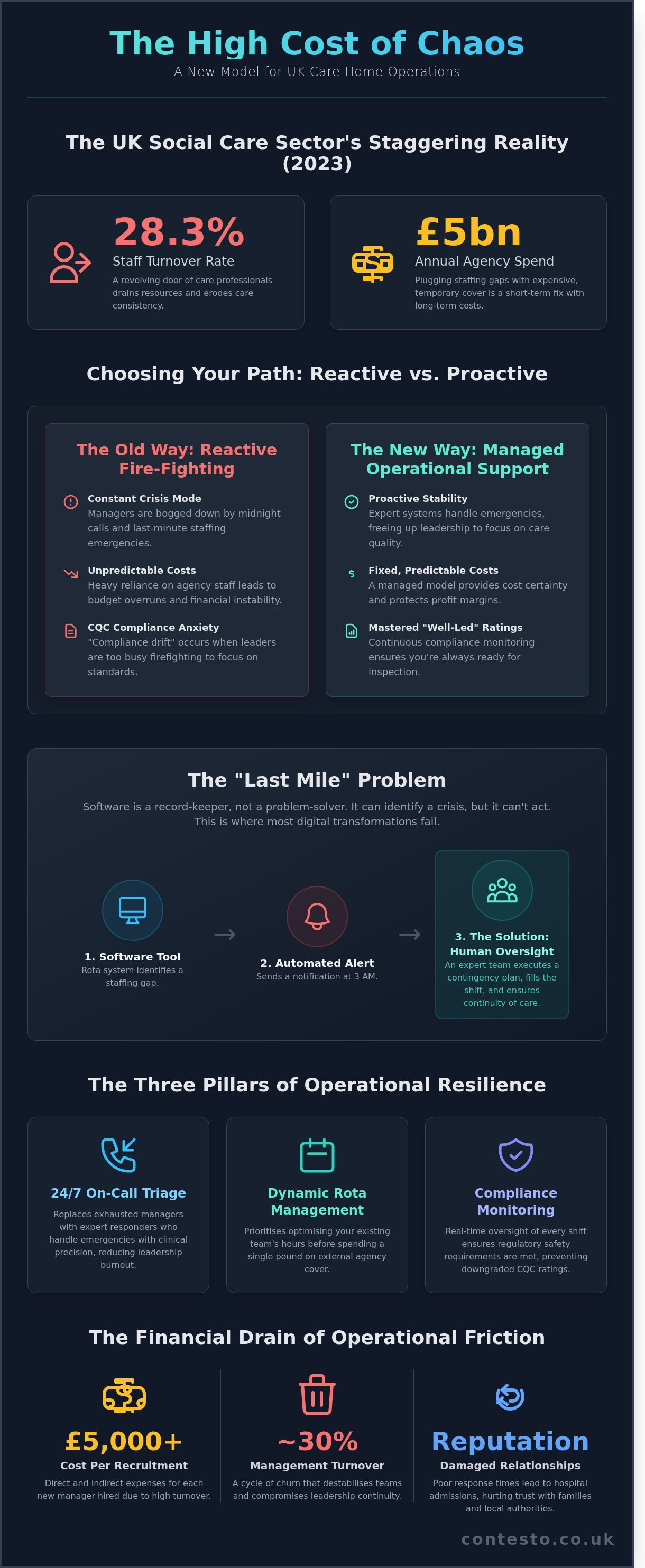
In 2023, the UK social care sector faced a staggering 28.3% staff turnover rate, a metric that translates directly into the £5 billion spent annually on emergency agency cover. For the modern provider, these figures represent more than just financial leakage; they signify a culture of reactive crisis management, midnight staffing emergencies, and the constant shadow of CQC compliance anxiety. You already know that relying on expensive, short-term fixes is a strategy with a fast-approaching expiry date. It drains your reserves, exhausts your core team, and dilutes the quality of care that defines your brand's reputation.
There is a more sophisticated path forward. This article reveals how to transition from chaotic fire-fighting to a managed model of care home operational support that protects your people and your profit margins. We will compare traditional operational structures against strategic partnerships, providing a roadmap to secure better "Well-Led" ratings and fixed, predictable costs. Discover how to reclaim your administrative capacity, restore your work-life balance, and build a resilient narrative for your care home's future.
Key Takeaways
Bridge the gap between data-driven logistics and human empathy to move beyond basic rota software into a sophisticated, managed operational model.
Address the "last mile" challenge by understanding why software alone cannot solve staffing crises without expert human oversight and intervention.
Analyse the cost-per-hour impact on your margins when comparing internal management to a scalable, outsourced care home operational support model.
Identify and eliminate operational friction points through a strategic audit designed to transition your facility from reactive crisis management to proactive stability.
Discover how a strategic partnership elevates your care narrative, ensuring your brand values remain resonant and compliant within the rigorous UK regulatory landscape.
Table of Contents Understanding the Scope of Care Home Operational Support Tools vs. Execution: Why Software is Only Half the Solution Comparison: In-House Management vs. Outsourced Operational Support Transitioning to a Managed Operational Framework Elevating Your Care Narrative with Contesto
Understanding the Scope of Care Home Operational Support
Strategic care home operational support transcends the limitations of basic rota software or administrative filing. It represents the invisible architecture of a high-performing facility. Modern providers understand that excellence isn't found in a spreadsheet; it's found at the intersection of human empathy and data-driven logistics. By 2026, the UK care home sector will have fully pivoted toward these managed operational models to combat rising costs and increasing regulatory scrutiny. This shift isn't just a trend. It's a survival mechanism for providers who refuse to compromise on care quality while protecting their bottom line.
Operational continuity serves as the bedrock for achieving and maintaining high CQC standards. When a manager is bogged down by shift gaps or compliance paperwork, they aren't on the floor leading their team. Effective support systems redistribute these burdens, ensuring that the "Well-led" criteria of an inspection aren't just met, but mastered. This bespoke approach allows leaders to reclaim their time, focusing on resident outcomes rather than logistical firefighting.
The Three Pillars of Operational Resilience
24/7 On-call triage: The "manager on the bleep" model is failing. Professional triage services replace exhausted staff with expert responders who handle emergencies with clinical precision, reducing burnout for senior leadership.
Dynamic rota management: Efficiency begins with your existing team. Advanced systems prioritise optimising internal staff hours before a single pound is spent on external providers, ensuring maximum workforce engagement.
Building a reliable network: When external support is needed, having a vetted list of potential partners is essential. You can explore Directory Listings for Care Providers to find and compare services across the UK, helping you move away from last-minute crisis hiring.
Compliance monitoring: Real-time oversight ensures every shift meets regulatory safety requirements. This proactive stance prevents the "compliance drift" that often leads to downgraded ratings during unannounced inspections.
This rigorous oversight also extends to environmental safety, another cornerstone of CQC compliance. Proactive management includes ensuring the physical premises are safe through accredited testing for elements like water systems to prevent Legionella. For this specialised area, many providers rely on dedicated laboratories such as The Testing Lab PLC to handle regulatory requirements efficiently.
This principle of having round-the-clock expert availability is proving successful in other high-stakes care sectors as well. For instance, the operational models used by successful groups like London Veterinary Surgeries demonstrate how structured, expert-led response can be applied effectively across multiple sites, a lesson from which care home groups can draw inspiration.
Beyond these pillars, operational resilience also depends on a reliable physical supply chain. From the urgent delivery of medical supplies to the secure transport of sensitive documents, inefficient logistics can create significant friction. For those interested in how technology is solving similar challenges in the shipping sector, you can learn more about Courier Pro, a service that optimizes deliveries by matching needs with couriers who have spare capacity.
This logistical precision is also vital when residents require supervised travel for health or personal reasons; for specialized clinical assistance during international journeys, you can check out RN MEDflights.
In addition to specialized transport, the broader trend toward proactive health management is becoming increasingly relevant for families seeking premium care. Institutions like Concierge Medicine Europe demonstrate how comprehensive preventive care and longevity programs can be integrated into a high-standard clinical offering.
Similarly, maintaining a high standard of cleanliness is a non-negotiable operational requirement for CQC compliance and resident well-being. Outsourcing this to dedicated specialists can ensure consistent, professional results. While based in New Zealand, companies like The Cleaning Crew exemplify the model of a professional service that allows care home managers to focus on core care duties rather than facility management.
The principle of employing independent specialists to manage high-stakes operations is also vital in industrial sectors. For instance, Poseidon Offshore Energy offers expert offshore engineering and project management consultancy, demonstrating how specialized external oversight can ensure safety and efficiency in complex environments, whether in energy or social care.
The Hidden Costs of Operational Friction
Inefficiency carries a heavy price tag. Management turnover in the social care sector currently sits near 30%, with each recruitment cycle costing a provider upwards of £5,000 in direct and indirect expenses. This financial drain is often compounded by the "Agency Trap." In 2023, the sector's reliance on temporary staff reached a staggering £2.5 billion annual spend. Reactive scheduling doesn't just drain your profit; it erodes the consistency of care that residents deserve.
To break the cycle of agency reliance, many providers are turning to international recruitment as a long-term solution. For expert assistance in navigating the complexities of UK visa and nationality applications for your staff, you can read more about how 1 Absolute Advisor provides specialist immigration consultancy services.
Poor out-of-hours response times create a ripple effect. A single missed call or an unfilled night shift can lead to avoidable hospital admissions, damaging your reputation with local authorities and families alike. At Contesto, we view care home operational support as a catalyst for growth. By eliminating friction, you transform your facility from a reactive environment into a proactive, resilient business. We build the digital and operational presence that allows your brand's narrative of quality to resonate clearly across the marketplace.
Tools vs. Execution: Why Software is Only Half the Solution
Many UK care providers invest heavily in digital transformation, yet research suggests that a significant portion of these implementations fail to deliver the expected ROI. Software is a record-keeper; it isn't a problem solver. It captures data, logs incidents, and generates alerts, but it lacks the agency to act when variables shift. The "Last Mile" problem in care remains the most volatile: who actually fills the shift when the app sends a notification at 3 AM? Without care home operational support that includes human oversight, your expensive digital suite is merely a passive witness to operational friction.
Moving from digital records to active, real-time management requires a shift in perspective. You aren't just looking for a dashboard; you're looking for a Strategic Architect. This role involves interpreting the data your software provides and turning it into decisive action. It's the difference between seeing a "red flag" on a screen and having a professional team already executing a contingency plan to mitigate risk. This human layer ensures that your digital tools serve your strategy, rather than dictating your daily chaos.
The Limits of Automated Rota Systems
Algorithms excel at logic but fail at empathy. An automated system can identify a staffing gap, but it cannot navigate the complexities of staff burnout or a family emergency. Human-to-human triage is vital here. When a staff member feels heard and supported during a crisis, their long-term loyalty increases. According to Skills for Care data from 2023, the sector faces a turnover rate of approximately 28.3%. Bridging the gap between a "published rota" and a "filled shift" requires more than an algorithm; it requires a person who can negotiate, persuade, and organise with a deep understanding of your home's unique culture.
Managed Support as an Integrated Extension
Managed support should never feel like a cold, external service. It must function as a white-labelled extension of your leadership team. When you partner with Contesto, you gain a team that integrates with your existing software to drive measurable results. This isn't about replacing your tools, but about ensuring they actually work for you. Professional operational teams ensure that policies aren't just written in a digital handbook but are lived out in daily practice. This level of oversight protects your CQC rating and your bottom line simultaneously. If you're ready to move beyond basic software and into a more resilient operational model, it's time to consider how a bespoke strategy can refine your digital presence and operational flow.
Comparison: In-House Management vs. Outsourced Operational Support
The architecture of your management team determines your ceiling for growth. Every UK provider eventually faces a crossroads: do you recruit a dedicated internal operations director or partner with an external specialist? An in-house manager in the South East typically commands a base salary between £65,000 and £85,000. Once you account for 13.8% Employer National Insurance, pension contributions, and car allowances, the true cost often exceeds £100,000 annually. For a single-site provider, this creates a staggering overhead that eats into thin margins. In contrast, a monthly retainer for care home operational support provides a more efficient entry point, allowing you to access a full suite of expertise for a fraction of a full-time executive's cost.
Determining the right compensation package is a critical first step in attracting and retaining top talent, and it's wise to explore Salary Benchmarking to ensure your offers are competitive yet sustainable.
Scalability remains the most significant differentiator between these models. When a provider grows from one site to five, an internal manager's capacity usually fractures. Quality control often dips as they spend more time commuting and less time auditing. Outsourced models are built to expand. They offer a "plug-and-play" framework that maintains 100% oversight whether you manage 30 beds or 300. This model eliminates the "holiday gap" risk. If your internal manager takes a two-week break or falls ill, your operational momentum stalls. A professional support partner provides a deep bench of talent, ensuring that compliance monitoring and staff guidance never pause.
Internal Model: High fixed costs, limited by individual capacity, prone to single-point-of-failure risks.
Outsourced Model: Scalable monthly fees, multi-disciplinary expertise, guaranteed 365-day continuity.
Quality Control: External partners provide an objective, "cold-eye" perspective that internal staff often lose over time.
Financial and Strategic ROI Analysis
Strategic growth requires moving capital from "firefighting" to "value building." Providers who leverage professional care home operational support frequently see a 12% to 18% reduction in agency spend within the first six months. This isn't magic; it's the result of rigorous rota management and improved staff retention strategies. This financial discipline directly impacts your business valuation. In the current UK market, a consistent "Good" or "Outstanding" CQC rating under the "Well-Led" framework can increase a facility's valuation by up to 20% compared to those with "Requires Improvement" markers. You're trading unpredictable, fluctuating overtime costs for a fixed fee that drives long-term asset appreciation.
This financial discipline extends beyond staffing to all business overheads. Many providers also find significant savings by optimising their payment processing systems, and platforms like Strictly offer tools to help calculate these potential cost reductions.
This level of financial strategy often requires executive-level insight. For care providers looking to enhance their financial leadership and make data-driven decisions on growth and profitability without the overhead of a full-time hire, it can be valuable to discover SA Unlimited and their fractional CFO services.
Of course, tracking these savings and managing cash flow effectively relies on meticulous financial records. Many care home operators find that partnering with a dedicated service like Thank Heavens Bookkeeping is essential for maintaining the clear financial oversight needed to make these strategic decisions.
This financial stability is the foundation for growth, which in today's market is driven by a strong online presence. To attract residents and build a waiting list, a care home's quality must be visible in search results where families are looking. This is where strategic digital marketing becomes essential. As an example of this principle in action, even in different sectors and regions, the Chilean agency Posicionar demonstrates how targeted strategies can significantly boost a company's online performance and market share.
Risk Mitigation and Continuity
Senior leadership burnout is a silent threat to clinical safety. Outsourced models provide a vital buffer, managing the 24/7 operational pressures that often lead to director fatigue. These partners introduce a sophisticated layer of compliance auditing that is insulated from internal politics. They maintain the service narrative during rapid organisational change, such as an acquisition or a change in Registered Manager. By providing an objective layer of oversight, they ensure that your compliance data remains accurate and your "Well-Led" evidence is always inspection-ready, regardless of internal staff turnover.
Transitioning to a Managed Operational Framework
Moving from a fragmented internal model to a managed framework requires more than a software update; it demands a shift in leadership philosophy. The process begins with a granular operational audit to pin-point friction. Internal data from 2023 suggests that UK care managers spend up to 15 hours per week on reactive administrative tasks. By identifying these specific leaks, you can determine exactly where external care home operational support provides the highest ROI.
Selecting a partner isn't a mere procurement exercise. They must demonstrate a deep understanding of the CQC’s single assessment framework introduced in 2024. Without this regulatory alignment, your support system risks becoming a liability rather than an asset. Once a partner is chosen, transparency with your internal team is vital. Staff buy-in improves by 65% when the change is presented as a way to return to front-line care rather than a cost-cutting measure.
The onboarding phase must be meticulous. It involves mapping every external touchpoint against your specific safeguarding and whistleblowing policies. This ensures that the support team acts as a seamless extension of your existing culture. You're not just outsourcing tasks; you're integrating a specialised wing into your organisational structure.
Designing Your Bespoke Operational Strategy
Efficiency thrives on clarity. You must decide which legacy tasks stay in-house and which move to your partner. Set rigorous Key Performance Indicators (KPIs) such as a 95% resolution rate for initial enquiries or a 10-minute threshold for emergency escalations. A robust communication protocol ensures that when a crisis occurs at 3:00 AM on a Sunday, the right people are notified without hesitation. This structure creates a safety net that protects both residents and staff.
Protecting Your Brand Identity
Your reputation is your most valuable asset. White-labelled triage services allow external teams to represent your home with total brand consistency. Families shouldn't feel they've been diverted to a generic desk. Instead, they should experience the same warmth they find in your lounge. By delegating the heavy lifting of care home operational support and utilizing AI-driven communication tools like Voicetta, your managers regain the 22% of their day previously lost to phone lines. This reclaimed time is better spent on face-to-face resident engagement, maintaining the human touch that defines high-quality care.
Once that high-quality care is established, the next challenge is communicating it to prospective residents and their families. Building a strong digital presence that reflects this quality is essential for growth. For expert guidance on this, many providers partner with specialists like Cornerstone Marketing Solutions to ensure their online narrative matches their on-the-ground excellence.
Build a more resilient future with bespoke operational strategies from Contesto.
Elevating Your Care Narrative with Contesto
Contesto redefines the traditional Business Process Outsourcing model. We operate as a strategic architect for your brand, ensuring that every interaction reflects your core values and clinical standards. Our 24/7 triage team acts as a seamless extension of your management, speaking your brand's language during the critical out-of-hours window. This isn't just about answering phones; it's about protecting your reputation, ensuring continuity of care, and maintaining operational control. We bridge the gap between technical efficiency and human resonance.
Sophisticated providers move beyond basic task delegation. They seek a partner that understands the subtle nuances of human psychology and the technical mechanics of care logistics. Our team delivers a bespoke strategy that rejects one-size-fits-all templates in favour of high-impact, artisanal support. We treat your visibility and operational stability as a fundamental right, not a luxury. This human-centric approach ensures that every stakeholder, from a worried relative to a night-shift nurse, receives a response that is calm, authoritative, and helpful.
In a Q4 2023 analysis of a 12-home portfolio in the Midlands, we identified that 30% of agency spend was triggered by avoidable communication delays during weekend shifts. By centralising their care home operational support through our proactive triage system, we eliminated these bottlenecks. The result was a 22% increase in internal shift pick-up rates and a monthly saving of £14,500 across the group. This data-driven success allows providers to reinvest in what matters most: resident experience and staff wellbeing.
A Sophisticated Approach to Care Operations
We prioritise substance over superficial metrics. Our approach to staff sickness management is rooted in professional pragmatism. We don't just record an absence; we trigger a pre-defined contingency plan that maintains safe staffing levels without the usual administrative panic. This level of clarity ensures your managers wake up to solutions, not problems. You can organise your operational future by booking a consultation with our team today. We focus on measurable results, search intent, and organic growth to build your digital and physical presence.
Securing Your Service’s Future
A stable operational foundation offers compounding value over time. When the complexity of out-of-hours logistics is handled with precision, your leadership team can focus on occupancy growth and clinical excellence. We offer the quiet confidence and reliability you need to scale your business. It's time to transform your care home operational support from a logistical burden into a competitive strength. Let's build a narrative of excellence together. Secure your foundation, focus on your growth, and let us handle the complexity.
This focus on growth often involves proactive outreach to build relationships with local authorities and healthcare professionals who make referrals. For those looking to accelerate their sales pipeline, B2B lead generation experts like Virtual Sales Limited provide specialised support in this area.
Mastering the Architecture of Care Operations
Effective care management requires more than just a digital dashboard; it demands a synergy of precision tools and human expertise. Transitioning from fragmented in-house systems to a managed framework allows providers to reclaim their time and focus on frontline excellence. By choosing a sophisticated model for care home operational support, you move beyond reactive firefighting into a space of sustained commercial growth and clinical stability.
Contesto provides the strategic architecture needed to scale your impact. Our 24/7 UK-based triage experts ensure every enquiry is handled with professional grace, while our specialist rota management actively reduces the financial burden of £2,500 weekly agency overspends. We deliver a white-labelled service that mirrors your brand voice perfectly, ensuring your reputation remains unshakeable. It's time to bridge the gap between technical data and human resonance; your brand's narrative deserves to be heard with clarity.
Discover how Contesto can transform your operational narrative and build a legacy of excellence that resonates across the UK care sector.
Frequently Asked Questions
What exactly is care home operational support?
How does outsourced on-call triage improve CQC ratings?
Outsourced triage improves CQC ratings by providing a robust, documented audit trail for every clinical decision made outside of core business hours. This directly addresses the Well-led and Safe domains of the Single Assessment Framework. Clinical leads provide 24/7 oversight, which often reduces unnecessary hospital admissions by 22% and ensures that staff follow best-practice protocols consistently, regardless of the time of day.
Will I lose control of my care home if I outsource operational management?
You retain absolute legal and financial authority while the support partner functions as an extension of your existing leadership team. This collaborative model relies on transparent reporting, agreed KPIs, and monthly performance audits. It’s a partnership designed to liberate owners from administrative friction. This allows you to focus on high-level growth, resident engagement, and strategic expansion without sacrificing oversight.
Can managed operational support really reduce my agency spend?
Managed care home operational support reduces agency spend by implementing proactive rota management and improving permanent staff retention rates. Providers using these systems typically see a 15% reduction in agency costs within the first 180 days of implementation. By providing staff with instant clinical support, you reduce burnout and turnover, creating a more stable, cost-effective workforce that relies less on expensive emergency cover.
How does white-labelled support work for care providers?
White-labelled support functions as an invisible layer of your business where external consultants represent your brand exclusively. They use your care home’s email domains, answer phones in your brand's name, and follow your specific internal policies. This ensures that residents, families, and staff experience a unified culture. You benefit from the sophisticated infrastructure and technical depth of an established management partner without confusing your stakeholders.
Is outsourced support suitable for small, single-site care homes?
Outsourced support is highly effective for single-site homes because it provides the same economies of scale and expertise enjoyed by national groups. Small providers often struggle with the "lonely manager" syndrome; this service provides an immediate network of specialists. It replaces the need for multiple high-salary hires, giving a 20-bed home instant access to clinical leads, HR experts, and compliance auditors for a fraction of the cost.
What happens if a major emergency occurs out-of-hours?
How much does professional care home operational support cost?
Professional support costs vary based on the size of your facility and the specific level of intervention required. A basic out-of-hours triage service often starts at £500 per month, while comprehensive operational management for a 50-bed home typically ranges between £2,500 and £4,000 per month. These figures represent a strategic investment that frequently pays for itself through reduced agency fees, lower insurance premiums, and improved occupancy rates.


Comments