

The Financial Impact of Unfilled Care Shifts: A Strategic Audit for UK Providers
- Mara

- May 4
- 12 min read
Updated: May 12
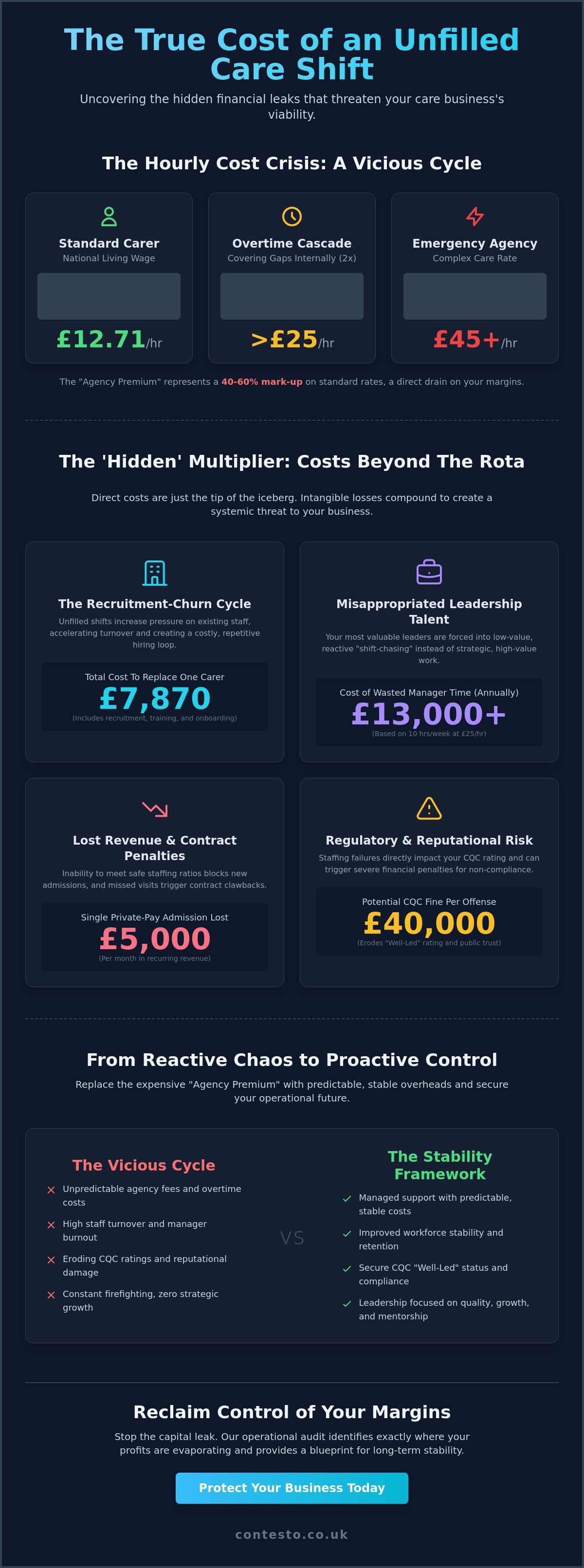
What if the most expensive line item on your balance sheet isn't your payroll, but the hours your team fails to work? Many providers treat a staffing gap as a temporary scheduling headache, yet the true financial impact of unfilled care shifts represents a systemic capital leak that compounds with every passing hour. When you factor in agency charge rates reaching £45 per hour for complex care and a median recruitment cost of £7,870 per new hire, the math quickly shifts from a minor inconvenience to a strategic threat.
You're likely already exhausted by the weight of relentless agency invoices and the persistent anxiety of a CQC inspection where staffing failures can trigger fines of £40,000 per offense. It's a cycle that breeds manager burnout, accelerates staff turnover, and erodes your "Well-Led" rating. We promise to help you reclaim control by identifying exactly where your margins are evaporating. This audit dissects the hidden costs of operational gaps, explores the ROI of workforce stability, and provides a blueprint to protect your care business's long-term viability.
Key Takeaways
Quantify the compounding financial impact of unfilled care shifts by connecting staffing gaps to rising insurance premiums and diminished private-pay enquiries.
Audit the management opportunity cost where strategic leadership is sacrificed for the immediate, low-value demands of out-of-hours triage.
Secure your CQC "Well-Led" status by implementing a robust framework for operational continuity that satisfies Regulation 18 mandates.
Evaluate the commercial advantage of managed support services as a way to replace the expensive "Agency Premium" with predictable, stable overheads.
Table of Contents The Anatomy of a Void: Defining the Direct Costs of Unfilled Care Shifts The 'Hidden' Multiplier: Quantifying Intangible Financial Losses Regulatory Risk and Reputation Capital: The CQC Factor The Strategic Response: Calculating Your True Coverage ROI Operational Immunity: The Contesto Managed Support Advantage
The Anatomy of a Void: Defining the Direct Costs of Unfilled Care Shifts
An unfilled shift isn't a static vacancy on a spreadsheet; it's a dynamic erosion of profit. For UK providers, every hour left uncovered represents a failure of operational continuity that triggers immediate financial penalties. The financial impact of unfilled care shifts manifests first as a scramble for resources and eventually as a structural deficit. When a scheduled carer fails to appear, the business doesn't just lose their labour. It loses the stability of the entire rotasystem, forcing a reactive chain reaction that consumes liquid capital at an alarming rate.
This systemic failure is often exacerbated by the broader nursing shortage in the UK, which has driven the market toward a high-stakes bidding war for qualified talent. As of May 2026, the delta between a standard hourly wage and emergency cover has reached a breaking point. While the National Living Wage sits at £12.71, providers are frequently forced into "Overtime Cascades." This occurs when a single gap compels remaining staff to cover additional hours at 1.5x or 2x their standard rate. At 2x pay, a senior carer costs the business over £25 per hour, yet this is often still the "cheaper" alternative to external help.
The Premium Pay Trap
The reliance on emergency labour creates a fiscal gravity that pulls margins downward. We define the Agency Premium as a 40-60% mark-up on standard hourly rates. In the current 2026 market, while internal bank staff might cost a provider £15 to £18 per hour, last-minute agency bookings for standard care now range from £24 to £35. For complex care, these rates spike to £45 per hour. Beyond the hourly rate, providers often overlook "Emergency Call-out" fees and administrative surcharges that can add hundreds of pounds to a single week's expenditure. This is why a bespoke strategy for workforce resilience is no longer optional; it's a requirement for survival.
Contractual Penalties and Lost Revenue
The damage extends far beyond the payroll. In domiciliary care, an unfilled shift results in missed visits, which triggers immediate contract clawbacks from Local Authorities and clinical commissioning groups. Many private care contracts now include "Failure to Provide" clauses, allowing clients or their families to seek compensation or terminate agreements without notice.
In residential settings, the cost is even more acute. Staffing ratios are the gatekeepers of growth. If your levels don't meet safe occupancy requirements, you cannot admit new residents. Losing a single private-pay admission due to staffing gaps can cost a facility upwards of £5,000 per month in lost recurring revenue, a figure that dwarfs the cost of the original missing shift.
The 'Hidden' Multiplier: Quantifying Intangible Financial Losses
Direct costs like agency premiums are merely the visible tip of a much larger fiscal iceberg. To truly understand the financial impact of unfilled care shifts, providers must look at the "hidden" multipliers that erode profit margins from within. Every gap in the rota acts as a catalyst for a destructive recruitment-churn cycle. As of February 2026, the median agency cost per departing care worker reached £3,683.86, while the total cost to recruit, train, and onboard a replacement is now estimated at £7,870 per hire. When shifts go unfilled, the pressure on the remaining team intensifies, triggering a secondary wave of resignations that makes these five-figure losses repetitive rather than isolated.
Beyond the recruitment ledger, there's the catastrophic loss of institutional knowledge. Inconsistent staffing leads to operational friction. New or temporary staff take longer to complete routine tasks, use more resources, and lack the subtle insights into resident needs that drive high-quality, efficient care. This inefficiency is a silent drain on your ROI, manifesting as wasted supplies, increased administrative errors, and a general slowing of service delivery speed.
The High Price of Managerial Triage
The most significant "capital leak" in many care businesses is the misappropriation of leadership talent. A Registered Manager earning £50,000 per year has an effective hourly cost of roughly £25 to £30. When this individual spends ten hours a week on "shift-chasing" or out-of-hours triage, the business is effectively paying a premium for administrative labour.
This isn't just a payroll issue; it's a strategic disaster. Every hour spent firefighting the rota is an hour stolen from business development, quality auditing, or staff mentorship. This constant state of high-alert leads to "quiet quitting" among senior leadership, where the emotional exhaustion of handling 10pm call-outs diminishes their ability to lead with the strategic architecture required for long-term growth.
The Cultural Tax of Staff Burnout
Unfilled shifts operate on a "Rule of Three" regarding staff burnout: they lead to increased sickness, decreased productivity, and eventual resignation. The "surviving" team members who cover the gaps don't just feel tired; they develop "rota resentment." This cultural decay is expensive. High sickness rates among permanent staff force even more reliance on expensive agency cover, creating a self-sustaining loop of financial loss. By the time a core team member resigns to join a competitor with better work-life balance, the business has already lost thousands in diminished service quality and morale-related friction. Protecting your bottom line starts with protecting the mental bandwidth of your team.
Regulatory Risk and Reputation Capital: The CQC Factor
Regulatory scrutiny is intensifying. In 2023, the Care Quality Commission (CQC) issued over £5 million in fines, a clear signal that the post-pandemic grace period has ended. For providers, the financial impact of unfilled care shifts extends far beyond the immediate payroll gap; it enters the territory of statutory penalties and legal liability. Staffing levels are the primary metric by which the CQC measures safety and leadership. When shifts remain empty, you aren't just missing a pair of hands. You're providing documented evidence of a "Failure to Manage Risk," which is a direct violation of Regulation 18.
The financial consequences of these violations are immediate and punitive. Fines for staffing failures typically range from £4,000 to over £40,000 per offense, depending on the severity of the risk to service users. Beyond these headline figures, the CQC often issues fixed penalties of £4,000 to the provider and £2,000 to the registered manager. These costs are unrecoverable capital leaks that offer zero return on investment, unlike the proactive cost of maintaining a stable workforce. A "Requires Improvement" or "Inadequate" rating acts as a public scarlet letter, immediately depressing private-pay enquiries and damaging your reputation capital in a competitive marketplace.
Regulation 18 and the Cost of Non-Compliance
Compliance is expensive. Negligence is ruinous. Under Regulation 18, providers must deploy sufficient numbers of suitably qualified, competent, and experienced staff. A "Well-Led" rating is impossible without resilient rota management. To satisfy inspectors, you need more than just a filled schedule; you need a transparent audit trail of how gaps are identified and mitigated. Contesto serves as a strategic partner in this domain, providing the managed support and documentation required to prove operational resilience during the "Safe" and "Well-Led" assessments. This level of preparation transforms staffing from a liability into a defensive asset during an inspection.
Insurance and Legal Liability
The correlation between unfilled shifts and safeguarding incidents is well-documented. When a facility is short-staffed, the probability of falls, medication errors, and missed observations increases exponentially. These accidents are the primary drivers of litigation and skyrocketing professional indemnity insurance premiums. Insurers are increasingly auditing staffing ratios before setting rates; a history of uncovered shifts signals a high-risk profile that can double your annual premiums. Protecting your brand's narrative requires a consistent, managed operational presence that minimizes the window for human error. By closing the gap on unfilled shifts, you're effectively buying down your future legal and insurance liabilities, ensuring the long-term solvency of your care business.
The Strategic Response: Calculating Your True Coverage ROI
Calculating the true ROI of coverage requires moving beyond the mindset of reactive shift-filling. It demands a transition toward operational resilience. Most providers find that the financial impact of unfilled care shifts is actually a clinical symptom of a brittle management structure. To fix this, you must conduct a forensic audit of the last six months. Aggregate your total agency spend, the cost of management overtime, and the recruitment fees spent replacing staff who left due to overwork. When these figures are consolidated, the business case for a managed solution becomes an undeniable financial imperative.
Stable rotas do more than just lower your immediate payroll costs. They reduce long-term recruitment marketing spend by fostering a culture where staff feel supported rather than exploited. When your team sees that gaps are managed professionally rather than being "absorbed" by the remaining carers, retention rates stabilise. This stability preserves your institutional knowledge and prevents the £7,870 loss associated with every new hire. It's about moving from a state of constant panic to a state of strategic architectural control.
The 24/7 Triage Model vs. In-House On-Call
The out-of-hours window is where the highest financial damage occurs. An internal on-call manager is often too exhausted to perform the sophisticated triage needed to prevent a gap. They react; they don't solve. Comparing the direct costs of internal on-call payments against a fixed-fee managed support service often reveals a surprising delta. A professional 24/7 triage service provides early intervention, catching potential "no-shows" hours before the shift begins. This proactive approach prevents shifts from becoming "unfilled" in the first place, saving you from the 60% agency mark-up and protecting the registered manager's ability to focus on high-value business scaling.
Building a Resilient Rota Architecture
Resilient rota architecture integrates bank staff, internal sickness management, and emergency cover into a single cohesive narrative. It involves identifying staffing "red zones" before they manifest as empty shifts. By utilising rota management services, you can optimise internal resource allocation and ensure compliance monitoring is a constant, automated process. This data-driven approach allows you to deploy your most expensive human assets where they have the most impact, rather than using them to plug holes in a sinking ship. To begin your transition toward a more profitable model, request a strategic audit of your current operational overheads.
Operational Immunity: The Contesto Managed Support Advantage
Contesto operates as the strategic architect of your care operations, transforming the way your business navigates workforce volatility. We don't just fill gaps; we build systems that prevent them. By mitigating the financial impact of unfilled care shifts through a managed framework, we allow you to pivot from administrative triage to executive growth. This transition is essential for providers who want to maintain a competitive edge while navigating the rising costs of the 2026 National Living Wage and increasing regulatory demands. Our role is to ensure your brand's narrative isn't defined by the chaos of a missing rota, but by the reliability of its service delivery.
Moving from a reactive stance to one of operational immunity requires a fundamental shift in how you value management time. When you outsource your on-call requirements to a professional partner, you aren't just buying a service. You're reclaiming the intellectual capital of your registered managers. This allows your senior team to focus on high-impact activities like organic growth, search intent for private-pay clients, and service innovation. The result is a triple-win: increased visibility, stable overheads, and a restored work-life balance for your most valuable leaders.
White-Labelled Professionalism
Our 24/7 On-Call Triage acts as a seamless, white-labelled extension of your internal team. When a staff member calls in sick at 3am, our specialists don't just record the absence. They execute a pre-approved reallocation strategy based on your specific policies, bank staff priorities, and compliance requirements. This professional support provides the quiet confidence that your operations are in expert hands. Top-tier UK care providers are increasingly moving toward this managed model because it replaces the unpredictable stress of the "on-call" phone with a reliable, data-driven solution. Your staff receive consistent, professional instructions, which reinforces a culture of accountability and reduces the "rota resentment" that often leads to turnover.
Next Steps for Strategic Growth
Integrating Contesto's support into your existing care management software is a streamlined process designed for immediate impact. We offer a free operational audit to help you identify the exact "capital leaks" within your current staffing model. This audit provides a meticulous breakdown of where your margins are evaporating and how a bespoke strategy can restore your bottom line. It's about becoming "Inspection-Ready" at all times, ensuring that your rota and compliance monitoring satisfy every CQC domain with a robust, digital audit trail. Don't let your business be defined by the shifts you didn't fill. Secure your operational continuity with Contesto today.
Reclaiming Your Margins through Operational Resilience
The financial impact of unfilled care shifts is a quantifiable capital leak that erodes the very foundation of your business. We've explored how a single gap triggers a chain reaction of £45 agency premiums, £7,870 recruitment cycles, and the constant threat of £40,000 regulatory fines. These aren't just numbers on a balance sheet; they represent the stolen time of your leadership team and the gradual decay of your "Well-Led" reputation. To survive the 2026 economic landscape, providers must move beyond reactive shift-filling and embrace a model of strategic architectural control.
Contesto acts as your partner in this evolution, providing 24/7 white-labelled UK support specifically designed to maintain CQC compliance and protect your operational narrative. Our specialists ensure you remain "Inspection-Ready" while your managers focus on high-value growth rather than the exhaustion of out-of-hours triage. By closing the gap on staffing voids, you're not just saving money; you're investing in the long-term resonance and authenticity of your brand.
Book a Strategic Operational Audit with Contesto today to identify your capital leaks and secure your business's future. You've built a service that cares; now it's time to build a system that protects it.
Frequently Asked Questions
What is the average cost of an unfilled care shift in the UK?
The cost is a composite of immediate agency premiums and long-term operational loss. For a standard eight-hour shift, emergency agency cover can cost between £192 and £360, representing a 40% to 60% mark-up on standard payroll. When you factor in the financial impact of unfilled care shifts on staff retention, the cost per vacancy can exceed £3,000 due to the resulting recruitment-churn cycle.
How does CQC Regulation 18 affect my staffing requirements?
Regulation 18 mandates that providers must deploy sufficient numbers of suitably qualified, competent, and experienced staff to meet resident needs. Failure to comply with these safety standards can lead to fixed penalties of £4,000 for the provider and £2,000 for the registered manager. Inspectors require a clear, documented audit trail showing how staffing gaps are identified and mitigated in real-time.
Can outsourcing my on-call triage really reduce agency spend?
Professional triage services reduce agency reliance by shifting from reactive to proactive management. By identifying potential no-shows hours before a shift begins, a managed service can deploy internal bank staff or negotiate lower rates before emergency premiums apply. This early intervention frequently eliminates the "Emergency Call-out" fees that can inflate monthly staffing budgets by 15% or more.
What are the hidden costs of staff turnover in the care sector?
The median cost to replace a single care worker has reached £7,870 as of May 2026. This figure includes recruitment marketing, mandatory training, and the loss of productivity during the onboarding phase. Beyond the ledger, high turnover erodes institutional knowledge and resident trust, which often leads to a decrease in private-pay enquiries and higher professional indemnity insurance premiums.
How do unfilled shifts impact a care home's CQC rating?
Unfilled shifts are a primary driver for downgrades in the "Safe" and "Well-Led" domains. A pattern of staffing gaps is viewed by the CQC as a failure to manage risk, often resulting in a "Requires Improvement" rating. Such a rating can lead to the suspension of new admissions, costing a facility upwards of £5,000 per month in lost recurring revenue from a single missing resident.
What happens if a care manager burns out from handling on-call shifts?
Manager burnout leads to a catastrophic loss of executive oversight and strategic direction. When a registered manager is preoccupied with 3am rota firefighting, they cannot focus on business development or quality auditing. This administrative burden often results in "quiet quitting" or resignation, which destabilises the entire workforce and costs the business significant institutional knowledge and leadership continuity.
Is managed operational support more cost-effective than hiring an in-house deputy?
Managed support often provides a superior ROI because it offers 24/7 coverage without the associated costs of National Insurance, pension contributions, and holiday pay. While a deputy manager addresses daytime operations, a managed service provides specialised out-of-hours triage to mitigate the financial impact of unfilled care shifts during high-risk periods. This allows your core leadership to focus on high-value commercial growth.
How does Contesto manage last-minute staff sickness?
Contesto acts as a white-labelled extension of your team, executing your specific sickness and reallocation policies with professional precision. Our specialists handle all staff communications, attempt to fill gaps using your internal bank staff first, and provide a full audit trail for CQC compliance. This ensures that every absence is managed according to your brand's standards without requiring intervention from your senior management team.


Comments