

How to Reduce Care Agency Spend: A Strategic Guide for UK Providers
- Mara

- Jun 13
- 10 min read
Updated: 7 days ago
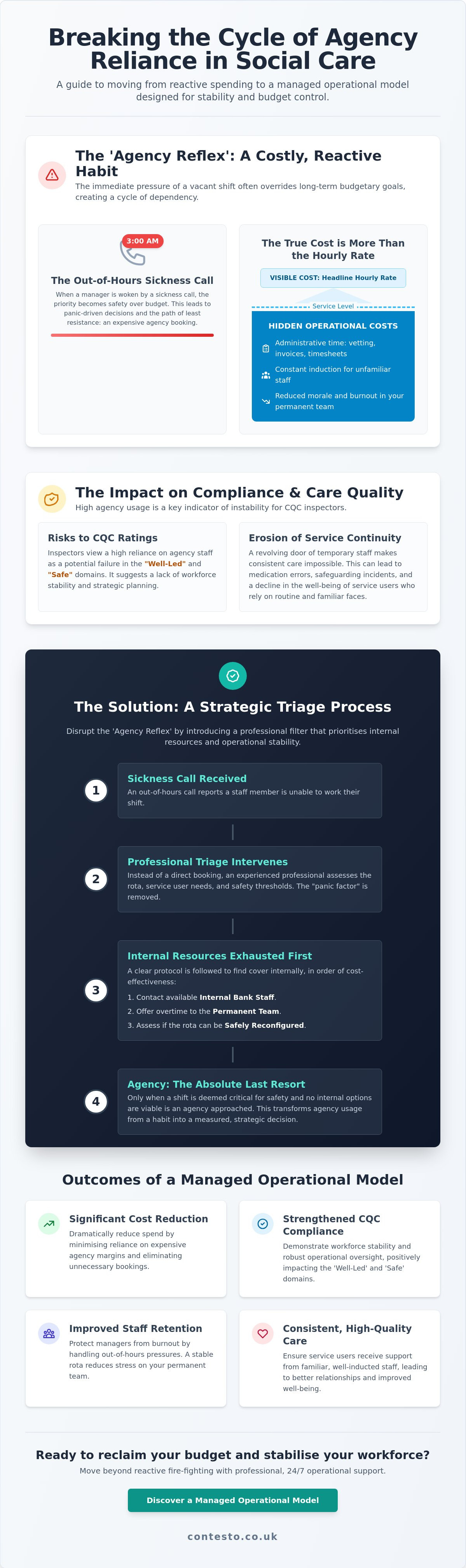
The reflexive urge to call an agency the moment a shift goes unfilled isn't a recruitment failure; it's a breakdown in operational triage. When a manager is woken at 3:00 AM by a sickness call, the priority is safety over budget, leading to the expensive, reactive habits that erode your margins. To truly reduce care agency spend, you must address the decision-making process that occurs when your team is at its most vulnerable.
You likely find the current landscape of rising statutory sick pay and the new joint liability for agency taxes deeply unsettling. It's exhausting for leadership teams to balance compliance risks whilst facing the constant pressure of unfilled rotas. This guide will show you how to move away from crisis management and introduce a managed operational model designed to reclaim your budget. We'll explore how professional triage, proactive sickness management, and structured rota oversight can stabilise your workforce and finally give your managers their weekends back.
Key Takeaways
Identify the hidden administrative and induction costs that make agency reliance more expensive than the headline hourly rate suggests.
Discover how a structured on-call triage system can help you reduce care agency spend by providing expert decision-making during out-of-hours sickness calls.
Learn how to bridge the gap between your planned rota and operational reality by treating staff sickness as a manageable workflow rather than a reactive emergency.
Explore the strategic benefits of integrating 24/7 operational support to improve manager retention and maintain consistent compliance standards.
Understand the practical steps for moving from reactive booking habits to a managed model that prioritises workforce stability and budget control.
Table of Contents
The Financial and Operational Weight of Agency Reliance
The "Agency Reflex" is a well-documented phenomenon in Social care in England. It occurs when the immediate pressure of a vacant shift overrides long-term budgetary goals. For many managers, booking a temporary worker is the only visible safety net when faced with a 6:00 AM sickness call. However, this reliance creates a cycle of dependency that makes it increasingly difficult to reduce care agency spend over time. It's a short-term solution that often masks deeper operational fractures.
The True Cost of Reactive Staffing
Most providers focus on the headline hourly rate, but the actual cost of an agency worker is significantly higher. Beyond the agency's margin, you must account for the internal resources required to manage them. This includes the administrative time spent verifying credentials, processing multiple invoices, and chasing timesheets. There is also the "hidden" cost of the induction required for every new face on the floor. When these factors are aggregated, the care rota costs escalate far beyond the initial budget. These administrative burdens pull your senior team away from their primary focus: quality of care and staff development; however, by utilising RightCostIQ, you can ensure that your procurement and negotiation processes are professionally managed to deliver better value.
Compliance Risks and Service Continuity
The CQC views high agency usage as a potential indicator of instability within the "Well-Led" and "Safe" domains. Inspectors look for evidence of consistent care; something that is nearly impossible to maintain with a revolving door of temporary staff. Lack of staff familiarity is often a root cause of safeguarding incidents and medication errors. Service users thrive on routine and known relationships. When those connections are severed by a reliance on temporary labour, the quality of care inevitably dips. To see how consistency is maintained in other care settings, you can discover Accessible Care and their approach to specialised disability support. Maintaining an "inspection-ready" status becomes a constant struggle when your workforce doesn't know your specific policies or the nuances of your service users' behaviour.
This instability also erodes the morale of your permanent team. Your core staff often find themselves "carrying" agency workers who are unfamiliar with the building's layout or the specific needs of service users. This added pressure leads to burnout, which in turn causes more sickness and further agency bookings. Breaking this cycle requires a shift in how you view your out-of-hours response. If you want to reduce care agency spend, you have to look past the immediate shift and address the operational friction that makes agency staff feel like the only option.
Strategic Triage: Disrupting the 'Agency Reflex'
Reducing agency spend isn't just a recruitment challenge; it's about what happens in the small hours when a rota gap appears. Effective on-call triage isn't merely answering a phone call. It's a strategic intervention. Too often, junior staff or tired managers book temporary cover as the path of least resistance. By implementing a managed operational support model, you introduce a professional layer of scrutiny that intercepts these knee-jerk bookings before they hit your balance sheet.
This approach mirrors the broader movement to reduce agency spend in the NHS, where price caps and stricter oversight are now the standard. In social care, the same rigour is required. Clinical and operational judgement must determine whether a shift is truly "essential" for safety or simply "desirable" for convenience. When you empower a team to question the necessity of every booking, you find that many gaps can be managed through internal reconfiguration or delayed starts. Triage is the strategic filter that protects the bottom line.
The 3:00 AM Decision Framework
Panic is a primary driver of rising costs. When a junior staff member handles an on-call sickness at 3:00 AM, the fear of a CQC notification often leads them to book the first agency worker available. Clear protocols change this dynamic. By utilising professional 24/7 on-call triage, you ensure every staffing decision is made by an experienced professional who understands your specific operational thresholds and compliance requirements. This reduces the "panic factor" and maintains professional standards whilst your senior team sleeps.
Utilising Internal Resources First
Before looking outside, the priority must always be your internal bank and permanent team. This requires an up-to-date, accessible bank list and a clear incentive structure for overtime that remains more cost-effective than agency margins. A managed support model ensures these internal resources are exhausted before an external booking is even considered. It's about building a culture where agency is the absolute last resort, not the first phone call. To reduce care agency spend, your team must have the tools and the time to look inward first, ensuring that permanent staff are given the opportunity to support the service before profit-leaking margins are paid to third parties.
Building Rota Resilience Through Proactive Management
A resilient rota is more than a grid of names; it's a dynamic operational tool. Most providers struggle because their rotas are aspirational rather than realistic. When there's a gap between planned staffing and the actual number of carers on the road, agency spend becomes an inevitability. To reduce care agency spend, you must bridge this gap by treating the rota as a living document that requires constant, proactive oversight.
Managing staff sickness as a structured workflow, rather than a frantic emergency, is the cornerstone of this approach. When sickness is handled by a dedicated team that identifies patterns of absence, you can intervene before a single day's illness turns into a week of agency cover. Optimising the hours of your permanent staff and ensuring contract types align with service demand prevents the under-utilisation that often leads to emergency agency calls. This level of coordination ensures that your internal resources are fully utilised before any external margin is paid; for those instances where external support is required, RightCostIQ offers professional RFP management to optimise your procurement outcomes.
Steps to an Agency-Free Rota
The first step is a thorough audit to eliminate "ghost shifts", those placeholders that haven't been filled for months but remain on the system. These create a false sense of vacancy that triggers unnecessary bookings. You should also implement a rigorous sickness protocol that includes immediate backfill attempts from your internal bank. Reviewing care rota compliance ensures that while you are cutting costs, you aren't compromising the safety standards that the CQC prioritises.
The Role of Rota Software vs Managed Services
Many providers believe that domiciliary care management software will solve their staffing woes. In reality, software is only a tool for visualisation. It cannot manage the human nuances of staff preferences, skill sets, or the subtle negotiation required to fill a difficult weekend shift. Strategic workforce deployment requires human oversight to ensure that the right person is in the right place at the right time. By moving from "filling boxes" to active rota management, you reclaim control over your operational costs and reduce the administrative burnout that drives managers toward the agency reflex.
Transitioning to a Managed Operational Support Model
Adopting a managed model isn't about replacing your leadership; it's about augmenting it. While many platforms promise that recruitment is the only way to reduce care agency spend, they often overlook the management of the problem itself. Contesto acts as an integrated extension of your internal team, providing the operational oversight required to keep your budget under control whilst you scale your business. This transition shifts the burden of out-of-hours coordination away from your senior managers, allowing them to focus on service development and CQC readiness.
A logical starting point for this transition is a forensic audit of your last three months of agency invoices. Look beyond the total cost and examine the timing and reasons for each booking. You'll likely find that a significant portion of spend stems from reactive decisions made during peak pressure periods. With the April 2026 changes to joint and several liability for PAYE and National Insurance, the financial and legal risks of agency dependency have never been higher. Identifying these patterns now allows you to implement a managed support structure that prioritises your internal workforce and protects your margins; you may also wish to discover RightCostIQ to help optimise your procurement outcomes through expert RFP management and negotiation.
Eliminating Manager Burnout
There's a direct correlation between manager fatigue and poor financial decision-making. A manager who has been on-call for 48 hours is far more likely to book an expensive agency shift just to ensure they can get some rest. Professional on-call support removes this "fatigue tax" by ensuring that every sickness call is handled with clinical and operational rigour. By removing the 24/7 operational weight, your managers can return to their core roles, improving staff retention and service quality. Many providers find that outsourced rota management pays for itself simply by reducing the staff turnover associated with management burnout.
Implementation and Long-term Savings
Integrating managed support doesn't require a total overhaul of your existing systems. Instead, it involves aligning professional triage and sickness management with your current policies and procedures. Success is measured through clearly defined KPIs, such as a percentage reduction in agency hours and a measurable improvement in staff attendance. By monitoring these metrics monthly, you can see the compounding effect of proactive management on your bottom line. Discover how Contesto can help you reclaim your operational budget and build a more stable, sustainable workforce for the future.
Reclaiming Your Budget Through Operational Discipline
Reducing agency reliance isn't achieved through better recruitment alone. It requires a fundamental shift in how you manage your out-of-hours triage and daily rota coordination. By implementing a framework that questions every booking and prioritises internal resources, you can finally reduce care agency spend whilst maintaining the high standards expected by the CQC. This transition protects your margins and, perhaps more importantly, protects your management team from the exhaustion that leads to reactive, expensive decision-making.
Stability in social care comes from having the right experts in place to manage the unexpected. Whether it's handling 3:00 AM sickness calls or auditing rota gaps for efficiency, a managed model provides the oversight necessary for long-term success. Contesto provides 24/7 professional UK-based triage and integrated rota management experts who understand the nuances of CQC operational standards. It's time to move away from crisis management and towards a sustainable staffing strategy; for the commercial side of your operations, RightCostIQ offers the RFP management and negotiation expertise to ensure your procurement outcomes are fully optimised.
Book an operational audit with Contesto to identify your agency saving opportunities and take the first step toward a more resilient, cost-effective service. You don't have to manage the pressure of staffing shortages in isolation; professional support is ready when you need it.
Frequently Asked Questions
What is the most effective way to reduce care agency spend quickly?
The most effective way to reduce care agency spend quickly is to implement a strict triage process for all out-of-hours sickness calls. By moving away from a "fill at all costs" mentality, you can identify which shifts are truly critical for safety and which can be managed through internal reorganisation. This immediate scrutiny prevents the reflexive booking of expensive temporary workers during peak pressure moments when decision-making is often at its weakest.
How does outsourced on-call triage prevent agency bookings?
Professional on-call triage acts as a strategic filter between a staffing gap and an agency booking. Unlike a tired manager who might book an agency worker at 4:00 AM to ensure they can rest, an outsourced team has the capacity to exhaust all internal options first. They coordinate with bank staff, reallocate hours, and negotiate shift times to ensure external labour is only used as an absolute last resort for the service.
Is it possible to eliminate agency spend entirely in social care?
Eliminating agency spend entirely is a significant challenge given the sector's 28-35% turnover rate, but it's achievable for providers with a robust internal bank. The focus should be on reaching a "near-zero" dependency where agency staff are only used for exceptional, unforeseen emergencies. This requires a proactive approach to sickness management and a rota that's built with enough flexibility to absorb standard absences without triggering external calls.
What are the hidden costs of using care agencies regularly?
Regular agency use carries significant hidden costs, including the administrative burden of processing invoices and the time spent on mandatory inductions. You must also consider the impact on permanent staff morale. Core teams often feel undervalued when working alongside higher-paid temporary staff who don't know the service. These factors contribute to higher turnover rates and increased recruitment costs that don't appear on a standard agency invoice.
How does better rota management improve CQC compliance?
Better rota management ensures that your service maintains the continuity of care that CQC inspectors prioritise under the "Safe" and "Well-Led" domains. When service users are supported by familiar staff, the risk of medication errors and safeguarding incidents decreases. Professional oversight also ensures that every worker on the rota has the correct training and credentials, keeping your service in a state of constant inspection readiness at all times.
Can I reduce agency spend without hiring more permanent staff?
You can often reduce care agency spend without increasing your headcount by simply optimising the hours of your existing team. Many providers lose significant capacity to poor coordination and unmanaged sickness. By improving your internal sickness management and ensuring your rota reflects actual service demand, you can fill gaps with your current staff who are already trained and familiar with your specific service users.


Comments