

5 Common Rota Gaps That Risk Care Rota Compliance in 2026
- Mara

- May 9
- 12 min read
Updated: May 12
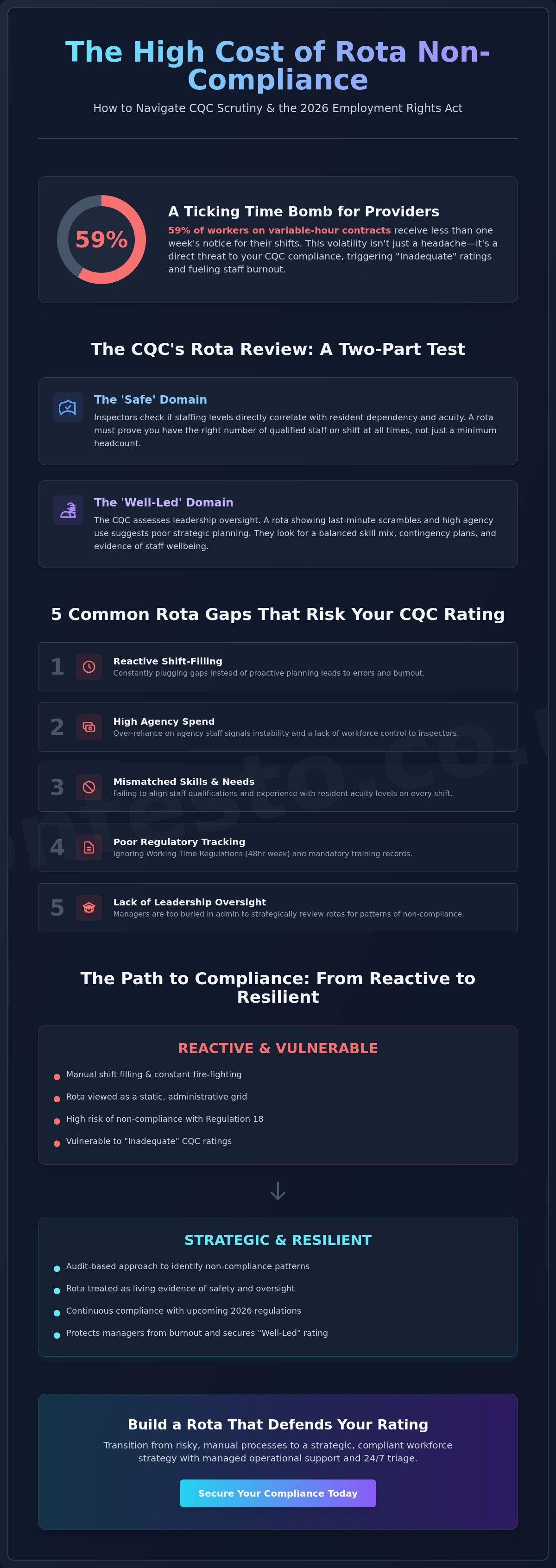
Did you know that 59% of workers on variable-hour contracts receive less than one week's notice for their shifts? In the wake of the Employment Rights Act 2026, this level of volatility is no longer just a management headache; it's a direct threat to your care rota compliance. If your strategy relies on manual shift filling and high agency spend, you're likely operating in a state of constant vulnerability. It's exhausting to manage, risky to sustain, and often triggers the "Inadequate" ratings that every provider fears.
We believe a rota is more than a filled grid; it's a narrative of safety, stability, and staff wellbeing. This guide identifies the five critical gaps currently triggering CQC red flags under the Single Assessment Framework. You'll discover how to build a resilient rostering strategy that reduces administrative exhaustion, minimizes spend, and secures your "Well-Led" rating. We'll analyze the impact of the April 2026 statutory changes, including the shift to 80% earnings for sick pay, and provide a clear roadmap for operational excellence in an increasingly regulated market.
Key Takeaways
Align staffing levels with service user needs by understanding how the CQC uses rotas to evaluate leadership oversight and safety standards.
Master the nuances of care rota compliance to stay ahead of the 2026 regulatory changes and avoid the common pitfalls that lead to inspection failures.
Transition from reactive shift-filling to a strategic, audit-based approach that identifies patterns of non-compliance before they impact your rating.
Discover how managed operational support and 24/7 triage can protect your managers from burnout while maintaining continuous oversight of your workforce.
Table of Contents
Defining Care Rota Compliance: More Than Just a Filled Grid
True care rota compliance is not merely a mathematical exercise in filling empty shifts. It represents the precise alignment of staffing levels with the complex, fluctuating needs of service users. For many providers, the rota is viewed as a static document, yet the Care Quality Commission (CQC) treats it as a living evidence log. Under the Health and Social Care Act 2008 (Regulated Activities) Regulations 2014, your workforce strategy must prove that you aren't just putting bodies in a room, but placing the right expertise where it's needed most. It's a narrative of safety, continuity, and clinical oversight.
The concept of "Safe Staffing" serves as the core of this narrative. This requires having enough staff who are qualified, competent, and experienced at all times to meet the specific dependency levels of your residents. While modern employee scheduling software provides the digital framework for these patterns, true compliance lives in the strategic monitoring of those numbers. Administrative rostering focuses on the "who" and "when," but strategic compliance focuses on the "how" and "why." It's the difference between surviving a shift and delivering high-quality, regulated care.
The Legal Framework: Regulation 18
For registered managers, Regulation 18 (Staffing) is the non-negotiable standard that dictates operational survival. It mandates that providers must deploy sufficient numbers of suitably qualified staff to meet the requirements of the regulated activity. If your rota shows a pattern of "near misses" or a reliance on staff who haven't completed their mandatory training, you're already in breach. The CQC looks for evidence of proactive planning rather than reactive crisis management. Regulation 18 is the bedrock of care quality.
The Role of Working Time Regulations
Compliance also extends to the physical and mental state of your workforce. Staff fatigue is a silent killer of care quality and a major red flag during inspections. The Working Time Regulations 1998 set a 48-hour weekly limit that requires meticulous tracking, especially for staff working across multiple sites. To maintain a "Well-Led" rating, you must provide clear evidence of rest breaks and compensatory rest periods. This data proves to the CQC that your leadership prioritizes both staff wellbeing and resident safety. Effective care rota compliance depends on your ability to demonstrate that every carer on shift is alert, rested, and capable of making critical decisions under pressure.
Qualified: Staff must hold the necessary certifications for their specific roles.
Competent: Skills must be verified through regular supervision and practical assessment.
Experienced: The skill mix on a shift must balance junior staff with seasoned professionals.
Moving beyond simple grids allows you to build a resilient strategy. It protects your business from the 180-day pay penalties associated with redundancy mismanagement and ensures you're ready for the October 2026 shifts in zero-hour contract regulations. Real compliance is about building a digital presence that reflects your operational excellence.
How the CQC Evaluates Your Staffing Rotas
The CQC's Single Assessment Framework (SAF) has transformed the inspection process from a snapshot in time into a continuous, data-driven evaluation. When inspectors scrutinize your staffing patterns, they're looking for more than just names on a page. They're seeking evidence of care rota compliance through the lens of the 'Safe' and 'Well-Led' domains. Under the 'Safe' domain, your rota must demonstrate a direct correlation between resident dependency levels and the staff on shift. If a wing houses ten residents with high acuity scores but only two junior carers, the narrative of safety collapses.
Leadership oversight, a cornerstone of the 'Well-Led' domain, is often where providers falter. Inspectors don't just ask if the shift was filled; they ask how it was managed. They look for a balanced skill mix that pairs experienced seniors with newer staff to ensure clinical safety. A rota that consistently shows gaps or last-minute scrambles suggests a lack of strategic foresight. Effective care rota compliance requires robust contingency planning. You must be able to prove that when an unexpected absence occurs, your system triggers a pre-defined response rather than a frantic search for agency cover.
Evidence-Based Staffing: The Narrative of the Rota
The CQC prioritizes the "reasoning" behind your numbers. It's no longer enough to say you have five carers because that's the "usual" number. You must justify those levels using resident acuity data and the 34 Quality Statements of the SAF. By using a sophisticated care home management system, you create a transparent audit trail that links staffing decisions to service user outcomes. This level of detail is essential for meeting CQC Regulation 18, which demands that staffing is sufficient to meet the needs of those being cared for.
The Impact of Agency Usage on Compliance
While agency staff are a vital safety net, a heavy reliance on them is a significant red flag for 'Well-Led' ratings. It suggests a failure in recruitment, retention, or internal bank management. To maintain compliance, you must document thorough inductions for every agency worker, ensuring they understand your specific protocols and resident needs. Many providers are now looking to reduce care agency spend by optimizing their internal bank and sickness management processes. If you're struggling to maintain this balance, our operational support services can help stabilize your workforce narrative and restore confidence in your compliance data.
5 Common Rota Gaps That Risk Your CQC Rating
Identifying administrative errors is simple; managing operational failures is where the real challenge lies. For many registered managers, the burden of manual shift filling consumes up to 15 hours of their working week, leaving little room for strategic oversight. These five gaps aren't just logistical hurdles. They're direct invitations for CQC inspectors to question your "Well-Led" status and the safety of your service users. Achieving care rota compliance requires a shift from reactive "hole-plugging" to a sophisticated, data-driven narrative.
Gap 1: The 'Friday Night' Triage Crisis
Operational continuity often fractures the moment the office closes for the weekend. When staff call in sick on a Friday evening, the responsibility typically falls on a manager who is already exhausted. Without a dedicated system for sickness management, these gaps lead to "unfilled" status on weekend handovers, which is a major red flag during inspections. Utilizing outsourced on-call for care providers removes this burden. It ensures every sickness alert is met with an immediate, compliant triage response rather than a frantic Saturday morning scramble. This proactive approach preserves the integrity of your care delivery when your core team is off-duty.
Gaps 2-5: Skill Mix, Fatigue, and Data Silos
The remaining four gaps often hide in plain sight, embedded in the daily rhythm of the home. They manifest as subtle patterns that, over time, erode your safety standards and resident outcomes.
Gap 2: Inadequate Skill Mix. This occurs when a night shift is staffed entirely by junior carers without a senior lead present. The Fix: Hard-code competency requirements into your rostering templates to prevent "unbalanced" shifts from being published.
Gap 3: Fatigue and Burnout. Ignoring the 48-hour weekly limit or failing to track 11-hour rest periods between shifts leads to errors. The Fix: Implement automated alerts that flag potential Working Time Regulation breaches before the shift starts.
Gap 4: Shallow Bank Depth. Relying on a small pool of staff leads to emergency agency calls, which cost significantly more and disrupt care continuity. The Fix: Actively recruit and maintain an internal "bank" of at least 20% of your total workforce capacity to absorb shocks.
Gap 5: The Software-Reality Disconnect. Many providers find that their domiciliary care management software shows a perfect grid that doesn't match the actual floor presence. The Fix: Bridge the gap with live operational support that verifies attendance and performance in real-time.
By May 2026, the CQC expects a narrative that proves your staffing decisions are intentional and sustainable. When you eliminate these common failures, you don't just protect your rating; you reclaim the time needed to lead your team with clarity and purpose.
Strategies for Building a Resilient, Compliant Rota
Building a resilient workforce isn't about speed; it's about architectural integrity. While many competitors promise tools to "build rosters in minutes," they often ignore the structural weaknesses that lead to inspection failures. True care rota compliance emerges when you stop treating the rota as a weekly chore and start treating it as a strategic asset. By integrating the April 2026 Fair Pay Agreements and the new statutory sick pay rules into your planning, you create a buffer against the financial shocks of high agency spend. A proactive framework moves you away from the "hole-plugging" mentality that exhausts managers and compromises care quality.
Your bank staff serves as the primary shield against the rising costs of the 2026 employment reforms. With a record 1.23 million UK workers on zero-hour contracts, the sector is increasingly volatile. To counter this, you must integrate staff feedback into your rostering process. When carers feel heard regarding their shift patterns, retention improves, and the need for emergency agency cover drops. It's a human-centric approach to SEO and operations that values visibility as a brand's fundamental right to be heard and respected by its own workforce.
Step-by-Step: The Rota Audit Process
A monthly care home audit checklist is your best defense against "Well-Led" red flags. You shouldn't just check if shifts are filled. You need to analyze why they weren't. Look for patterns in staff sickness, especially following the 2026 SSP overhaul that mandates 80% earnings from day one of illness. If 15% of your weekend shifts are consistently filled by agency workers, your bank staff depth is insufficient. Documenting these "lessons learned" provides the CQC with a narrative of continuous improvement. It proves that your leadership is meticulous, insightful, and deeply invested in long-term success.
Leveraging Technology and Human Oversight
Digital tools are essential, but software is a tool, not a strategy. A dashboard can show a gap, but it can't manage the human nuance of a 2 a.m. triage call or the subtle psychology of staff burnout. To ensure data integrity, your digital system must be backed by human oversight that operates 24/7. This managed approach ensures the rota remains a live, accurate reflection of care delivery. It bridges the gap between the technical mechanics of a scheduling app and the lived reality of a busy care environment. If you're ready to move beyond basic dashboards, discover how our compliance monitoring and rota management services can secure your operational future.
Managed Operational Support: The Strategic Path to Compliance
Software is a silent partner; it records data but cannot act on it. While many providers believe that a digital dashboard is the final destination for care rota compliance, it's actually just the infrastructure. The real work happens in the gaps between the data points. This is where Contesto functions as a high-level creative partner, bridging the divide between technical mechanics and human necessity. Our managed operational support isn't a software replacement. It's a strategic layer of human oversight that ensures your compliance narrative remains authentic and resilient under pressure.
By integrating 24/7 on-call triage, we remove the reactive burden that traditionally fractures a manager's focus. We act as a white-label extension of your team, operating with the quiet confidence and reliability you expect from an internal department. This professional management directly impacts the care rota costs associated with last-minute agency reliance and administrative friction. It's a pragmatic solution that delivers measurable ROI through operational stability and reduced workforce churn.
Eliminating the 'Manager Burnout' Compliance Risk
Manager turnover is a critical red flag for the CQC, often signaling a lack of leadership stability within the 'Well-Led' domain. When a registered manager is tethered to a phone for out-of-hours sickness alerts, their ability to lead strategically vanishes. Outsourcing this triage doesn't just fill shifts; it preserves your most valuable human assets. Contesto handles every shift reallocation according to your specific internal policies and staff competencies, ensuring consistency regardless of the hour. Stable leadership is the most direct route to a high CQC rating, and protecting your managers from burnout is the first step in that journey.
Strategic Growth Through Operational Excellence
Operational excellence is the foundation of strategic growth in the care sector. When management is no longer buried in the minutiae of manual rostering, they can focus on expanding service capacity and improving resident outcomes. You gain the peace of mind that comes from being inspection-ready 365 days a year, rather than scrambling in the weeks before an assessment. True visibility isn't a metric on a screen. It's your brand's right to be heard and respected as a leader in quality care. We invite you to contact Contesto to see how we can secure your rota compliance and transform your operational narrative today.
Securing Your Operational Future in 2026
The landscape of the UK care sector is shifting beneath the weight of the Employment Rights Act 2026. Maintaining care rota compliance now requires more than just administrative diligence; it demands a strategic architecture that can withstand 80% sick pay mandates and the October 2026 zero-hour contract reforms. By eliminating the five critical gaps we've identified, from the Friday night triage crisis to the disconnect between software and floor reality, you protect your "Well-Led" rating and your team's mental health. It's a multi-layered solution that prioritizes stability, safety, and strategic growth.
Operational continuity is a narrative of reliability. When you move beyond the limitations of standalone software and embrace a managed approach, you reclaim the time needed for high-level leadership. Our operational continuity specialists act as a white-labelled extension of your team, following your exact policies to ensure every shift is safe and every gap is bridged. This measured flow mirrors the long-term, compounding nature of the compliance work we perform.
Discover how Contesto’s managed support ensures your rotas are always inspection-ready. With 24/7 managed triage and a meticulous focus on data integrity, you can lead with confidence. Your brand has a right to be heard and respected in a crowded marketplace. Let's build that legacy together.
Frequently Asked Questions
What are the CQC requirements for staff rotas?
The CQC requires that providers meet Regulation 18 (Staffing) by deploying sufficient numbers of suitably qualified, competent, and experienced staff. Your rotas must align with the current dependency levels of your service users rather than just following a fixed template. Under the Single Assessment Framework, inspectors look for evidence that your skill mix supports clinical safety and resident wellbeing at all times.
How many years of rotas should a care home keep for CQC?
Care providers should retain at least 3 years of staffing rotas to meet both CQC inspection requirements and GDPR data retention standards. This historical data allows inspectors to identify long term patterns in your workforce stability, such as sickness trends or excessive agency reliance. Keeping these records accessible ensures you can prove a consistent narrative of safety and leadership oversight during any unannounced visit.
Can the CQC fine a care provider for rota gaps?
Yes, the CQC has the authority to issue Fixed Penalty Notices or even prosecute providers for persistent breaches of Regulation 18. If significant rota gaps lead to a failure in care delivery or compromise resident safety, the commission can downgrade your rating to "Inadequate" or cancel your registration. These enforcement actions are typically triggered when a provider cannot demonstrate a proactive strategy for care rota compliance.
Is it mandatory to use care rota software for compliance?
While the CQC doesn't mandate the use of specific software, digital systems are highly recommended for maintaining accurate, real time audit trails. Paper based systems are often cited for lack of clarity or version control errors during inspections. However, software is merely a tool; true compliance requires a strategic layer of human oversight to manage the nuances of staff sickness and triage effectively.
How does the Working Time Directive affect care rota compliance?
The Working Time Regulations 1998 mandate a 48 hour weekly limit and 11 hour rest periods between shifts to prevent staff fatigue. Failing to track these rest periods is a major red flag for inspectors, as exhausted staff are more likely to make clinical errors. Effective care rota compliance depends on your ability to prove that your workforce is rested, alert, and capable of delivering safe care.
What is the difference between 'Safe Staffing' and just filling shifts?
Safe staffing is the strategic alignment of staff competencies with resident acuity scores, whereas filling shifts is a purely numerical exercise. A "filled" shift might still be unsafe if it lacks a senior lead or a staff member with specific PEG feed or dementia training. Inspectors look for a balanced skill mix that ensures all service user needs are met, regardless of staff absences.
How can I evidence rota compliance during a CQC inspection?
You can evidence compliance by presenting a clear audit trail that links your staffing levels to resident dependency tools and risk assessments. Be prepared to show your training matrix, agency staff induction records, and documented "lessons learned" from previous staffing crises. This evidence proves that your leadership is meticulous and that you have full oversight of your operational continuity.
What happens if a staff member calls in sick and I can't fill the shift?
If a shift remains unfilled, you must document a formal risk assessment that explains how you've mitigated the impact on resident safety. This might include reallocating tasks or bringing in on call management support to maintain oversight. Using a 24/7 on call triage service ensures that these incidents are handled according to your internal policies, providing a compliant narrative for the CQC.


Comments