

Reducing Operational Costs in a Domiciliary Care Agency UK: A Strategic 2026 Roadmap
- Mara

- 2 days ago
- 12 min read
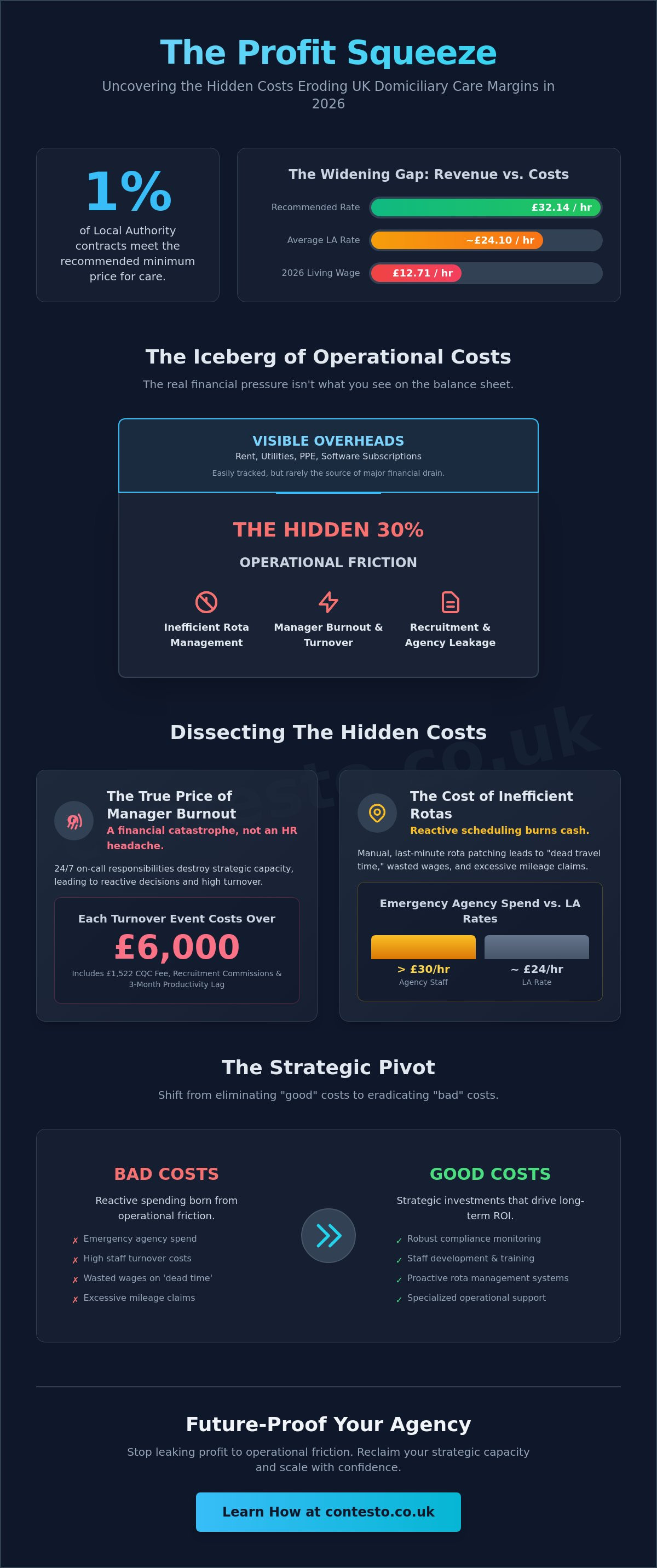
When only 1% of local authority contracts meet the Homecare Association’s recommended minimum price of £32.14 per hour, your margin for error effectively disappears. With the National Living Wage rising to £12.71 as of April 2026, the traditional approach to reducing operational costs in a domiciliary care agency UK is no longer about trimming the edges; it’s about a total structural overhaul. You likely feel the weight of this squeeze every time a rota collapses or an emergency call out drains your final remaining management capacity, leaving your profit margins vulnerable to hidden leaks.
We agree that the current landscape feels unsustainable, especially when manager burnout and high agency spend threaten your stability. This article promises to help you reclaim your strategic capacity by identifying the friction points that stall growth. You'll discover how to transform your financial health and stabilize cash flow while securing an improved CQC Well-Led rating. We will preview a 2026 roadmap that moves beyond basic budgeting, focusing instead on optimizing travel time and leveraging specialized operational support to ensure your agency doesn't just survive the current economic climate, but thrives within it.
Key Takeaways
Identify the "Hidden 30%" of operational spend by distinguishing between visible overheads and the invisible capacity leaks caused by manager burnout.
Execute proactive rota management as a core strategy for reducing operational costs in a domiciliary care agency uk, significantly decreasing reliance on high-cost external staffing.
Evaluate the financial impact of managed operational triage versus traditional in-house on-call teams to reclaim significant management bandwidth and reduce salary burdens.
Optimise the "Care Cash Flow Cycle" by aligning local authority payment schedules with weekly payroll to shorten debtor days and improve liquidity.
Scale your agency profitably by integrating white-labelled operational support that maintains CQC standards while freeing your leadership for high-level strategic growth.
Table of Contents
Beyond the Balance Sheet: Identifying the Core Drivers of Operational Costs in Domiciliary Care
Optimising Rota Management to Combat Agency Reliance and Recruitment Leakage
The Strategic Choice: In-House On-Call vs. Managed Operational Triage
Practical Frameworks for Managing Cash Flow and Minimising Overheads
Future-Proofing Your Agency: Scaling Profitably with Contesto’s Operational Support
Beyond the Balance Sheet: Identifying the Core Drivers of Operational Costs in Domiciliary Care
Most providers view operational expenditure through a narrow lens of rent, utilities, and PPE. While these visible overheads are easily tracked, they rarely represent the true financial pressure points within the UK home care sector. Real fiscal erosion happens in the "Hidden 30%": a combination of management burnout, recruitment leakage, and inefficient service delivery. In 2026, simply "shopping around" for cheaper gloves isn't a strategy. With the National Living Wage at £12.71 and the CQC implementing a stricter, evidence-heavy inspection framework, survival requires a more nuanced distinction between "good" costs and "bad" costs.
Good costs are investments in quality that drive long-term ROI, such as robust compliance monitoring and staff development. Bad costs are the result of operational friction. These include the financial fallout of a manager quitting due to on-call fatigue or the wasted fuel and wages spent on "dead" travel time. For those focused on reducing operational costs in a domiciliary care agency uk, the goal is to eliminate friction while protecting the clinical excellence that secures a high CQC rating.
The True Price of Management Burnout
Losing a Registered Manager is a financial catastrophe, not just an HR headache. When you factor in the £1,522 CQC application fee for a new manager, recruitment agency commissions, and the three-month "onboarding lag" where productivity drops, the total cost often exceeds £6,000 per turnover event. Much of this stems from 24/7 on-call responsibilities. When a manager spends their night triaging staff sickness, their daytime strategic capacity vanishes. They become reactive, making hurried decisions that lead to disengaged frontline staff and, eventually, further turnover.
Identifying 'Dead Time' in Your Current Rota
Efficiency in domiciliary care is measured by the ratio of contact time to travel time. If your coordinators are manually patching rotas at 2 AM to cover a 7 AM call, they aren't optimizing for geography; they're optimizing for survival. This leads to excessive mileage claims and "dead time" where you pay for travel that generates zero revenue. Poor triage processes often result in emergency agency spend, where you pay premium rates for last-minute cover that could have been avoided with proactive staff sickness management. Operational friction is the primary barrier to agency profitability in 2026. By addressing these structural leaks, you can start reducing operational costs in a domiciliary care agency uk without compromising the standard of care your clients expect.
Optimising Rota Management to Combat Agency Reliance and Recruitment Leakage
Rota management is often treated as an administrative burden, but it's actually your most powerful lever for reducing operational costs in a domiciliary care agency uk. When scheduling is reactive, you're constantly fighting fires. This leads to a heavy reliance on external agencies, where fees often exceed £30 per hour, far outpacing the average local authority fee rate of £24.10. To reclaim your margins, you must shift toward a proactive model that identifies gaps before they become emergencies. By leveraging historical data to predict sickness patterns, you can build a resilient schedule that survives the unexpected.
Building an internal "Bank Staff" system creates a critical safety net. Instead of calling an external agency when a carer calls in sick at 6 AM, you activate a pre-vetted list of internal staff who are incentivised to pick up extra hours. This doesn't just save on agency commissions; it ensures continuity of care, which is a vital metric for your CQC Well-Led rating. Integrating 24/7 on-call triage and staff sickness management into this workflow allows you to predict high-demand periods with surgical precision, ensuring you aren't caught off guard during peak times.
5 Steps to Reducing Agency Spend Through Better Planning
Strategic scheduling requires a structured approach. Follow these steps to tighten your operations:
Step 1: Audit historical "emergency" gaps. Review the last six months of rota failures to find recurring patterns, such as specific postcodes or shift times that consistently require agency cover.
Step 2: Implement a "first-call" internal bank system. Create a tiered list of your own staff who want extra hours, offering them a small premium that is still significantly lower than agency rates.
Step 3: Optimise travel routes. Use geographic clustering to increase contact-time ratios. Reducing a carer's travel time by just 10 minutes per call can save thousands in mileage and wages over a year.
Step 4: Integrate compliance monitoring. Ensure your rota doesn't just fill slots but also tracks training expiries and working time regulations automatically.
Step 5: Pre-empt sickness. Use proactive staff sickness management to check in with carers after a period of absence, reducing the likelihood of "rolling" sick days.
The Link Between Rota Stability and Staff Retention
Carers leave for two main reasons: low pay or inconsistent hours. In a market where the National Living Wage is £12.71, you can't always win on price alone, but you can win on stability. Consistent hours are the primary factor in carer retention. Using transparent rota management as a recruitment tool shows potential hires that you value their work-life balance and financial security. This stability is the foundation of How to scale a care business UK effectively. If your current team is struggling to balance these moving parts, exploring bespoke operational support can provide the breathing room needed to focus on high-level growth.
The Strategic Choice: In-House On-Call vs. Managed Operational Triage
While previous sections explored the "Hidden 30%" of operational leaks, the most significant drain on management capacity often rings at 3 AM. For many providers, the default response is to distribute on-call duties among the existing management team. This feels like a "free" solution, but it carries a heavy price in terms of strategic stagnation. Managed operational triage offers a sophisticated alternative, acting as a white-labelled extension of your agency that handles the friction of out-of-hours coordination without the associated overheads. It's a move from a reactive survival mode to a controlled, professional infrastructure.
The "Control Myth" often holds owners back. There is a fear that an external partner won't care for clients as deeply as an in-house team. However, managed support actually increases manager oversight. By using a service that follows your specific protocols and provides detailed morning reports, you gain a level of visibility that is impossible to achieve when a tired manager is scribbling notes on a bedside table. You aren't losing control; you're gaining a professionalised audit trail that is essential for reducing operational costs in a domiciliary care agency uk.
Financial Breakdown: The Cost of the 'Bleep'
To run a compliant 24/7 in-house on-call function, you aren't just paying for hours. You must account for National Insurance, pension contributions, and the inevitable burnout that leads to turnover. If three managers share on-call duties, their daytime productivity drops by an estimated 20% due to fatigue. Shifting to a managed service retainer provides budget certainty with a fixed monthly cost, allowing you to scale without needing to hire more coordinators every time you take on a new package of care. Managed triage is not just a call centre; it's a strategic buffer that protects your senior team from the operational noise that prevents high-level scaling.
Impact on CQC Compliance and Inspection Readiness
Professional triage systems ensure every staff sickness or client emergency is logged with a clear, digital audit trail. This level of meticulous documentation is gold dust during a CQC inspection. It proves that the agency is "Well-Led" even when the Registered Manager is asleep. By standardising incident reporting during out-of-hours shifts, you ensure that every shift reallocation follows your specific agency policies automatically. This removes the risk of human error and ensures that compliance monitoring remains constant, regardless of the time of day. This systematic approach provides the "Well-Led" evidence required to move from a "Good" to an "Outstanding" rating while simultaneously reducing operational costs in a domiciliary care agency uk.
Practical Frameworks for Managing Cash Flow and Minimising Overheads
Cash flow is the oxygen of your business. In the UK domiciliary care sector, the "Care Cash Flow Cycle" is notoriously volatile, often defined by the friction between weekly payroll obligations and monthly local authority payments in arrears. When the average local authority fee rate sits at £24.10 per hour, there is zero room for administrative lag. Managing this cycle isn't just an accounting task; it's an operational discipline. By tightening the gap between care delivery and invoice generation, you directly shorten your "debtor days," ensuring liquidity remains stable even during periods of rapid growth.
A primary driver of financial erosion is "leakage." This occurs when contact time is delivered but remains unbilled due to rota discrepancies, or when travel expenses aren't reconciled against actual GPS data. For those serious about reducing operational costs in a domiciliary care agency uk, identifying these micro-leaks is essential. It requires a shift from monthly reviews to real-time auditing. When your operational data is clean, your billing is accurate, and your cash flow becomes predictable rather than a source of monthly anxiety.
A How-To Guide for Managing Cash Flow in Home Care
Stabilising your agency's finances requires three specific actions. First, implement real-time monitoring of hours delivered versus hours commissioned. If a carer stays an extra 15 minutes, you need to know immediately if that time is billable. Second, use the savings generated from your rota optimisations (discussed in Section 2) to build an emergency contingency fund. Finally, perform a quarterly audit of your local authority contracts. If a specific contract consistently fails to cover the £12.71 National Living Wage plus on-costs, it's time to renegotiate or pivot toward more sustainable private-pay models.
Leveraging Technology for ROI, Not Just Compliance
Many agencies treat care management software as a "set and forget" compliance tool. However, software is only half the solution; it requires managed execution to deliver a true return on investment. To maximise ROI, ensure your tech stack eliminates double-entry data costs. When your rota management system communicates directly with your payroll and billing platforms, you drastically reduce paper-based overheads and administrative lag. This digital synergy allows your office team to focus on growth rather than data entry. If your current infrastructure feels fragmented, you can reclaim your time and profitability by integrating strategic operational support that bridges the gap between your data and your bottom line.
Future-Proofing Your Agency: Scaling Profitably with Contesto’s Operational Support
Building a sustainable agency in 2026 requires more than just grit; it requires a fundamental structural shift. As we have explored, the path to reducing operational costs in a domiciliary care agency uk isn't found in cutting frontline quality but in eliminating the administrative friction that stalls growth. Contesto acts as your Strategic Architect, building the digital and physical infrastructure that allows your agency to operate with clinical precision. We don't just provide a service; we provide the operational breathing room needed to move your business from a state of constant survival into a phase of aggressive, profitable scaling.
By integrating a white-labelled operational layer into your business, you ensure that your brand’s narrative remains consistent even when your office doors are closed. Our team manages the complexities of out-of-hours coordination, staff sickness, and compliance monitoring under your agency's name. This seamless integration ensures that you maintain full visibility through detailed reporting while reclaiming over 40 hours a month of senior management time. This is time that should be spent on business development, high-level commissioning, and nurturing client relationships rather than triaging a 2 AM shift failure.
Your Integrated Operational Partner
The peace of mind that comes with professionalised triage cannot be overstated. While you sleep, we handle the volatile reality of staff sickness management and emergency shift reallocations. Every decision we make follows your specific protocols, ensuring that your CQC audit trail remains immaculate and your "Well-Led" rating is protected. This isn't just a safety net; it's a performance-marketing engine for your operations. Learn more about our 24/7 On-Call Triage and how it can stabilise your daily management cycle.
The Path to Sustainable Growth
The most profitable agencies in 2026 will be those that embrace managed support to decouple their growth from their stress levels. Scaling a care business traditionally meant hiring more coordinators and increasing your overheads proportionally. With Contesto, you scale your capacity without the equivalent rise in management burnout or recruitment leakage. We provide the substance, clarity, and measurable results required to navigate a competitive UK market where margins are thin but opportunities are vast. If you're ready to stop fighting fires and start building a legacy, book an operational audit with Contesto today and discover how we can assist in reducing operational costs in a domiciliary care agency uk while accelerating your long-term ROI.
Turning Operational Strategy into Sustainable Profit Margins
The transition from reactive survival to proactive growth requires a departure from traditional, fragmented management. By addressing the "Hidden 30%" of capacity leaks and implementing a resilient bank staff strategy, you move beyond the limitations of the £24.10 average local authority fee rate. Real progress in reducing operational costs in a domiciliary care agency uk isn't found in cutting corners. It's found in professionalising the friction points that currently drain your senior team's bandwidth and strategic focus. This roadmap has highlighted that financial health and CQC excellence are two sides of the same coin.
Contesto offers a sophisticated, white-labelled integration that acts as your Strategic Architect. Our professional 24/7 On-Call Triage and specialised UK care sector expertise allow you to reclaim over 40 hours of management time every month while maintaining an immaculate audit trail. It's time to stop fighting daily fires and start building a scalable, resilient legacy. Discover how Contesto can reduce your operational burden and agency spend today. Your agency's future is ready for a more profitable chapter.
Strategic Insights: Frequently Asked Questions
What is the most effective way to reduce agency spend in a UK care home?
The most effective way to reduce agency spend is by establishing a robust internal bank staff system that acts as your first line of defence. By incentivising your existing team to cover gaps at a controlled premium, you avoid the £30+ hourly rates frequently charged by external agencies. This strategy protects your margins from the disparity between the £24.10 average local authority fee and the rising £12.71 National Living Wage.
How does managing cash flow differ for domiciliary care vs. residential care?
Managing cash flow in domiciliary care is uniquely challenging because it relies on reconciling high-frequency, variable data like travel mileage and fragmented contact hours. Unlike residential care, which benefits from fixed facility overheads, domiciliary providers must account for "dead time" and fuel costs. Shortening your debtor days requires an immediate link between care delivery and invoice generation to maintain liquidity for weekly payroll.
Can outsourcing on-call triage actually improve my CQC rating?
Professional triage improves your CQC rating by generating the meticulous, digital evidence required for the "Well-Led" assessment. It removes the risk of human error during out-of-hours emergencies, ensuring that every incident follows a standardised protocol. This level of oversight provides inspectors with a clear audit trail, proving that your agency maintains safe, high-quality care 24 hours a day without relying on exhausted managers.
What are the hidden costs of running an in-house on-call service?
The primary hidden cost is the erosion of your management's strategic capacity, which often leads to a turnover event costing over £6,000 per manager. When senior staff are exhausted by night-time triaging, their daytime productivity drops by an estimated 20%. You aren't just paying for the hours they are awake; you're paying for the strategic stagnation and staff disengagement that follows managerial burnout.
How can I improve staff retention through better rota management?
Carers prioritising financial stability find that consistent, predictable hours are more valuable than a marginal wage increase. By using transparent rota management to provide schedules at least 14 days in advance, you reduce the "churn" associated with unpredictable income. This stability acts as a powerful recruitment tool in the competitive 2026 UK market, where staff retention is the ultimate cost-saving measure.
Is it possible to manage operational costs without reducing carer wages?
You can achieve significant savings by eliminating operational friction rather than suppressing wages. Focusing on reducing operational costs in a domiciliary care agency uk involves tightening travel routes and reclaiming unbilled contact time. By optimising the efficiency of your existing infrastructure, you protect the £12.71 National Living Wage for your staff while simultaneously expanding your agency's profit margins.
What metrics should a care manager track to ensure operational efficiency?
Managers should prioritise tracking the ratio of contact time to travel time and the volume of emergency agency cover hours. Adhering to the 45p per mile HMRC Approved Mileage Allowance is also critical for controlling leakage. These metrics provide a clear picture of your operational health, allowing you to identify which contracts or geographical areas are underperforming before they drain your cash reserves.
How does white-labelled support maintain my agency's brand narrative?
White-labelled support maintains your brand narrative by operating as a seamless, invisible extension of your office team. By strictly adhering to your agency’s specific escalation protocols and communication style, the triage service ensures that clients and carers experience a consistent level of care. This bespoke approach reinforces your reputation for reliability without requiring your senior team to be personally available at all hours.


Comments