

Outsourced Rota Management for Care Providers: A Strategic Guide to Operational Continuity
- Mara

- May 8
- 13 min read
Updated: May 12
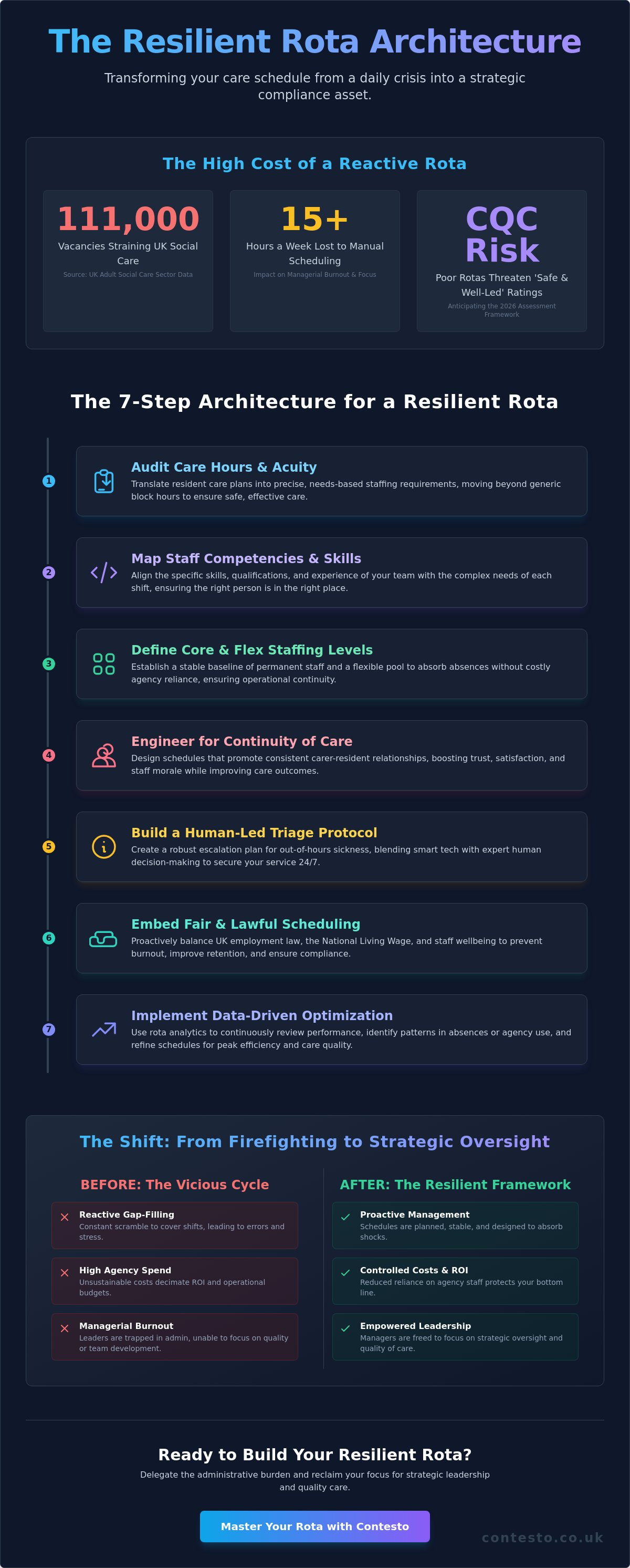
What if your care rota wasn't just a grid of filled hours, but the primary safeguard against the 111,000 vacancies currently straining the UK adult social care sector? For many providers, the schedule feels like a fragile house of cards, where a single staff sickness triggers a cascade of unsustainable agency spend and compliance anxiety. You likely feel the pressure of the £12.71 National Living Wage alongside the looming oversight of the Fair Work Agency starting in April 2026. It's a cycle that drains your budget, exhausts your managers, and risks the quality of care your residents deserve.
We believe a rota is a dynamic operational narrative, not a static spreadsheet. By mastering the architecture of outsourced rota management for care providers uk, you can stabilize your operations while reclaiming hundreds of hours of administrative time. This guide explores how to build a resilient framework that balances CQC compliance with genuine staff wellbeing. We will examine the strategic shift from reactive filling to proactive management, ensuring your service remains robust, reliable, and ready for the 2026 regulatory rebuild.
Key Takeaways
Transform your rota from a static spreadsheet into a high-impact compliance asset that satisfies CQC inspectors. Learn how a structured schedule serves as immediate evidence of safe, consistent care delivery.
Discover a seven-step framework for building resilience through outsourced rota management for care providers uk. This strategic approach moves beyond filling gaps to aligning staff competencies with specific service-user needs.
Master the Rule of Three to balance UK employment law, staff continuity, and the human resonance of your care delivery. Learn how predictable schedules drive retention and reduce managerial burnout.
Secure your operations against midnight emergencies by integrating human-led triage into your out-of-hours strategy. Identify why software alone cannot replace expert decision-making during critical staff sickness events.
Shift your leadership focus from daily firefighting to strategic oversight. Reclaim your time by delegating administrative burdens while maintaining full visibility over your operational continuity.
Table of Contents
Beyond the Grid: Why Your Care Rota is a Strategic Compliance Asset
For many providers, the rota is a source of persistent friction, a spreadsheet of shifting names that never quite feels finished. Yet, when you view it through the lens of a Strategic Architect, the rota reveals itself as the foundational architecture of your entire operation. It's the primary safeguard for resident safety, the engine of your financial stability, and the ultimate evidence of your management's competence. Adopting a model for outsourced rota management for care providers uk transforms this administrative burden into a strategic asset that protects your service from the volatility of the current labor market.
Moving beyond the "filling gaps" mentality is essential for long-term survival. Reactive scheduling, where managers scramble to cover shifts at 6 AM, creates a fragile system. A resilient rota is designed to absorb shocks, such as the 7% vacancy rate currently affecting 111,000 posts across England. By focusing on an optimised skill mix rather than just headcount, you ensure that every shift has the right blend of experience and training to meet specific service-user needs. This is a sophisticated form of Workforce Management that prioritises operational continuity over temporary fixes.
The CQC Connection: Safe and Well-Led
During a CQC inspection, your rota is often the first document requested to verify Safe and Well-Led criteria. It serves as a transparent narrative of your oversight. Inspectors don't just look for filled slots; they look for evidence that you've considered staff fatigue, competency levels, and the consistency of care. A well-structured rota demonstrates that you aren't just reacting to crises but are actively managing risk. Safe staffing in UK care means ensuring that enough people with the right skills and experience are available at all times to meet the needs of service users and keep them safe from harm. When your rota is managed with precision, it becomes an irrefutable record of your commitment to these standards, especially as the CQC implements its 2026 assessment framework rebuild.
The True Cost of a Poorly Managed Rota
The financial and human costs of a dysfunctional schedule are staggering. When a manager spends 15 hours a week manually adjusting shifts, they aren't leading their team or improving care quality; they're firefighting. This administrative drain leads to burnout, which in turn fuels the high turnover rates currently seen in the sector. Furthermore, a lack of predictability often results in a heavy reliance on agency staff, which can decimate a provider's ROI. You can explore these financial implications further in our analysis of The True Cost of Care Rota Management: A Strategic Analysis for UK Providers. Ultimately, a poorly managed rota isn't just a nuisance. It's a threat to your reputation, your staff retention, and your bottom line.
The 7-Step Architecture for Building a Resilient Care Rota
Building a resilient rota is an exercise in engineering, not just scheduling. It requires a move away from reactive "gap-filling" toward a proactive framework that anticipates volatility. By implementing a sophisticated architecture, you ensure your service remains compliant with CQC Regulation 18, which mandates that providers must deploy sufficient numbers of suitably qualified, competent, and experienced staff. When you embrace outsourced rota management for care providers uk, you gain access to this level of strategic precision without the internal administrative drain.
The foundation of a resilient rota rests on five core architectural pillars:
Step 1: Audit Care Hours. Start with the actual acuity of your residents. Care plans must be translated into precise staffing requirements that reflect the intensity of support needed, rather than generic block hours.
Step 2: Map Staff Competencies. Beyond contracted hours, you must understand the specific skill sets of your team. This ensures that every shift has the necessary expertise for medication administration, manual handling, or dementia care.
Step 3: Establish a Core vs. Bank Ratio. Aim for a stable ratio, such as 80% core staff and 20% internal bank staff. This structure protects your budget from the high costs of emergency agency reliance.
Step 4: Design Compliant Shift Patterns. Your schedule must strictly adhere to the Working Time Regulations 1998. This includes managing weekly hour limits and ensuring mandatory rest breaks to prevent staff fatigue.
Step 5: Build in Buffer Capacity. Resilience requires a margin for error. Designing a rota with built-in "floaters" or on-call tiers allows you to absorb the shock of sudden staff sickness without collapsing the entire schedule.
Calculating Staffing Requirements
Precision is the enemy of operational chaos. To calculate requirements accurately, you must account for more than just direct resident contact. A robust model includes time for handovers, mandatory training, and the administrative duties that often bleed into care time. For services managing complex clinical needs, referring to our guide on clinician-specific rostering can provide a deeper blueprint for high-acuity environments. Accurate calculation ensures that your team isn't just present, but is actually capable of delivering the care promised in your service user guides.
Designing the Shift Pattern
The choice between 12-hour shifts and 8-hour rotations is a strategic decision that impacts both staff resonance and care continuity. While 12-hour shifts can offer staff more days off and reduce the frequency of handovers, they also increase the risk of fatigue-related errors during the final hours. Conversely, 8-hour shifts can maintain higher energy levels but require more complex management of transition periods. Balancing these factors requires a human-centric approach that values fairness and transparency. If you find the complexity of these calculations overwhelming, exploring a bespoke rota strategy can help you align your operational needs with staff wellbeing.
Balancing Regulation and Resonance: Legal and Human Factors
A care rota is more than a logistical puzzle; it's a legal contract and a psychological foundation for your workforce. In an industry where the human element is the primary product, rigid automation often falls short. While software can flag a double-booked shift, it cannot understand the nuanced impact of a "clopening" shift on a caregiver's mental health. To achieve true operational excellence, providers must master the Rule of Three in scheduling: Compliance, Continuity, and Care. By leveraging outsourced rota management for care providers uk, organizations can ensure these three pillars remain in perfect alignment, even as regulatory pressures mount.
The transition to a sophisticated, human-centric model is no longer optional. With the Fair Work Agency set to begin enforcement in April 2026, payroll and scheduling compliance will face unprecedented scrutiny. Moving away from the "firefighting" approach allows you to treat the rota as a strategic narrative. This shift ensures that your scheduling decisions respect both the letter of the law and the human resonance required to deliver high-quality support. For practical frameworks on implementing these standards, the IHSCM Rota Management resources offer essential best practices for the UK sector.
Working Time Regulations for Care Staff
Legal compliance in the UK care sector is non-negotiable. You must strictly adhere to the Working Time Regulations 1998, which mandate a minimum of 20 minutes of rest for every six hours worked and at least 11 hours of daily rest between shifts. "Clopening" shifts, where a staff member finishes late only to start early the next morning, are a primary driver of fatigue and CQC concerns. While some staff may choose to sign a 48-hour weekly opt-out agreement to increase their earnings toward the £12.71 National Living Wage, managers must still monitor these hours to ensure safety isn't compromised. Expert management ensures these legal boundaries are never crossed, protecting your business from litigation and staff from exhaustion.
Fostering Staff Wellbeing Through Rota Design
Predictable schedules are the most effective tool for reducing the 7% vacancy rate currently troubling the industry. When staff can plan their lives weeks in advance, their commitment to the organization deepens. Modern care management is increasingly embracing self-rostering and flexible patterns to accommodate the diverse needs of a workforce that relies heavily on domestic and international recruitment. Staff resonance is the harmonious alignment between a caregiver’s personal wellbeing and their professional capacity to deliver empathetic, high-standard care. By prioritizing this resonance, you create a culture of reliability that naturally improves retention and reduces the constant, costly need for new recruitment drives.
Managing the Unpredictable: Strategies for Sickness and Triage
The moment of maximum vulnerability for any care provider occurs between 6 PM and 8 AM. This is when the carefully constructed architecture of your rota meets the reality of staff sickness. Most rotas fail not because of poor planning, but because they lack a robust mechanism for managing the unpredictable. While many providers invest heavily in digital tools, software-only solutions fail when a human decision is required at 3 AM. A computer can identify a gap; it cannot negotiate with a bank staff member or assess the clinical priority of a specific visit. This is where outsourced rota management for care providers uk becomes an operational lifeline, providing the human intelligence needed to maintain rota integrity through 24/7 on-call triage.
Effective triage is the difference between a minor scheduling hiccup and a full-scale operational crisis. By implementing a system that treats sickness calls as data points to be managed rather than fires to be fought, you protect your service's continuity. This approach ensures that your response to the 111,000 vacant posts currently reported in the sector is strategic rather than desperate. Managing the out-of-hours gap with professional oversight prevents the frantic, last-minute reliance on expensive agency staff that erodes your ROI and disrupts the consistency of care for your residents.
The Out-of-Hours Challenge
Evening and weekend sickness calls place an immense administrative burden on registered managers. These calls often trigger a cascade of compliance risks as managers scramble to find coverage while exhausted. When a manager’s phone rings in the middle of the night, their ability to lead the following day is compromised. This cycle of exhaustion is a primary driver of the burnout seen across the 1.71 million posts in the adult social care workforce. For a deeper look at why digital tools aren't a silver bullet, read our analysis: Beyond the Dashboard: Why Domiciliary Care Management Software is Only Half the Solution.
Implementing an Effective Triage System
A strategic triage system relies on clear escalation protocols. Rather than every sickness call becoming an emergency, a triage partner acts as a filter. They assess the urgency, contact your existing bank staff, and reallocate resources according to your specific service-user needs. This 24/7 operational support protects your manager’s downtime, ensuring they remain focused on high-level strategy rather than shift-filling. Unlike agency-led models that prioritise their own staffing sales, a white-labelled triage service preserves your brand narrative by operating as an extension of your own team. It ensures that when a crisis occurs, the response is measured, professional, and consistent with your values. Protect your operational continuity and your managers' wellbeing with expert 24/7 on-call triage and sickness management.
From Administrative Burden to Operational Excellence
The evolution of a care service depends on the leader's ability to step away from the spreadsheet and focus on the wider vision. If you're still manually adjusting shifts at 7 PM on a Sunday, you're acting as a Firefighter rather than a Strategic Architect. Transitioning to outsourced rota management for care providers uk isn't just about delegating tasks; it's about reclaiming the mental capacity needed for strategic growth and scaling. When you stop "doing" the rota and start managing the service, you shift your focus toward resident outcomes, staff resonance, and long-term viability in an increasingly competitive marketplace.
This transition marks the point where operational support becomes a competitive advantage. By removing the administrative friction that leads to manager burnout, you create space for innovation and quality improvement. A managed service doesn't just fill holes; it builds a sustainable ecosystem where compliance is a constant and staff feel valued through predictable, fair scheduling. In the context of the 2026 CQC assessment framework, having a robust, professionally managed rota system provides the documented evidence of "Well-Led" leadership that inspectors demand.
The Case for Managed Rota Support
Managed services bridge the gap between cold data and human psychology. While software provides the metrics, a professional management partner understands the nuances of human-centric operations. They ensure your brand's narrative remains authentic even during periods of operational stress. The ROI of professional rota management is most visible in the significant reduction of agency spend. By proactively managing your internal bank staff and identifying sickness patterns before they become chronic, you avoid the premium costs associated with emergency cover. This protects your margins while maintaining the continuity of care that is essential for resident safety and satisfaction.
Next Steps for Care Managers
Reclaiming your operational narrative begins with a clear-eyed assessment of your current system. Conduct a rota health check by analyzing your agency spend over the last quarter and identifying the frequency of out-of-hours sickness calls that required manager intervention. If your leadership team is spending more than 15 hours a week on scheduling and triage, you've reached the threshold where internal management becomes a liability rather than an asset.
Identify the specific pain points where your rota currently fails, whether it's the 3 AM sickness call or the complexity of managing the £12.71 National Living Wage payroll transition. Once these gaps are clear, you can move from reactive chaos to proactive excellence. Discover how Contesto’s 24/7 triage and rota management can transform your operations, allowing you to build a digital presence and a physical service that truly resonate with your community.
Redefining Operational Continuity in UK Care
The transition from a reactive schedule to a resilient operational architecture is the hallmark of a high-performing care service. By treating the rota as a strategic asset rather than a clerical task, you safeguard your residents and your reputation. You've seen how a structured approach mitigates the risks of the 111,000 vacant posts currently straining the sector and ensures your service remains robust against the CQC's 2026 regulatory updates. Mastering the intersection of legal compliance and staff resonance isn't just about efficiency; it's about building a sustainable culture of care.
Embracing outsourced rota management for care providers uk allows you to focus on the human heart of your service while expert partners handle the technical mechanics of continuity. Our model integrates specialized 24/7 on-call triage with a CQC compliance focused strategy and comprehensive operational support. This synergy ensures that even during midnight sickness calls, your service is managed with the same precision and authority you provide during the day.
Secure your service continuity with Contesto’s expert rota and on-call management. It's time to reclaim your narrative and lead your team toward a future of predictable, sustainable excellence. Your brand deserves a foundation that is as dedicated to quality as you are.
Frequently Asked Questions
How many staff do I legally need on shift in a UK care home?
UK law doesn't specify a fixed staff-to-resident ratio for care homes. Instead, CQC Regulation 18 requires you to deploy enough suitably qualified and competent staff to meet the specific needs of your residents. You must use a robust dependency tool to calculate these numbers based on care plans. Failing to adjust staffing levels when resident acuity rises is a primary trigger for CQC enforcement under the 2026 assessment framework.
Can a care manager be forced to do the on-call rota?
A care manager's requirement to perform on-call duties depends on their employment contract. However, even with a contractual obligation, the Working Time Regulations 1998 still apply. Managers must receive their 11 hours of daily rest and 90 hours of compensatory rest per week. If on-call demands prevent these rest periods, the provider risks legal action and manager burnout, which currently contributes to the 7% vacancy rate in the sector.
What are the best shift patterns for reducing caregiver burnout?
Shift patterns that prioritize predictability and rest are most effective at reducing burnout. While 12-hour shifts are popular because they offer more consecutive days off, they can lead to fatigue-related errors during the final hours. Many high-performing providers use a blend of 8-hour rotations with fixed patterns. This approach supports staff resonance by allowing caregivers to plan their lives around the £12.71 National Living Wage without sacrificing their mental health.
How far in advance should a care rota be published?
You should aim to publish your care rota at least four weeks in advance to ensure operational stability. While there's no specific UK law mandating a timeframe, providing early visibility is a critical factor in domestic staff retention. It allows your team to manage their personal commitments, reducing the likelihood of last-minute sickness calls that disrupt your service's continuity and safety.
What is the difference between a rota and a roster in healthcare?
A rota is the recurring pattern of shifts, while a roster is the specific assignment of named staff members to those shifts. In a sophisticated outsourced rota management for care providers uk model, the rota serves as the architectural blueprint. The roster is the dynamic execution of that plan. Understanding this distinction helps managers move from reactive shift-filling to strategic workforce architecture.
How can I reduce agency spend using my existing rota?
You can reduce agency spend by implementing a tiered internal bank system and proactive triage. By identifying gaps 48 hours in advance rather than four hours before a shift, you give your bank staff more opportunity to respond. Managing your existing resources through professional outsourced rota management for care providers uk ensures that agency use becomes a last resort rather than a daily necessity, protecting your service's ROI.
What happens if a care rota is not CQC compliant?
A non-compliant rota can lead to a "Requires Improvement" or "Inadequate" CQC rating. Under the new 2026 assessment framework, inspectors treat staffing gaps as evidence of poor leadership and increased risk to resident safety. The CQC has already begun returning incomplete registration applications as of February 2026. This indicates a lower tolerance for administrative inaccuracies that compromise care quality.
Does rota software automatically ensure Working Time Regulation compliance?
Rota software is a tracking tool, not a compliance guarantee. While it can flag potential breaches, it doesn't account for the human nuances of "on-call" time or compensatory rest. Effective compliance requires a Strategic Architect to interpret the data and make human-led decisions. Relying solely on automation without expert oversight often leads to the very regulatory failures that trigger CQC interventions or Fair Work Agency scrutiny.


Comments