

Business Continuity Plan for Domiciliary Care Agency: A Strategic Operational Guide
- Cosmo - Chief Guardian

- Jun 15
- 8 min read
Last Friday evening, a registered manager we know sat down for dinner only to be interrupted by three simultaneous "no-show" alerts on the roster. For many providers, this is the moment the weekend unravels into a series of frantic phone calls and expensive agency bookings. It is easy to view a business continuity plan for domiciliary care agency operations as a dry document meant only to satisfy a CQC inspector during a "Well-Led" assessment. However, when the workforce is stretched thin and the vacancy rate in social care sits at 13%, a static folder on a shelf isn't enough to keep your service safe or your managers sane.
You deserve an operational framework that works as hard as you do. This guide will show you how to build a robust business continuity plan that protects your care managers from the crushing weight of 24/7 on-call duties whilst ensuring your agency remains "inspection-ready" at all times. We will explore how to move away from reactive firefighting by creating clear, actionable protocols that your staff can follow without needing to dial your number. From managing sudden sickness to reducing high agency spend through smarter emergency planning, you will learn how to turn regulatory compliance into a practical tool for operational stability.
Key Takeaways
Understand how a business continuity plan for domiciliary care agency operations provides the essential evidence required for the CQC 'Well-Led' assessment framework.
Identify the 'Big Four' operational risks—staffing shortages, IT failure, extreme weather, and utility loss—and build a communication tree that ensures your team knows exactly who to call without defaulting to the manager.
Learn how to move from static documentation to active readiness by running 30-minute 'desktop exercises' that simulate real-world service disruptions.
Discover why 24/7 on-call triage and managed operational support are strategic investments that protect managers from burnout whilst ensuring service stability.
Defining the Business Continuity Plan for Domiciliary Care
A business continuity planning strategy is more than just a reaction to a crisis; it's a proactive blueprint for operational resilience. For a home care provider, this means ensuring that essential care visits continue even when the unexpected happens. Whilst many confuse this with Disaster Recovery, the two serve different masters. Disaster Recovery is technical, focusing on restoring IT systems and data access. In contrast, a business continuity plan for domiciliary care agency operations focuses on people, logistics, and the safe delivery of care.
Domiciliary care presents a unique set of challenges compared to residential settings. You aren't managing a single building with a static team; you're coordinating a mobile workforce across a wide geographic area. When snow hits or a fuel strike occurs, the logistics of a distributed team become incredibly complex. A robust business continuity plan for domiciliary care agency management accounts for this fragmentation, ensuring that even if the office is inaccessible, the care remains uninterrupted.
The CQC Perspective: Why Compliance is Only the Starting Point
Regulation 17 of the Health and Social Care Act 2008 demands "Good Governance." This isn't just about having a policy folder in the office; it's about proving you have the systems to monitor and mitigate risks to service delivery. The CQC views service continuity as a fundamental safeguard for vulnerable individuals who rely on daily support for their safety and dignity.
Building this level of resilience allows you to move beyond basic survival. Once you have a stable, compliant foundation, you can begin to look at how to scale a care business in the UK with the confidence that your infrastructure can handle the growth. A well-constructed plan demonstrates to inspectors that your leadership is capable of maintaining safety under pressure, which is a core component of the "Well-Led" domain.
The Core Components of an Inspection-Ready Plan
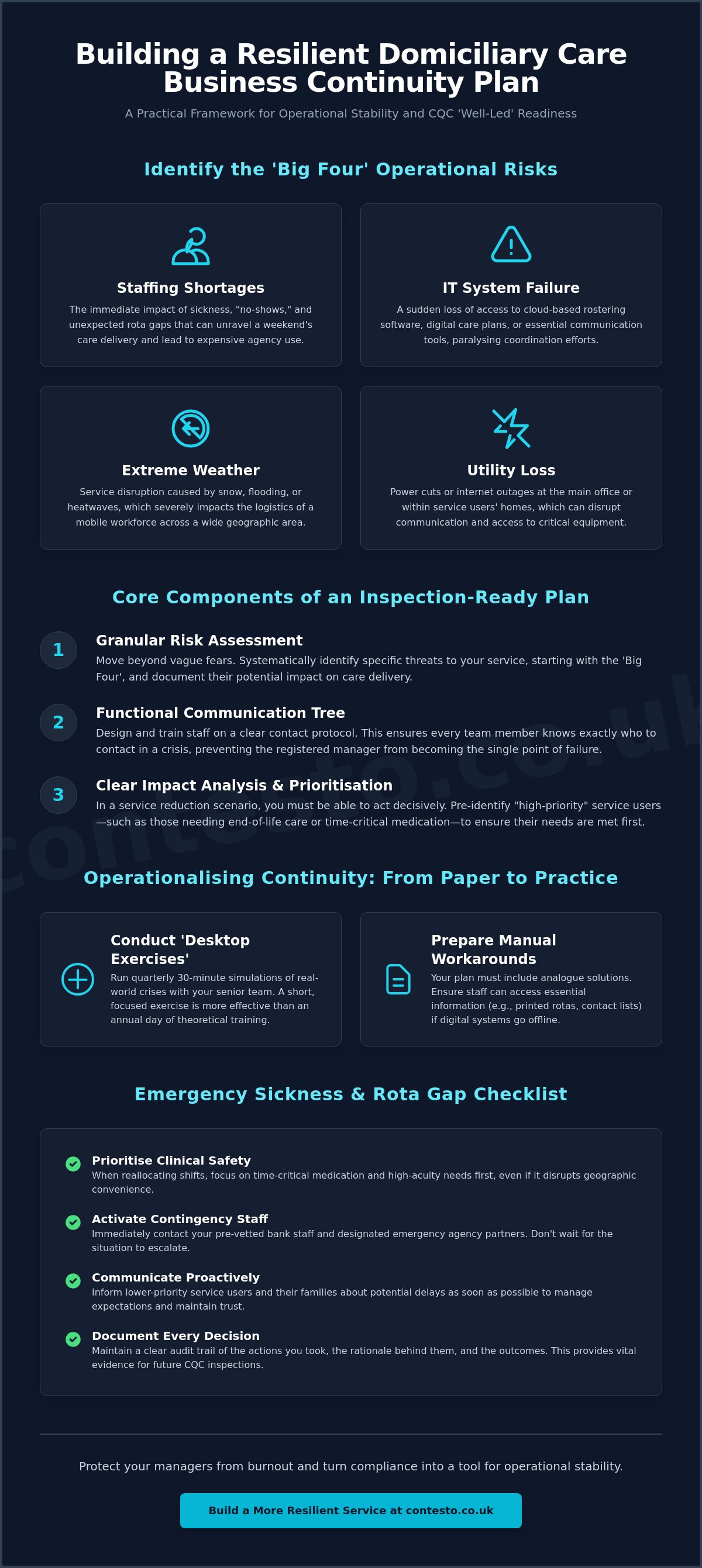
An effective business continuity plan for domiciliary care agency leadership starts with a granular risk assessment. You must move beyond vague fears and identify the "Big Four" specific to home care: staffing shortages, IT system failure, extreme weather, and utility loss at the office or within service user homes. This approach aligns with the principles of Continuity of Operations Planning (COOP), where the focus remains on maintaining essential functions regardless of the threat.
A functional communication tree is equally vital. It ensures that when a crisis hits, every staff member knows exactly who to contact without defaulting to the registered manager. This should be paired with a clear impact analysis. In a service reduction scenario, you must pre-identify "high priority" service users, such as those requiring end-of-life care or time-critical medication, to ensure their needs are met first. If the operational strain of maintaining this readiness feels unsustainable, professional operational support can provide the breathing room your managers need.
Managing Staff Sickness and Rota Gaps
Integrating a business continuity plan for domiciliary care agency resilience into your daily rota management prevents small absences from cascading into full-scale crises. When sickness strikes, you need a defined "trigger" system to recognise when a staffing gap shifts from a standard administrative task to a continuity event. Use this checklist during emergency shift reallocations:
Prioritise clinical safety and time-critical medication over geographic convenience.
Activate your pre-vetted bank staff and emergency agency contacts immediately.
Communicate delays to lower-priority service users to manage expectations early.
Document every decision made to provide a clear audit trail for future CQC inspections.
Operationalising Continuity: From Paper to Practice
A policy is only as strong as the team's ability to execute it under pressure. Many providers fall into the trap of treating their business continuity plan for domiciliary care agency requirements as a "one and done" administrative task. To prevent your plan from becoming a dusty folder in the office, you must integrate it into your regular leadership meetings. A 30-minute "desktop exercise" once a quarter is more effective than a full day of theoretical training. Present your senior team with a specific scenario, such as a sudden regional power cut or a total failure of your digital roster, and ask them to walk through the immediate response steps.
Whilst modern care software provides incredible efficiency, your Business Continuity Plan must include manual workarounds. If your cloud-based system goes offline, your staff need access to an offline version of the day’s visits and emergency contact numbers. This isn't about being old-fashioned; it's about being prepared for the technical vulnerabilities that often occur during wider disruptions. Every near-miss or actual service disruption should trigger a formal review cycle, allowing you to refine your protocols based on real-world performance rather than assumptions.
The 24/7 Pressure Point: Managing Out-of-Hours Emergencies
The "always-on" culture in domiciliary care is a primary driver of manager burnout. A robust continuity strategy addresses this head-on by establishing clear triage protocols. When your on-call team can distinguish between a routine query and a genuine continuity crisis, the number of midnight calls to the Registered Manager drops significantly. This psychological relief is essential for long-term operational stability. If you find your senior team is still being overwhelmed by out-of-hours demands, our 24/7 on-call triage service can act as your first line of defence, ensuring your managers only wake up for the things that truly matter.
Building Long-Term Resilience with Managed Operational Support
Viewing a business continuity plan for domiciliary care agency success as a purely internal responsibility is a common misconception. In an industry where the turnover rate was 30.6% in 2025, relying solely on a small management team to handle every disruption is a risk in itself. Framing outsourced support as a strategic investment rather than an admission of failure allows you to build true resilience. By integrating 24/7 on-call triage into your framework, you create a permanent safety net that operates even when your internal team is at capacity.
This managed approach offers a significant "White-Label" advantage. During a crisis, consistency is vital for maintaining the trust of both staff and service users. Professional partners act as a seamless extension of your office, using your specific protocols and tone of voice to manage incidents. This ensures that a service user's family or a stressed carer receives the same level of care and professional response they expect from your core team, regardless of the hour. It marks the transition from a reactive posture to a proactive, resilient agency model.
Reducing Manager Burnout Through Strategic Partnerships
The most immediate benefit of managed operational support is the drastic reduction in leadership strain. Professional triage services don't just answer the phone; they actively manage staff sickness and shift reallocation whilst strictly adhering to the priorities set out in your BCP. This level of precision is exactly what CQC inspectors look for under the "Well-Led" domain. Demonstrating that your agency has 100% operational coverage through a vetted partnership provides powerful evidence of robust governance.
Ultimately, a business continuity plan is about protecting the most valuable asset in your business: your people. When you have a system that handles the heavy lifting of out-of-hours coordination, you allow your managers to reclaim their evenings and weekends. If you're ready to move away from constant firefighting and towards a more sustainable way of working, it's time to formalise your support. Reach out to see how we can help you secure your agency’s future whilst giving your team the rest they deserve.
Securing Long-Term Stability for Your Care Service
Building a resilient operation requires moving from reactive responses to a structured, strategic framework. We've explored how a robust business continuity plan for domiciliary care agency success relies on more than just a policy folder; it requires active testing, clear triage protocols, and a commitment to protecting your leadership team from burnout. By identifying your high-priority service users and automating emergency responses through a communication tree, you ensure that safety remains constant even during significant disruption.
At Contesto, we provide specialised UK care sector expertise designed to transform your operational resilience. Based in Mayfair and serving providers nationwide, we offer CQC-aligned operational support that acts as your agency's built-in safety net. Discover how Contesto's 24/7 triage can strengthen your agency's business continuity and allow your registered managers to focus on quality care rather than midnight rota gaps.
You don't have to carry the weight of 24/7 responsibility alone. With the right systems in place, you can build a service that is both inspection-ready and sustainable for the long term.
Frequently Asked Questions
Does the CQC require a specific template for a business continuity plan?
No, the CQC doesn't mandate a specific template for your business continuity plan for domiciliary care agency operations. Instead, inspectors look for evidence of robust governance under the "Well-Led" domain and compliance with Regulation 17. Your plan must be bespoke to your service size and the specific needs of your service users to be considered effective during an inspection.
How often should a domiciliary care agency test its business continuity plan?
You should review your plan at least annually, but best practice involves running quarterly "desktop exercises." These short sessions allow your senior team to simulate responses to specific disruptions, such as a localized power cut or a sudden spike in staff sickness. Your business continuity plan for domiciliary care agency management should also be updated immediately after any significant operational change or a "near-miss" incident.
What are the most common risks a home care BCP should address?
The most frequent risks include staffing shortages, IT system failures, extreme weather, and utility loss. With the social care vacancy rate currently at 13%, staffing is often the most critical pressure point for providers. Your plan should also account for digital resilience, ensuring you have manual workarounds if your cloud-based roster system becomes inaccessible.
Can I outsource my business continuity management to a third party?
You can outsource the operational delivery of your continuity strategy, such as on-call triage and rota management, to a specialist partner. Whilst the registered manager remains legally responsible for compliance, professional operational support provides a reliable safety net. This ensures your agency maintains 24/7 coverage and consistent service delivery without placing an unsustainable burden on your internal team.
How do I prioritise service users if I don't have enough staff to cover all calls?
Prioritisation must be based on a pre-defined risk stratification of your service users. Individuals requiring end-of-life care, time-critical medication, or those without any alternative support should be classified as "high priority." During a severe staffing crisis, non-essential social visits or domestic tasks are deferred first to ensure that clinical safety and basic human needs are met for the most vulnerable.


Comments