

How to Handle a CQC Complaint About Staffing: An Operational Response Guide
- Mara

- 6 days ago
- 11 min read
You open your inbox on a Monday morning to find a formal notification from the CQC regarding a complaint about your staffing levels. The immediate instinct is often one of defensiveness; after all, you’ve likely spent the weekend personally covering gaps or pleading with agency coordinators to find a last-minute fix. It’s a high-pressure scenario that feels like a personal critique of your leadership, especially when you’re already battling the exhaustion of constant rota management and staff sickness. You aren't alone in this feeling, as many providers find the pressure of proving safe staffing levels to be the most draining part of the job.
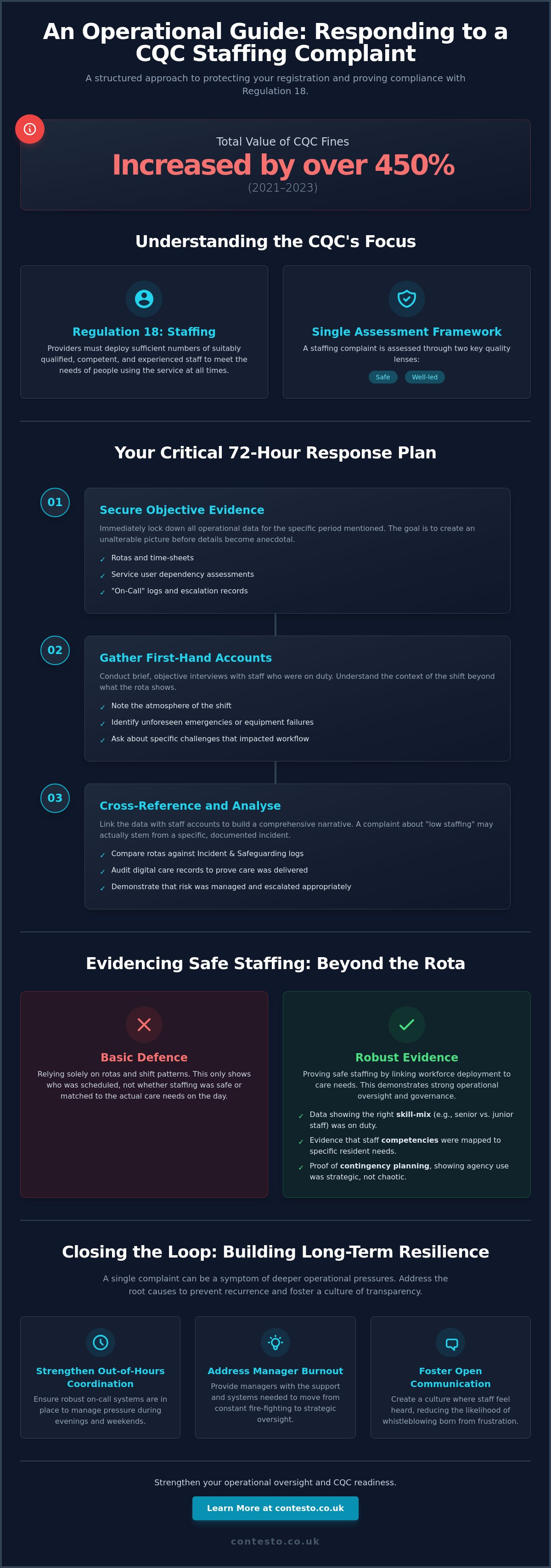
This guide will show you how to handle a CQC complaint about staffing with a calm, operational focus that protects your registration and builds long-term resilience. With the total value of CQC fines increasing by over 450% between 2021 and 2023, the cost of a poorly managed response is simply too high to ignore. We will explore how to construct a successful factual accuracy response, use data to prove compliance with Regulation 18, and implement systems that reduce your dependency on high-cost emergency agencies whilst maintaining total oversight of your service.
Key Takeaways
Understand how Regulation 18 intersects with the Single Assessment Framework to frame your response around the CQC’s specific safety and leadership expectations.
Learn how to handle a CQC complaint about staffing by launching a rapid internal investigation that secures vital evidence like rotas, dependency assessments, and first-hand staff accounts.
Move beyond basic shift patterns to prove safe staffing through data that links your workforce deployment directly to the changing needs of those in your care.
Address underlying operational pressures, such as out-of-hours coordination or manager burnout, to create a culture of transparency and prevent similar complaints from recurring; Core Integrity can help you build these essential frameworks of accountability.
Table of Contents
Deciphering the CQC Staffing Complaint: Intent and Impact
Receiving a notification from the Care Quality Commission (CQC) regarding your workforce deployment is a high-stakes moment for any registered manager. It’s vital to remain objective. Panic leads to defensive, rushed explanations that often raise more questions than they answer. Under the current Single Assessment Framework, a staffing complaint isn't merely a critique of a single shift; it's an inquiry into your operational oversight. Understanding how to handle a CQC complaint about staffing begins with identifying exactly what the regulator is looking for and why they've chosen to intervene at this specific time.
Regulation 18 is the primary focus of these inquiries. It demands that providers have enough qualified, competent, and experienced staff to meet people's needs. The CQC views this through two specific lenses: "Safe" and "Well-led." If you can't prove your staffing levels are safe, inspectors will likely question the effectiveness of your leadership. It's the difference between an isolated sickness event and a systemic failure to manage your rota or provide adequate operational support for your team during peak pressure periods.
The Regulatory Context of Staffing Levels
Safe staffing isn't just a numbers game. Inspectors look at the skill-mix on duty to ensure the right balance of expertise is present. Do you have enough senior staff to supervise junior carers? Are competencies mapped to the specific needs of the residents on that day? Maintaining a robust training matrix with You Can Do It Training Ltd allows you to demonstrate this skill-mix to inspectors during a review. Red flags that often trigger these investigations include a sudden spike in high-cost agency staff or a pattern of missed care calls. If your dependency assessments don't match the numbers on your rota, the CQC will view this as a breach of governance rather than a simple recruitment challenge.
Whistleblowing vs. Operational Grievances
While a complaint might come from a family member, it often stems from staff whistleblowing. Whistleblowers have significant legal protections, and the CQC takes these notifications seriously because they suggest a culture where staff feel unheard. You must distinguish between a genuine systemic failure and an isolated grievance between colleagues. This is where the Nominated Individual plays a crucial role. They must oversee the initial contact, ensuring that the response is evidence-led and reflects the provider's commitment to transparency. Knowing how to handle a CQC complaint about staffing requires a calm, analytical approach to determine if the concern is an outlier or a sign of deeper cultural issues within the service. For providers looking to strengthen their leadership in this area, a legal recruitment agency UK can help find specialists who understand the regulatory landscape.
The 72-Hour Response: Investigating Staffing Concerns Internally
The first 72 hours following a notification are critical. This is your window to move from a reactive stance to an evidence-based one. When considering how to handle a CQC complaint about staffing, your initial move must be to secure all operational data before it becomes anecdotal. This includes locking down rotas, time-sheets, and dependency assessments for the specific dates mentioned. You need a clear, unalterable picture of who was on the floor, what their competencies were, and what the actual care demand looked like at that moment; adopting the meticulous standards of workplace investigation services Australia can ensure your internal data collection is both objective and defensible.
Don't rely solely on digital records. Conduct brief, objective interviews with the staff who were on duty during the period in question. Ask about the atmosphere of the shift, any unforeseen emergencies, or equipment failures that might have impacted their workflow. Cross-reference these accounts with your Incident Reporting and Safeguarding logs. Often, a complaint about "low staffing" is actually a complaint about a delayed response to a specific incident. If you can show that a delay was caused by a medical emergency rather than a lack of personnel, you provide the context needed to satisfy CQC's Regulation 18 on Staffing.
Gathering Objective Evidence
Audit your digital care records to prove care was delivered despite any perceived pressures. If every scheduled task was completed and signed off, the argument for "unsafe staffing" becomes much harder to sustain. Look specifically at your "On-Call" logs. These demonstrate that when pressures rose, you had a system in place to escalate and manage the risk. Using professional rota management data allows you to show contingency planning in action, proving that agency use or shift swaps were strategic decisions rather than signs of a service in crisis. Many providers find that having external compliance monitoring helps identify these gaps before an inspector does.
Communication with the CQC Inspector
Maintain a professional, transparent tone from the outset. While you can request specific details of the allegation, remember that the inspector must protect whistleblower anonymity. Acknowledge the concern promptly. If your internal audit reveals a genuine gap, don't hide it. Instead, present an immediate "Action Plan" that outlines how you've already rectified the issue. This proactive approach shows the CQC that your leadership is responsive and capable of self-correction. Prepare your team for a potential unannounced site visit; if you are confident in your data, a visit is simply an opportunity to demonstrate your operational stability.
Evidencing Safe Staffing: Turning Rotas into Compliance Data
When an inspector challenges your workforce levels, your most powerful defensive tool isn't a verbal explanation; it's your data. Knowing how to handle a CQC complaint about staffing effectively means transforming your rotas from simple shift patterns into a narrative of safe, responsive care. You must be able to demonstrate that every person on duty was there because your dependency assessments required it. If a resident's needs increased during a night shift, your records should show how you adjusted the staffing or utilised your on-call system to maintain safety. This evidence-led approach is the cornerstone of meeting CQC Regulation 18: Staffing.
Operational resilience is proven by how you manage the unexpected. You need to showcase your "Bank" staff usage as a strategic choice rather than an emergency reaction. By prioritising a consistent bank of staff who already know your service's culture and residents, you reduce the risks associated with external agency dependency. Ensure that your records prove every person covering a shift, whether permanent or bank, has completed their mandatory training and induction. A gap in training records during a period of low staffing is a red flag that inspectors will quickly escalate to a "Well-led" concern. To ensure your team is fully compliant with all mandatory requirements, you can learn more about You Can Do It Training Ltd.
The Anatomy of a Compliant Rota
The CQC prioritises "planned vs actual" shift data above almost all other workforce metrics. It's not enough to show a full rota from three weeks ago; you must show who actually worked those hours. If a shift was under-staffed due to last-minute sickness, document the rationale behind your decisions. Did you reassess risks? Did you postpone non-essential activities? Using professional compliance monitoring allows you to spot these rota gaps in real-time, ensuring you have a contemporaneous record of your mitigation efforts before a complaint is even made.
Addressing the Agency Dependency Narrative
High agency use often triggers suspicion, but it doesn't have to lead to a poor rating if managed correctly. Provide evidence that every agency worker undergoes a robust service-specific induction before their first shift. This demonstrates that you value quality over mere "boots on the ground." As you look at scaling your care business, your ability to maintain a consistent staff team amongst national shortages becomes your greatest asset. Show the CQC your long-term recruitment and retention strategy to prove that your current agency use is a controlled, temporary measure.
Ensure your service is always inspection-ready by implementing professional Compliance Monitoring to audit your staffing data before the CQC arrives.
Closing the Loop: Resolving Operational Gaps to Prevent Recurrence
A CQC notification shouldn't be viewed as a dead end. Instead, it's an operational diagnostic tool. Successfully learning how to handle a CQC complaint about staffing requires you to look beyond the immediate rota gap and interrogate the culture that allowed the issue to escalate. If a staff member felt their only recourse was to contact the regulator, your internal "Freedom to Speak Up" mechanisms may need urgent review. Creating a culture where concerns are resolved at the service level is your best defence against future inspections. It's about ensuring your team feels heard before they feel the need to whistleblow.
Building a culture of trust and transparency is vital for ensuring that internal feedback loops work effectively; to see how Core Integrity can support your organisation in this, find out more.
Lessons learned must be formalised within your governance framework. Update your Business Continuity Plan to reflect how you'll manage extreme staffing shortages or sudden clusters of sickness in the future. This isn't just about paperwork; it's about proving to the CQC that you're a learning organisation. By documenting these changes, you turn a past failure into evidence of proactive leadership and robust governance, which are the hallmarks of a "Well-led" service. To further strengthen your management team, you might explore Legal Recruitment with Altum Recruitment to find specialists who can help navigate these regulatory requirements.
Managing Manager Burnout and Out-of-Hours Stress
Staffing complaints are frequently a symptom of manager burnout. When a registered manager is handling 24/7 on-call duties alongside their daytime responsibilities, oversight naturally slips. Fatigue leads to delayed responses to sickness or poor coordination of shift gaps during the night. Professional 24/7 on-call triage provides the breathing room needed for strategic leadership. It allows managers to focus on long-term stability rather than being bogged down by the administrative weight of midnight staff sickness management. This separation of duties ensures that emergency staffing decisions are made clearly, safely, and recorded accurately every time.
Building Long-Term Operational Resilience
Resilience is built through consistency and regular oversight. Make "Safe Staffing" audits a standard, non-negotiable agenda item for your monthly governance meetings. This ensures you're always looking at your data through the eyes of an inspector. Use these sessions to review dependency levels against your rota management effectiveness and identify trends in staff absence before they become systemic. A staffing complaint is a signal to refine your operational architecture. By implementing professional operational support and triage systems, you move from a reactive state to one of quiet confidence, ensuring your service remains both safe and compliant.
Strengthening Your Operational Defences
A staffing complaint doesn't have to result in a "Requires Improvement" rating. By moving swiftly to secure objective evidence, linking your rotas directly to resident dependency, and addressing the cultural gaps that lead to whistleblowing, you demonstrate the high-level governance that inspectors value. Mastering how to handle a CQC complaint about staffing is ultimately about proving that your service is resilient, responsive, and led by data rather than emergency reactions. It's an opportunity to move from a defensive stance to one of professional operational transparency.
True stability comes from having the right support in place before the pressure becomes unmanageable. Our UK-based team acts as a white-labelled extension of your management, providing 24/7 managed operational support that catches issues before they escalate. Discover how Contesto’s 24/7 On-Call Triage protects your compliance and your team’s well-being.
With the right systems and a commitment to transparency, you can navigate these regulatory challenges with confidence and emerge with a stronger, more sustainable service for your staff and those in your care.
Ensuring that every detail of a resident's life is managed with care contributes to this sustainability; for instance, you can explore Watch Battery Replacement with Atoz Watch And Jewellery Repairs to help maintain their personal belongings and daily routines.
Frequently Asked Questions
Can the CQC shut us down because of one staffing complaint?
The CQC rarely closes a service based on a single staffing complaint alone. However, they can issue a fixed penalty fine of £4,000 or even seek unlimited fines through Magistrates' Courts if they find systemic breaches of Regulation 18. Your focus should be on providing a robust factual response that demonstrates the safety and leadership of your service to prevent these enforcement actions from escalating into registration reviews.
Do I have to tell the staff member who made the complaint that I know it was them?
You aren't required to confront a staff member, and doing so often creates significant legal risks regarding victimisation. Whistleblowers have strong legal protections in the UK care sector. Instead of identifying the source, use the feedback to audit your internal culture. Focus on how to handle a CQC complaint about staffing by reviewing your systems and proving that your workforce deployment was safe, regardless of who raised the concern.
What is a "Safe Staffing" level according to CQC guidelines?
There is no single "Safe Staffing" ratio mandated by the CQC; instead, levels must be dictated by the specific dependency of your residents. Regulation 18 requires you to have enough qualified and competent staff to meet people's needs at all times. For those looking to benchmark their service delivery against high standards, it can be useful to explore Personal Care models that prioritise person-centred support. You prove compliance by showing that your rota was built using a recognised dependency tool and that staff competencies were mapped to the clinical or social needs of the individuals on that shift.
How should I respond if the CQC staffing complaint is clearly malicious?
Even if a complaint appears malicious, you must treat it with the same level of objective professionalism as a genuine concern. Avoid emotive language in your response to the inspector. Provide clear, data-driven evidence such as time-sheets, induction records, and dependency assessments. If your records are meticulous and prove that safe care was delivered, the motive behind the complaint becomes irrelevant to the CQC's final assessment.
Will a staffing complaint automatically trigger an unannounced inspection?
A complaint doesn't automatically trigger an unannounced inspection, but it does shift your service's risk profile within the Single Assessment Framework. The CQC uses a risk-based approach to prioritise inspections. If your initial response is defensive or lacks evidence, the likelihood of a site visit increases. Providing a transparent, evidence-led explanation of how to handle a CQC complaint about staffing can often satisfy an inspector's initial enquiries without the need for an immediate visit.
How can I prove our staffing is safe if we use a lot of agency workers?
High agency use is defensible if you can prove those workers were properly inducted and competent for their roles. Keep a file of agency staff profiles, signed induction checklists, and evidence of their training. If you use the same agency personnel regularly, highlight this to show a "consistent staff team." This proves that whilst you are using external resources, the quality and continuity of care remain uncompromised.


Comments