

Registered Manager On-Call Requirements: A Cost-Benefit Analysis for UK Providers
- Mara

- Jun 11
- 8 min read
What if the most expensive part of your out-of-hours provision isn't the cost of a dedicated service, but the hidden price of asking your leadership team to work around the clock? For many providers, meeting the registered manager on-call requirements in the UK often feels like an impossible choice between regulatory compliance and staff burnout. You've likely seen the cycle first-hand; a manager handles a 2 a.m. sickness call, spends the following morning struggling to fill rota gaps, and eventually reaches a breaking point that leads to a costly resignation.
It's easy to agree that the current pressure on UK care leadership is unsustainable, especially when poorly managed sickness leads to spiralling agency spend and the constant fear of a CQC Well-Led downgrade. This article will help you look beyond surface-level payroll figures to quantify the true financial and operational impact of outsourcing your triage. We'll examine how protecting your managers' downtime actually protects your margins, reduces your reliance on emergency staffing, and ensures your out-of-hours records remain consistently audit-ready.
Key Takeaways
Quantify the hidden financial impact of management exhaustion on daytime operational efficiency and senior staff retention.
Reduce reliance on expensive emergency agencies by using professional triage to prioritise internal bank staff during out-of-hours shifts.
Navigate registered manager on call requirements UK with a data-backed framework that ensures every incident is documented for CQC inspections.
Identify why software alone fails to solve complex rota gaps and how managed support provides a scalable solution for sickness management.
Calculating the Hidden Costs of In-House On-Call Support
Many providers view on-call as a "free" resource because managers are salaried. This is a financial fallacy. Meeting registered manager on call requirements UK shouldn't mean sacrificing your most expensive asset to handle basic rota gaps at 3 a.m. When a senior leader is woken up to manage a simple sickness call, the cost isn't just the lost sleep; it's the erosion of their daytime capacity to lead. Sleep deprivation doesn't just cause fatigue. It actively impairs the quality of clinical decision-making and reduces daytime productivity to a fraction of its potential.
Management Time vs. Operational Tasks
Consider the hourly value of a Registered Manager. Whilst their salary might sit between £35,000 and £45,000, their actual value lies in business growth and compliance. Every hour spent on administrative triage is an hour taken away from essential audits or staff development. This friction often conflicts with UK labour law regarding compensatory rest, creating a compliance loophole that puts the business at risk. If your manager is too exhausted to perform a daytime clinical review, the business carries the weight of that missed opportunity. Professional on-call triage ensures that your leadership team focuses on the high-value tasks they were hired to perform.
The Financial Weight of Staff Turnover
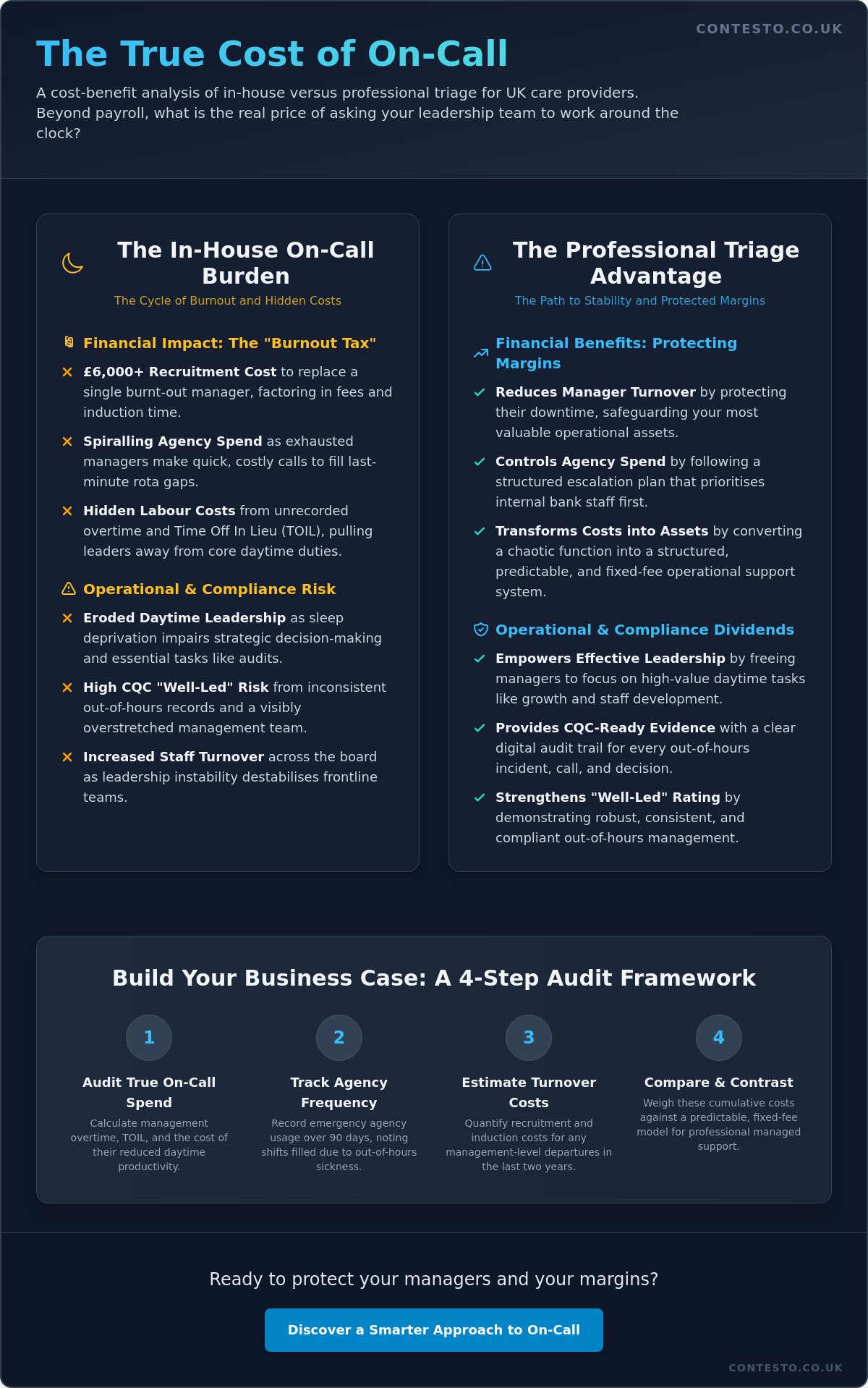
The true "Burnout Tax" appears in your recruitment budget. Replacing a care manager can cost a provider upwards of £6,000 when accounting for recruitment fees, induction time, and the temporary loss of leadership. An always-on culture is the primary driver of the current leadership crisis in social care. High turnover doesn't just hurt the P&L; it destabilises frontline teams. When managers quit due to on-call fatigue, the resulting instability often leads to frontline staff following them out the door, further increasing your reliance on expensive agency cover.
Quantifying the Economic Benefits of Professional Triage
Effectively managing registered manager on call requirements UK requires a balance between safety and financial pragmatism. Moving away from an in-house model isn't just about manager wellbeing; it's a strategic move to stabilise your bottom line. Professional triage transforms the out-of-hours function from a chaotic cost centre into a structured operational asset. By prioritising internal bank staff and existing team members during late-night sickness calls, providers can significantly reduce their reliance on emergency agencies. This shift protects margins that are often eroded by the heavy markups common in last-minute staffing requests.
Curbing Emergency Agency Spend
When a manager is woken at 4 a.m., their priority is often the quickest solution rather than the most cost-effective one. This often results in a call to an agency with high premium rates just to ensure the shift is covered. A professional 24/7 on-call triage service follows a structured escalation plan, exhausting all internal rota options before committing to external spend. This proactive approach prevents the common "double-booking" errors that occur when sleep-deprived managers try to update digital rotas manually the next morning. It's about precision, not just speed.
Regulatory Dividends: CQC and Compliance
Compliance is often won or lost in the details of out-of-hours records. Under CQC Regulation 7 requirements, registered managers must demonstrate they have the necessary skills and time to lead effectively. If a manager is constantly managing emergencies at night, their daytime leadership inevitably suffers. This creates a gap in oversight that inspectors quickly identify.
Meeting the complex registered manager on call requirements UK is much simpler when you have a digital audit trail for every incident. Digital logs provide clear evidence of how incidents were handled, safeguarding concerns were raised, and staffing was maintained. This transparency is invaluable during a CQC inspection, directly supporting a Well-Led rating. A Good or Outstanding rating isn't just a badge of honour; it's a commercial necessity that drives business growth and attracts higher-quality staff.
A Step-by-Step Cost-Benefit Analysis Framework
To move from reactive decision-making to a sustainable model, providers must look at the hard data behind their out-of-hours provision. Meeting registered manager on call requirements UK isn't just a compliance tick-box; it's a significant budgetary line item. You can build a clear justification for the board by following this four-step audit:
Audit your true on-call spend: Include management overtime and the cost of Time Off In Lieu (TOIL), which often results in senior staff being absent during peak daytime hours.
Track agency frequency: Record the cost of emergency agency usage over a 90-day period, specifically noting shifts filled due to poorly triaged out-of-hours sickness.
Estimate turnover costs: Calculate recruitment fees and induction costs for any management-level departures over the last two years.
Compare against managed support: Contrast these cumulative figures against a fixed-fee model for professional on-call triage to identify potential savings.
Direct vs. Indirect Financial Metrics
Leaky costs often hide in the gap between a manager's official hours and their actual workload. The Registered manager role category guidance highlights the broad leadership responsibilities these professionals carry. When they're bogged down by administrative triage whilst off-duty, you're paying a premium for a task that could be handled more efficiently by a dedicated service. Setting KPIs for an outsourced partnership, such as a percentage reduction in agency spend, ensures you see a measurable ROI.
Evaluating Long-Term Operational Stability
Beyond the balance sheet, consider the impact on your team's growth capacity. If your leadership team is constantly exhausted, they cannot focus on business development or service expansion. Balancing the registered manager on call requirements UK with a healthy work-life balance is essential for long-term retention. Improved manager morale is a "soft" benefit with "hard" financial consequences; a stable, rested manager is more likely to stay, providing the continuity your service users deserve.
Strategic Alignment: Integrating Managed Support into Your Care Business
Software is often marketed as a silver bullet for scheduling, but digital tools lack the critical judgment required for complex sickness management. A notification on a screen doesn't fill a shift; a person does. Relying solely on tech often leaves the heavy lifting to your team, which fails to truly address registered manager on call requirements UK. Strategic alignment means choosing a solution that combines technical efficiency with human intelligence, ensuring that out-of-hours incidents are resolved, not just logged.
Think of an outsourced partner as a white-labelled extension of your office. Staff and families shouldn't feel a shift in quality when the sun goes down. By using an integrated service, your brand reputation remains intact because the response is calm, informed, and aligned with your specific protocols. This professional veneer reassures your workforce that they're supported by a robust system, which is a powerful tool for staff retention in a competitive market.
Freeing up your leadership team isn't just about avoiding burnout. It's about redirection. When your managers aren't bogged down by midnight administrative triage, they can focus on strategic growth in the care sector. This might include exploring new tender opportunities, refining daytime care quality, or developing internal training programmes that add long-term value to the business.
Maintaining Quality and Culture
Every care business has its own unique operational DNA. A successful partnership relies on a seamless handover where the out-of-hours team understands your local policies as well as you do. This ensures that the culture you've built during the day isn't compromised by a generic or disconnected response at night. When your registered manager on call requirements UK are met by professionals who respect your organisational values, you create a unified front for both staff and inspectors.
Next Steps for Operational Resilience
Transitioning away from a reactive model is the first step toward true operational stability. It moves the business from a state of constant fire-fighting to one of proactive, calm management. If you're ready to protect your margins and your managers, you can learn more about our 24/7 on-call triage and how it fits into your wider strategy for resilience and growth.
Securing Your Operational Future
Moving away from a model of reactive crisis management toward a professionalised triage system is a commercial necessity for modern providers. We've explored how the hidden costs of management turnover and emergency agency spend can quietly erode your margins. By meeting registered manager on call requirements UK through a dedicated partnership, you ensure that your leadership team remains rested and focused on daytime quality and business growth. This shift doesn't just protect your budget; it stabilises your entire workforce and ensures your service remains audit-ready at all times.
Contesto acts as an integrated extension of your internal team, providing specialised UK social care expertise and deep CQC awareness. Our focus on service continuity helps you reduce manager burnout whilst maintaining a robust digital audit trail for every out-of-hours incident. You can calculate your potential savings with a Contesto operational audit to see exactly how much your current model is costing you. Building a more resilient care business starts with protecting the people who lead it. You have the tools to make this change today.
Frequently Asked Questions
Is it more cost-effective to pay managers for on-call or to outsource the service?
Outsourcing is often the more financially prudent choice once you account for the premium value of senior management time. Whilst paying an internal manager might seem cheaper on paper, it frequently leads to expensive TOIL or overtime payments that drain your budget. A managed service provides a fixed, predictable cost that protects your leadership's daytime capacity for strategic work and essential compliance audits.
How does an outsourced on-call service help reduce care agency spend?
Managed triage services reduce agency dependency by following a rigorous internal-first staffing protocol. Unlike a tired manager who might call an agency for a quick fix at 2 a.m., a professional triage team systematically contacts your internal bank and existing staff. This disciplined approach ensures shifts are filled at standard rates, protecting your margins from the high premiums of emergency agency bookings.
What are the hidden costs of manager burnout in the UK social care sector?
The most significant hidden cost is the erosion of service stability and the eventual departure of experienced leaders. Meeting registered manager on call requirements UK through an always-on internal model often leads to a "burnout tax" of high turnover and recruitment fees. This instability can also trigger CQC concerns, as exhausted managers may struggle to maintain the high standards of daytime oversight required for a Good or Outstanding rating.
Can an external triage service maintain our CQC compliance and Well-Led standards?
External triage services support CQC compliance by providing a consistent, digital audit trail for every out-of-hours incident. Inspectors value the transparency and reliability of professional logs, which demonstrate that your service is safely managed around the clock. This proactive approach to risk management directly contributes to the Well-Led domain by showing you've implemented a scalable, sustainable leadership framework.
How much does it typically cost to replace a Registered Manager in the UK in 2026?
Replacing a Registered Manager in the UK typically costs upwards of £6,000, including recruitment agency fees and the cost of induction training. This figure reflects the high demand for qualified leaders in the social care sector. When you factor in the temporary loss of leadership and the impact on staff morale, the total operational cost of a resignation is often much higher than the price of preventative support services.


Comments