

Care Rota Costs: Calculating the True Operational Burden for UK Providers
- Mara

- 6 days ago
- 7 min read
Updated: 1 day ago
It's 3 AM on a Tuesday, and your phone is vibrating on the bedside table. A staff member has called in sick for an early morning double-up, and within minutes, your profit margin for the day is set to vanish into an agency worker’s premium rate. For many UK domiciliary providers, this isn't a rare emergency; it's a weekly reality that makes managing care rota costs feel like an impossible balancing act.
You already know that the £12.71 National Living Wage is just the tip of the iceberg. Between employer National Insurance, pension contributions, and the staggering £7,870 it costs to recruit and train a single replacement, the financial pressure is relentless. This article provides a clear framework to calculate the true operational burden of your scheduling. We'll identify exactly where your budget is leaking through indirect expenses and the hidden administrative drain of manual triage. By the end, you'll have a roadmap to reduce agency dependency, satisfy CQC requirements, and finally give your managers the breathing room they need to lead effectively.
The Direct and Indirect Financial Impact of Rota Management
Calculating care rota costs requires looking far beyond the monthly software invoice. While a scheduling platform might only cost £100, the true expenditure includes the skilled labour required to operate it and the financial fallout of every unfilled shift. Effective Workforce management involves balancing these fixed technical fees against the high variable costs of administrative intervention and reactive staffing decisions.
Fixed vs Variable Costs in Scheduling
Most providers treat software as their primary scheduling expense, yet the administrative burden of managing bank workers and processing complex payroll often dwarfs the subscription fee. Per-user pricing models can also penalise growth, creating a hidden tax on every new hire you bring into the business. These fixed costs are predictable, but they fail to account for the countless hours your office team spends correcting data, chasing timesheets, or manually adjusting schedules to meet changing client needs.
The Reactive Cost Factor
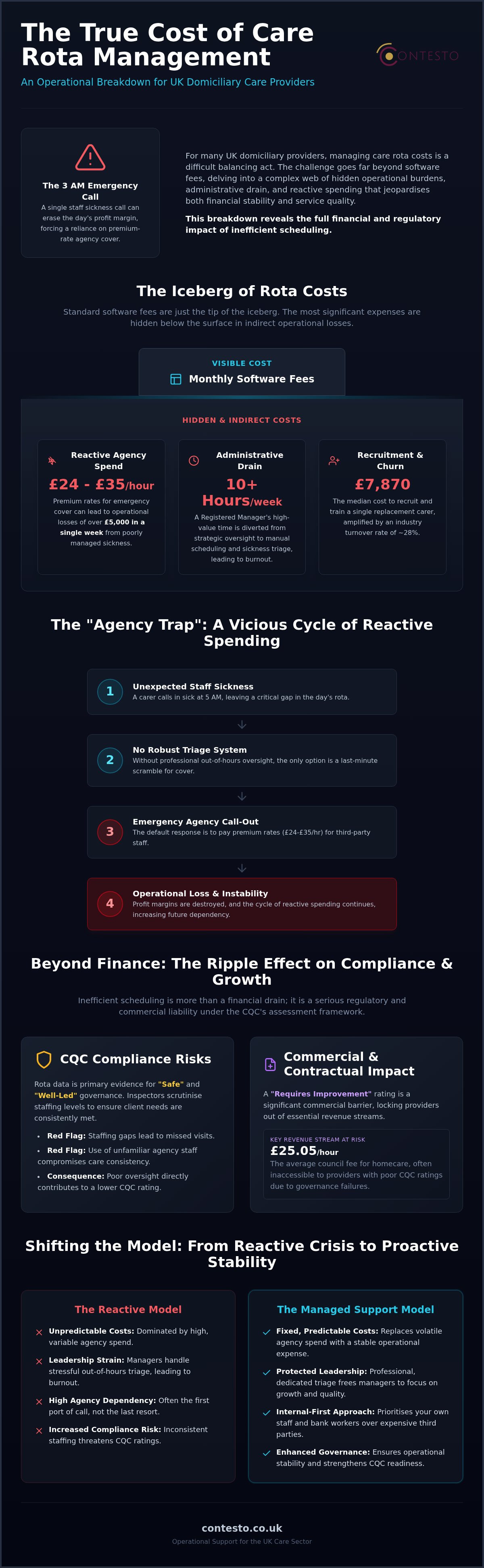
The real budget killer for home care providers is the "Agency Trap." It's an expensive cycle. When a carer calls in sick at 5 AM and there is no robust triage in place, the default response is often an emergency agency call-out. With agency rates for standard domiciliary care currently ranging from £24.00 to £35.00 per hour, a single week of poorly managed sickness can quickly result in a £5,000 operational loss. This reactive spending isn't just a staffing issue; it's a direct result of poor rota visibility and the lack of professional out-of-hours oversight. Stabilising these variable care rota costs requires moving away from reactive crisis management towards a managed approach that prioritises internal staff and bank workers over expensive third-party cover.
Beyond the Software: Calculating Administrative Labour Costs
While software vendors often promise "rotas in minutes," the reality for a Registered Manager is typically hours spent tethered to a spreadsheet. Admin drain is the primary barrier to scaling a UK care business, as it consumes the leadership capacity required for growth. These hidden care rota costs manifest in high-value hours diverted from strategic oversight to reactive coordination.
The Real Value of a Manager’s Hour
A Registered Manager is one of your most expensive and vital assets. When they spend upwards of ten hours a week manually adjusting schedules or handling sickness triage, you aren't just paying for admin; you're misallocating high-level expertise. The true cost includes the "broken sleep" factor. A manager woken at 3 AM to fill a gap rarely operates at peak productivity during the following day's CQC preparation or local authority negotiations. This fatigue leads to slower decision-making and a diminished ability to focus on service quality or business development. Every hour spent on a spreadsheet is an hour not spent on staff mentorship or client relationship management; these are the activities that actually drive revenue.
Burnout and Recruitment Costs
The Performance Tracker 2025 highlights the severe workforce stability issues currently facing the sector. With annual staff turnover in adult social care sitting at approximately 28%, the financial impact of leadership churn is devastating. Replacing a manager who leaves due to on-call exhaustion costs significantly more than the £7,870 median fee for a frontline carer, pushing your total care rota costs even higher. It involves lost institutional knowledge, disrupted compliance, and potential team fragmentation. Protecting your leadership from burnout through professional operational support isn't just a wellbeing initiative; it's a vital strategy for long-term financial stability.
The High Price of Inefficiency: Agency Spend and Compliance Risks
Inefficient scheduling is more than a financial drain; it is a regulatory liability. Under the CQC’s current assessment framework, inspectors scrutinise how effectively you manage staffing levels and out-of-hours emergencies. High care rota costs are often a symptom of poor operational oversight, where a lack of visibility leads to inconsistent care and safety risks. During an inspection, your rota data serves as primary evidence of "Safe" and "Well-Led" governance, proving that you maintain sufficient, competent staff to meet client needs.
CQC Compliance and Financial Stability
There is a direct link between consistent staffing and positive service user outcomes. When sickness is managed poorly, the resulting gaps lead to missed visits or the use of unfamiliar agency staff, both of which trigger red flags for the CQC. A "Requires Improvement" rating isn't just a badge of shame; it’s a commercial barrier that prevents you from winning new local authority contracts. With the average council fee for homecare currently sitting at £25.05 per hour, providers cannot afford to be locked out of these essential revenue streams due to avoidable governance failures.
Reducing Agency Spend Through Better Coordination
Agency dependency is often a failure of triage rather than a simple lack of available bodies. Across the sector, agency and bank staff usage accounts for over 8% of filled posts, yet many providers default to expensive agency call-outs before exhausting their own internal bank workers. Proactive coordination ensures that when a staff member calls in sick, the first response is to utilise existing capacity. This shift from reactive to proactive management is essential if you want to learn how to scale a care business whilst keeping overheads under control. Establishing a resilient, CQC-compliant operation requires moving away from emergency staffing towards a professionalised, 24/7 oversight model.
Optimising Your Budget: The Case for Managed Rota Support
Many providers invest in software expecting it to solve their scheduling woes, yet software alone cannot answer a sickness call at 3 AM. Moving from a "Software-Only" model to managed operational support shifts the weight of care rota costs from a variable, crisis-driven burden to a predictable, fixed line item. This transition allows your leadership team to step away from reactive coordination and return to the strategic work that actually grows the business.
The ROI of Outsourced Triage
The financial argument for professional triage is clear when you compare service costs against the high price of manager turnover. Replacing a Registered Manager who resigns due to on-call exhaustion is a significant blow to both your culture and your bottom line, far exceeding the median £7,870 recruitment cost of a frontline worker. Professional triage reduces agency spend by ensuring your internal bank and permanent staff are always the first choice for cover. By removing the "agency-first" default that often occurs during tired, late-night decision-making, you stabilise your margins whilst protecting the wellbeing of your most valuable leaders.
Building a Resilient Operation
True operational continuity requires a system that functions 24/7 without relying on the physical stamina of a single individual. When you partner with a professional service to handle out-of-hours sickness management and compliance monitoring, you build a more resilient, CQC-compliant operation. This peace of mind is invaluable, allowing you to present a "Well-Led" service to inspectors and local authority commissioners alike. Your next step should be a thorough "Rota Audit" to identify where administrative time is being wasted and where agency spend is leaking. You can discover how Contesto manages your rota and triage costs to help you reclaim your time and stabilise your operational budget.
Reclaiming Operational Stability in Home Care
Managing a domiciliary service is a relentless challenge, but your budget shouldn't be a casualty of reactive scheduling. We've explored how care rota costs extend far beyond software fees, encompassing the heavy price of manager burnout and the high premium of emergency agency cover. By shifting from a crisis-led approach to a managed operational model, you can protect your margins and ensure your Registered Manager stays focused on service quality rather than sickness triage.
Contesto acts as a white-labelled extension of your team, providing 24/7 on-call triage and professional rota management delivered by UK-based operational experts. This ensures service continuity whilst significantly reducing your reliance on expensive third-party staffing. Book an Operational Review with Contesto today to identify your hidden leaks and build a more resilient, CQC-compliant future for your business. You have the power to stabilise your operations; it starts with a smarter approach to your workforce.
Frequently Asked Questions
How much does care rota software typically cost in the UK?
Software licenses in the UK typically range from £1.50 to £3.00 per user, whilst flat-fee subscriptions often start around £100 per month. These figures are only a small part of the total. You must also factor in the administrative labour required to maintain the system and the cost of training staff. The software is just a tool; the real expense is the skilled time needed to manage it effectively every day.
What are the hidden costs of manual rota management?
The heaviest hidden care rota costs are found in senior management time and leadership turnover. When a Registered Manager spends significant hours fixing schedules, you're paying a high salary for administrative tasks. Manual errors also lead to missed visits, which damage your reputation. The stress of manual on-call duties also contributes to the sector's high turnover, with recruitment and training for one new carer costing an estimated £7,870 according to industry data.
How can I reduce my care agency spend through better rota planning?
You can lower agency spend by prioritising your internal bank and permanent staff through proactive coordination. Most agency dependency is a result of reactive decision-making during late-night sickness calls. By implementing professional triage, you ensure that internal options are exhausted before calling an agency. This approach avoids premium hourly rates, which often exceed £30.00, and ensures that service users receive care from staff who already know their needs.
Is it more cost-effective to outsource my on-call triage?
Outsourcing is often more economical because it converts unpredictable crisis spending into a fixed, manageable fee. Managing on-call in-house often leads to manager burnout, which is far more expensive to rectify than paying for professional support. A managed service provides 24/7 continuity and ensures that sickness is handled objectively. This professional oversight directly lowers your total care rota costs by reducing the "agency-first" default that often occurs during late-night emergencies.
How does rota management affect my CQC rating?
Rota management is a primary focus for the CQC under the "Safe" and "Well-Led" domains. Inspectors look for evidence of safe staffing levels and consistent care delivery. Poorly managed rotas that rely heavily on unfamiliar agency workers or result in missed visits are major red flags. Demonstrating a robust, resilient system for managing sickness and emergencies proves that your service has the strong governance required for a "Good" or "Outstanding" rating.


Comments