

CQC Rota Requirements: A Manager’s Guide to Compliance and Evidence
- Mara

- Aug 18
- 7 min read
Updated: 1 day ago
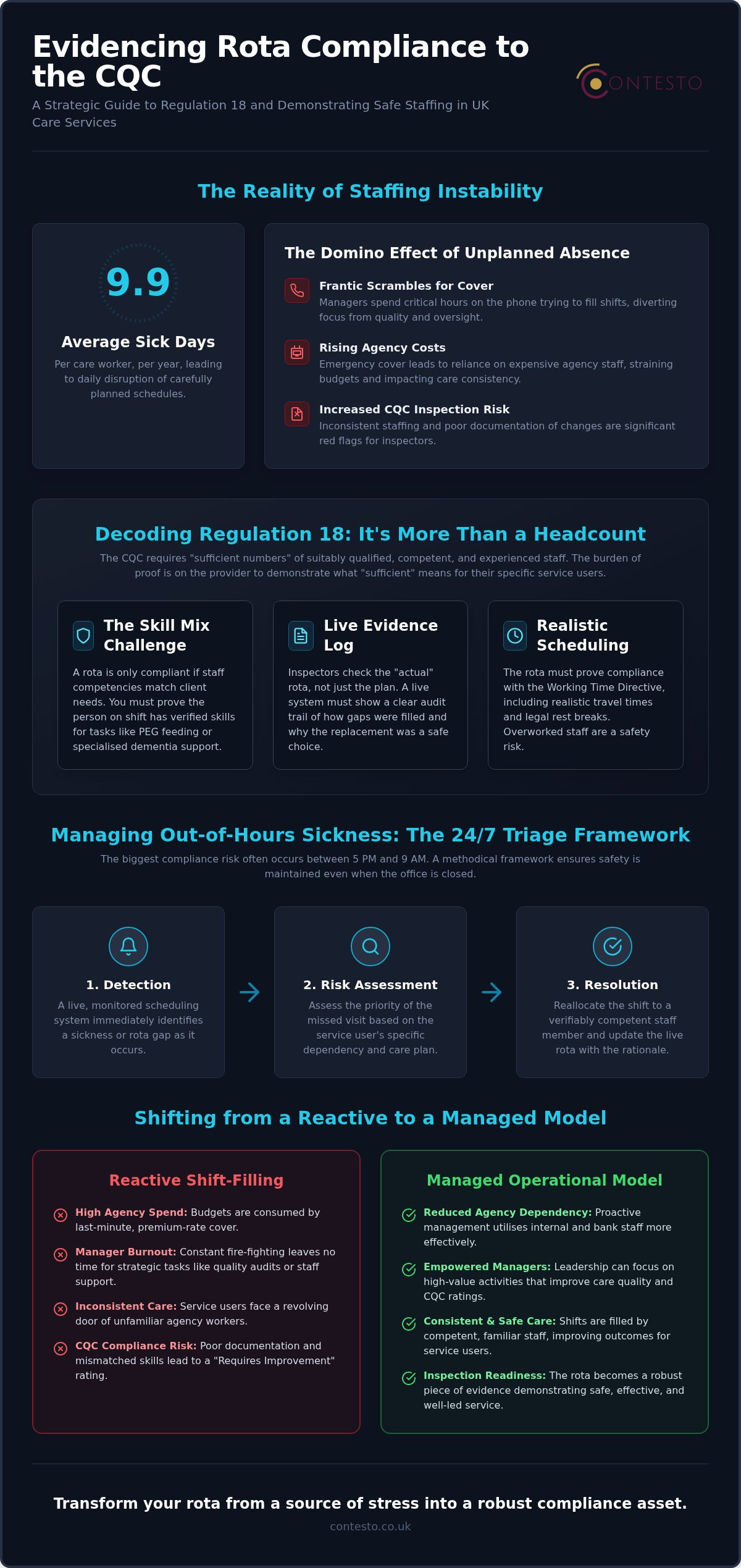
With the average care worker taking 9.9 sick days every year, your carefully planned staffing schedule can fall apart before the first shift even begins. It's a reality most care managers know too well; the frantic morning calls, the mounting agency invoices, and the nagging worry that a CQC inspector might walk through the door whilst you're still scrambling for cover. Figuring out how to evidence rota compliance to cqc isn't just about showing a list of names. It's about proving that your service remains safe and effective even when the unexpected happens.
You already know that "sufficient numbers" is a subjective term that keeps many managers awake at night. We promise to help you bridge that gap by aligning your staffing schedules with CQC Regulation 18. This guide provides a strategic roadmap to ensure operational stability and inspection readiness. We will explore how to transform your rota from a source of stress into a robust piece of evidence that demonstrates safe staffing levels and reduces your dependency on expensive agency support.
Understanding Regulation 18: Beyond the Staff Headcount
Regulation 18 is the regulatory requirement to ensure staff are competent and numerous enough to meet all care needs. Whilst the Care Quality Commission (CQC) mandates "sufficient numbers" of workers, they don't provide a rigid staff-to-user ratio for domiciliary care. This flexibility places the burden of proof on you. To understand how to evidence rota compliance to cqc, you must look beyond the headcount and focus on the specific dependencies of those you support. A compliant rota proves that travel times are realistic and that staff aren't working through their legal rest breaks, ensuring both worker well-being and service safety.
The Skill Mix Challenge
A "full" rota can still trigger a "Requires Improvement" rating if the competencies on shift don't align with care plans. If a service user requires PEG feeding or specialised dementia support, your schedule must explicitly show that the assigned worker holds those specific, verified skills. Recording these metrics within your scheduling system allows you to demonstrate a safe match between staff ability and service user necessity. It isn't enough to have a body in a house; that body must have the right knowledge to deliver the care promised in the support plan.
Evidence of Deployment
Inspectors aren't just interested in your "planned" rota; they want to see the "actual" record of care delivery. This requires moving from a static document to a live evidence log. When staff sickness occurs, you need a clear audit trail of how the gap was filled and why a specific reallocation was safe. Effective rota management involves capturing these emergency decisions to show that even under pressure, your deployment remains methodical. Documenting the rationale behind out-of-hours changes proves that your service maintains oversight, even when the management team isn't physically in the office.
Evidencing Staffing Sufficiency for CQC Inspections
Under the "Safe" domain of the Single Assessment Framework, inspectors look for tangible proof that you've deployed enough suitable staff. Your rota isn't just a list; it's your primary defence. When considering Regulation 18: Staffing, the CQC evaluates whether the mix of qualifications on the ground matches the complexity of your service users' needs. Professional rota management ensures every shift is accounted for, eliminating the unallocated visits that often trigger red flags during a desk-based review.
Proving Competency on the Rota
Understanding how to evidence rota compliance to cqc requires a granular approach to staff skill sets. Digital tagging allows you to filter shifts by specific competencies, such as medication administration or end-of-life care, proving a balanced team is always present. This methodology also supports Regulation 19 by documenting the induction of new or bank staff directly within the schedule. It ensures they aren't deployed until their training is verified, creating a clear audit trail that links staff suitability with shift allocation.
Managing Travel Time and Wellbeing
The CQC increasingly assesses the "human factor" behind the numbers. Overworked staff rushing between domiciliary visits are a safety risk. You must prove your scheduling respects the Working Time Directive and includes realistic travel windows between calls.
Demonstrating that your rota protects staff from burnout shows a well-led service that prioritises both employee welfare and service user safety. If your records show staff consistently working long shifts without breaks, inspectors will question your oversight. By maintaining this level of detail, you can discover how Contesto’s managed operational support keeps your care service inspection-ready without the administrative burden falling solely on your internal team. Proactively managing these variables is the most effective way to show how to evidence rota compliance to cqc during a busy inspection window.
Maintaining Compliance During Staff Sickness and Out-of-Hours
The biggest risk to a "Good" rating often lies in what happens between 5 PM and 9 AM. Unplanned staff sickness during these hours tests the resilience of your governance and your ability to maintain safety when the office is closed. For many domiciliary providers, the struggle is not just filling the gap, but ensuring the replacement possesses the specific competencies required for that client. Managed on-call triage ensures that shift reallocations are handled according to policy, even in the middle of the night. This level of oversight is precisely how to evidence rota compliance to cqc when an inspector asks how you maintain safety during out-of-hours emergencies.
The 24/7 Triage Framework
Effective sickness management requires a methodical approach that prioritises service user safety over simple shift completion. A robust framework follows three essential steps:
Detection: Identifying a sickness or gap immediately via a monitored, live scheduling system.
Risk Assessment: Assessing the priority of the missed visit based on service user dependency and care plans.
Resolution: Reallocating the shift to a competent staff member whilst updating the live rota to provide an immediate audit trail.
Reducing Agency Dependency
Poor out-of-hours coordination often leads to a knee-jerk reliance on expensive agency staff. When you have clear visibility of your own bank team's availability and skills, you can fill gaps internally with greater confidence. This operational stability does more than just lower recruitment costs; it ensures service users receive care from familiar faces who understand their specific preferences. CQC views chronic manager burnout from out-of-hours pressure as a significant leadership risk. By removing the administrative weight of midnight shift-filling, you demonstrate a well-led service that protects its management team from exhaustion. If you want to stabilise your workforce and ensure every shift remains compliant, explore Contesto’s 24/7 staff sickness management and on-call triage services.
Strategic Rota Management: Scaling Your Care Service Safely
Scaling a care business is a test of operational stamina. Moving from reactive shift-filling to a managed model is the only way to protect your rating whilst growing your hours. Outsourcing on-call triage and rota management gives you the breathing room to focus on quality audits and stakeholder engagement. Just as specialised music service management software streamlines the administration of performing arts services, this professional support ensures your rota acts as a robust piece of evidence for both the "Well-Led" and "Safe" domains, proving your oversight remains firm.
An integrated extension of your team provides the oversight needed to spot compliance gaps early. Continuous compliance monitoring is essential for maintaining a high CQC rating whilst you expand. It ensures that your growth is sustainable, compliant, and safe. By stabilising your day-to-day operations, you create a culture of transparency that inspectors value. For a detailed guide on this transition, read How to Scale a Care Business in the UK: A Strategic Operational Roadmap.
The Contesto Approach to Rota Integrity
We prioritise service continuity by removing the administrative weight from your leadership team. Every shift reallocation follows your specific policies and governance frameworks precisely. This level of detail is exactly how to evidence rota compliance to cqc during an assessment. By treating the rota as a live record of your commitment to safety, you provide inspectors with a transparent audit trail. This managed approach transforms your scheduling from a daily headache into a strategic asset that supports your long-term vision for the service, ensuring you remain inspection-ready at every stage of your growth.
Securing Your Service’s Operational Future
Transforming your rota from a static document into a dynamic evidence log is the most effective way to protect your rating. We've explored how Regulation 18 demands more than just a full headcount; it requires a documented synthesis of staff skills, realistic travel times, and resilient out-of-hours responses. By prioritising these strategic elements, you move away from the stress of reactive shift-filling and towards a model of operational calm. Mastering how to evidence rota compliance to cqc ensures that when an inspector reviews your records, they see a service that is safe, well-led, and consistently stable.
As UK social care compliance specialists, we understand that scaling requires robust oversight. Having a partner can remove the administrative weight of 24/7 on-call triage and sickness management. Discover how Contesto’s managed operational support keeps your care service inspection-ready through our expert rota management and dedicated support. With the right systems in place, you can focus on what matters most: delivering high-quality care that changes lives.
Frequently Asked Questions
What are the specific CQC staffing ratios for home care?
The CQC doesn't mandate specific staffing ratios for home care services. Instead, Regulation 18 requires you to determine "sufficient numbers" based on the assessed needs and dependency levels of your service users. You must demonstrate that your staffing levels are determined by a systematic approach that considers travel times, the complexity of care tasks, and the geographical spread of your visits to ensure safety and effectiveness.
How does Regulation 18 affect my use of agency staff?
Regulation 18 doesn't prohibit the use of agency staff, but it requires them to be suitably qualified and competent for their specific roles. You must ensure that any agency worker has received a proper induction and that their skills match the requirements of the service users they support. High agency usage can flag concerns about service continuity, so you should document how you maintain quality during these shifts.
Does the CQC require a paper or digital rota for inspection?
The CQC is format-neutral and accepts both paper and digital rotas, provided they are accurate and accessible. However, digital systems make it significantly easier when considering how to evidence rota compliance to cqc. Electronic records provide an automated audit trail of shift changes, travel times, and staff competencies, allowing you to present a clear, live history of your staffing decisions and governance during a desk-based assessment or on-site inspection.
What happens if I cannot fill a shift due to staff sickness?
If a shift remains unfilled, you must follow your internal contingency policy and document every action taken to mitigate the risk. Inspectors look for evidence that you prioritised high-risk visits and attempted all reasonable avenues to secure cover. Using a managed on-call triage service ensures that these emergency decisions are recorded in real-time, proving that you maintained oversight even during unplanned staffing shortages and out-of-hours pressure.
How do I prove that my staff are "suitably qualified" on the rota?
You can prove staff suitability by linking your training records directly to your scheduling system. Tagging individual staff members with specific competencies, such as dementia care or medication administration, allows you to show that the right skills were deployed for every visit. This level of detail is essential for showing how to evidence rota compliance to cqc, as it transforms a simple list of names into a verified record of safe care.


Comments