

Essential Domiciliary Care KPIs: 2026 Strategic Guide
- Mara

- 11 minutes ago
- 8 min read
Imagine it's 3am on a Tuesday, and your phone is vibrating with the third out-of-hours call this week because a carer has called in sick and the rota has no backup. This isn't just an inconvenience; it's the reality of a service running on the edge of collapse without clear operational kpis for domiciliary care to guide the way. You know that constant reactive crisis management isn't sustainable, yet finding the time to step back and look at the data feels like an impossible luxury when you're just trying to keep the rounds covered.
By mastering the right performance metrics, you can transform this chaos into a stable, inspection-ready operation that doesn't rely on your personal exhaustion to function. We'll explore how to use data to slash agency spend, navigate the CQC's 2026 transition to sector-specific frameworks, and finally reclaim your professional distance from the 24/7 grind. This guide provides the practical clarity needed to move beyond daily survival and towards a genuinely well-led service that meets the latest regulatory standards.
Workforce Stability and Continuity of Care Metrics
Staff turnover is often dismissed as an unavoidable industry reality, yet the distinction between general churn and a lack of internal progression is a critical metric. When you lose an experienced coordinator or a senior carer, you're losing the institutional knowledge that holds your service together. Tracking these specific operational kpis for domiciliary care allows you to see if your culture is fostering growth or simply acting as a revolving door. High turnover doesn't just increase recruitment costs; it erodes the quality of domiciliary care provided to your clients.
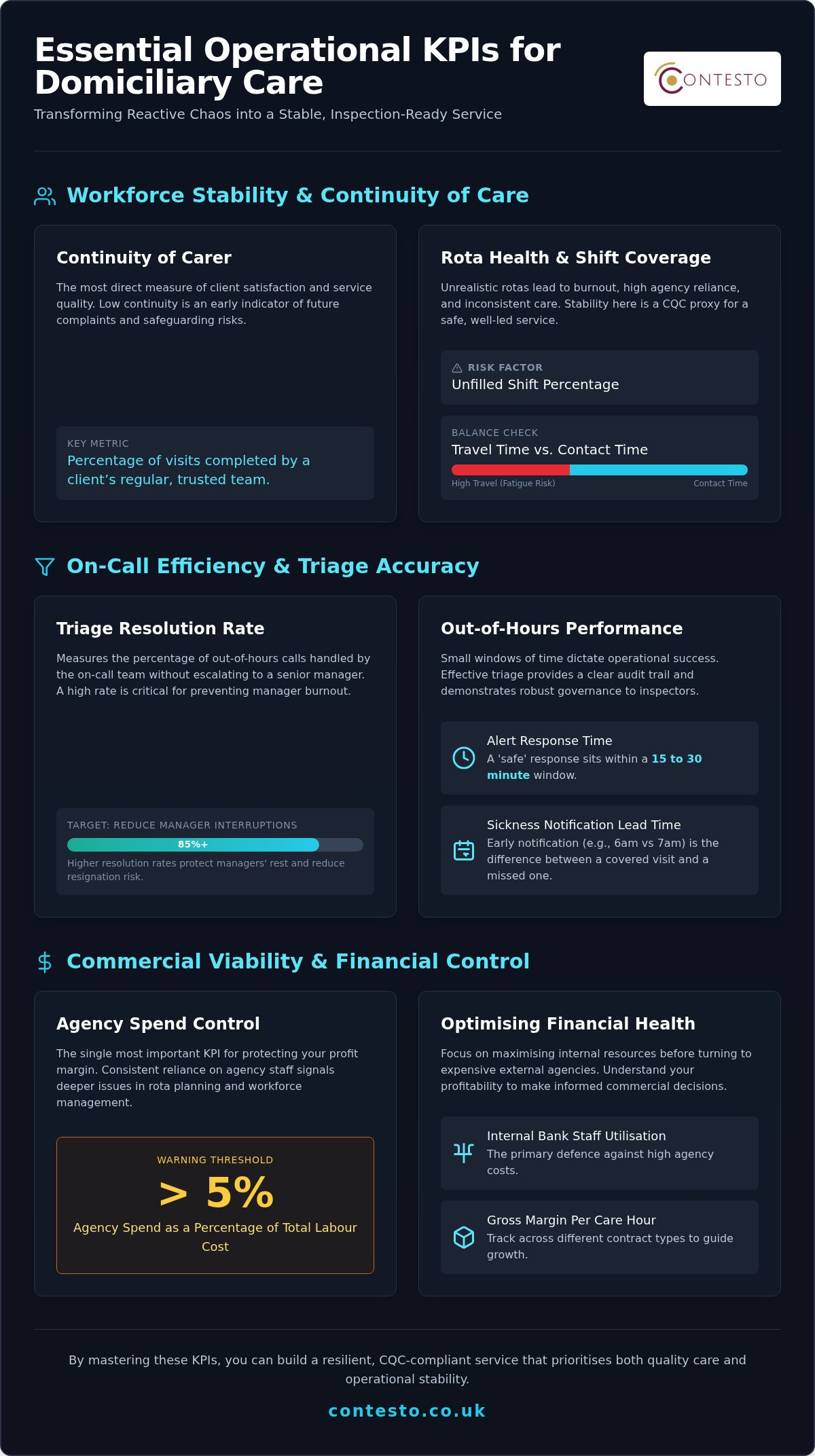
Measuring the continuity of carer is the most direct way to gauge client satisfaction. It's not enough to cover the calls; you need to know the percentage of visits completed by a client’s regular team. Low continuity scores are early indicators of future complaints and safeguarding risks. Similarly, monitoring sickness and absence frequency helps identify patterns of burnout before they lead to resignations. If a specific team has high absence rates, it's usually a signal of poor rota coordination or excessive travel pressure.
Measuring Rota Health and Shift Coverage
The unfilled shift percentage is your most significant operational risk factor. If this number creeps up, your reliance on expensive agency staff follows, damaging both your margins and service consistency. You must also balance travel time against contact time. If carers spend 40% of their shift behind the wheel, fatigue is inevitable. Professional Contesto Rota Management helps stabilise these operational kpis for domiciliary care by ensuring rotas are realistic and sustainable. The CQC views this stability as a proxy for safety; a well-led service is one where the data proves the workforce is supported and the rota is under control.
On-Call Efficiency and Triage Accuracy
The on-call phone is often the primary driver for senior staff leaving the profession. It creates a constant pressure that erodes the boundary between work and rest. According to the state of the adult social care sector and workforce report, retention remains a significant hurdle across the industry. Tracking operational kpis for domiciliary care specifically related to out-of-hours performance is essential for long-term stability. A "safe" response time for alerts usually sits within 15 to 30 minutes, but speed is secondary to the quality of the resolution.
Your triage resolution rate is a particularly telling metric. It measures the percentage of calls handled entirely by the on-call team without escalating to a senior manager. If your registered manager is still being woken for routine sickness or minor rota adjustments, your operational kpis for domiciliary care are likely out of alignment. We also monitor staff sickness notification lead time. Identifying a gap at 6am rather than 7am can be the difference between a covered visit and a missed one. These small windows of time dictate the day's operational success.
The "bleep" has a hidden financial cost that few providers quantify. High-level manager turnover is expensive and disruptive. By measuring how many times a manager's rest is interrupted, you gain a clear indicator of future resignation risk. Protecting this time is a commercial necessity for any provider aiming for growth.
Evaluating Out-of-Hours Performance
Effective oversight requires a clear distinction between medical emergencies and administrative rota issues. A professional triage service filters this noise, ensuring your daytime team starts their shift focused on service growth rather than clearing a backlog of night-time crises. Utilising outsourced on-call triage directly protects your Well-Led rating by demonstrating robust governance and oversight. It provides a clear audit trail that inspectors value whilst ensuring your leadership remains rested and effective. You may find that integrating professional triage is the most direct route to stabilising your management tier.
Commercial Viability and Agency Spend Control
Commercial viability in domiciliary care rests on tight control over variable costs. Agency spend as a percentage of total labour cost is the single most important KPI for protecting your profit margin. Whilst some agency use is inevitable during emergencies, a figure exceeding 5% often signals deeper issues in your rota planning. By tracking this alongside internal bank staff utilisation, you can ensure you're exhausting your own workforce before committing to high external rates. It's about ensuring every hour of care delivered contributes to the business rather than just covering a staffing gap.
Profitability also depends on understanding the gross margin per care hour across different contract types. With the National Living Wage rising to £12.71 in April 2026, the gap between local authority rates and private fees has never been more critical. Providers must also monitor their admin-to-care ratio; an efficient back office should support growth without becoming a bloated overhead. These operational kpis for domiciliary care provide the data needed to make informed decisions about which contracts to pursue and where to trim operational fat.
Reducing Dependency on External Care Agencies
Last-minute shift reallocations are expensive, not just in agency fees but in the administrative time taken to fix them. Proactive rota management allows you to identify gaps weeks in advance, rather than hours. This foresight is a pillar of our strategic operational roadmap for scaling care businesses. By maintaining constant oversight, you can stabilise costs and improve service continuity. If you're struggling to control these spiralling costs, Contesto's operational support can help you reclaim your margins and reduce agency reliance.
Governance, Compliance, and CQC Readiness
Governance in social care isn't a static checklist; it's a living demonstration of safety and responsiveness. Safeguarding alert frequency and resolution timeframes are critical safety KPIs that inspectors scrutinise. If an alert is raised but takes five days to resolve, your governance is failing. Similarly, audit completion rates must remain near 100% to ensure your service is always inspection-ready. These operational kpis for domiciliary care provide the hard evidence needed to defend your rating during a CQC assessment.
Moving beyond simple satisfaction, client and family feedback scores should be used as measurable quality indicators. High-quality services don't just ask if clients are happy; they measure specific outcomes and responsiveness. Constant operational oversight is the thread that connects these data points. It ensures that a dip in feedback in one area triggers a corrective action in another. This level of scrutiny is what separates a "Good" rating from an "Outstanding" one in the eyes of regulators.
Using Data to Drive Continuous Improvement
A key requirement of the 2026 CQC framework is the ability to show how you learn from mistakes. "Closing the loop" means taking a failure in your operational kpis for domiciliary care, such as a spike in missed calls or a delay in safeguarding resolution, and using it as evidence of proactive governance. You show the inspector the problem, the action taken, and the resulting improvement in the data. This proves that your leadership is both self-aware and effective.
Maintaining this level of consistent compliance monitoring is difficult whilst managing daily staff shortages. This is where white-labelled operational support becomes invaluable. It provides a layer of oversight that doesn't sleep, ensuring your governance remains robust even when your internal team is stretched. To secure your service’s future and maintain the highest standards, you can organise your operations with Contesto. Their expertise in triage and rota management ensures your data always tells a story of stability and care.
Securing Your Service’s Operational Future
Stabilising the rota, reducing agency dependency, and protecting the management team from the physical toll of out-of-hours burnout are the essential foundations of a "Well-Led" service. By tracking the right operational kpis for domiciliary care, you move beyond constant crisis management into a position of quiet, professional confidence. These metrics don't just ensure CQC compliance; they protect your profit margins and the health of your leadership team in an increasingly demanding market.
As you navigate the 2026 regulatory changes, you don't have to carry this administrative weight alone. Contesto provides 24/7 UK-based operational support specifically designed to maintain domiciliary care compliance. Our specialised triage and rota management systems are proven to reduce manager burnout and slash expensive agency spend, acting as a seamless extension of your internal team. Discover how Contesto can stabilise your care operations and reclaim your professional distance. Building a resilient, inspection-ready service is a significant undertaking, but with the right strategic support, it's entirely within your reach.
Frequently Asked Questions
What are the most important operational KPIs for a new domiciliary care agency?
Lead times for staff recruitment and unfilled shift percentages are the most vital metrics for new providers. They demonstrate whether your service can safely deliver the care packages you have accepted. Monitoring these operational kpis for domiciliary care from the start prevents a backlog of uncovered visits. You should also track your enquiry-to-assessment conversion rate to ensure your growth remains sustainable without overwhelming your coordination team or compromising safety.
How does the CQC use operational data during an inspection?
Inspectors look for evidence of proactive governance rather than just reactive problem-solving during assessments. They use your operational data to see if you identify trends, such as recurring late visits or specific patterns in staff sickness. If your records show a spike in missed calls, the CQC will check if you analysed the cause and implemented a change. Data is the proof that your leadership team has a firm grip.
Can I track domiciliary care KPIs without expensive management software?
It is possible to track performance using basic spreadsheets or manual logs, though this significantly increases the administrative burden on your management team. Simple trackers for turnover and agency spend are often effective for small startups. However, as your service scales, manual tracking frequently leads to data silos and missed insights. The objective is to achieve real-time visibility without requiring hours of manual data entry every single week.
How often should a care manager review operational performance metrics?
Managers should review critical rota data daily to manage immediate risks like staff sickness or unfilled shifts. Strategic operational kpis for domiciliary care, such as agency spend and turnover trends, are better suited to weekly or monthly reviews. A weekly flash report allows you to catch negative trends before they impact your compliance. Monthly deep dives are then used for strategic planning and reporting to your board or directors.
What is a healthy staff turnover rate for the UK home care sector in 2026?
A turnover rate below 20% is considered healthy, though the independent sector average was 24.7% in 2024/25. In 2026, with the National Living Wage at £12.71, retention is heavily influenced by rota stability and travel time optimisation. If your turnover exceeds this average, it is often a sign that staff are burnt out by poor coordination or excessive out-of-hours pressure. Aim for stability to reduce your long-term recruitment costs.


Comments