

Outsourced Staff Sickness Management for Care Providers
- Mara

- Aug 13
- 8 min read
Updated: 1 day ago
Imagine it's 6:00 AM on a Tuesday, and your phone vibrates with the first of three staff sickness notifications. Within minutes, your planned day of quality audits and team mentoring dissolves into a frantic scramble for agency cover. This cycle of reactive triage isn't just a logistical headache; it's a primary driver of leadership turnover across the UK social care sector. By integrating outsourced staff sickness management for care providers, you can finally break this exhausting loop and regain control over your service.
We know that managing a 3.0% sector-wide absence rate while ensuring CQC compliance feels like a constant uphill battle. This article explores how professional sickness management stabilises your rota, reduces dependency on emergency agency spend, and ensures every absence is meticulously documented. We will examine how shifting this operational burden to an expert partner allows your managers to focus on quality and growth rather than constant crisis management.
The Operational Burden of Staff Sickness in the Care Sector
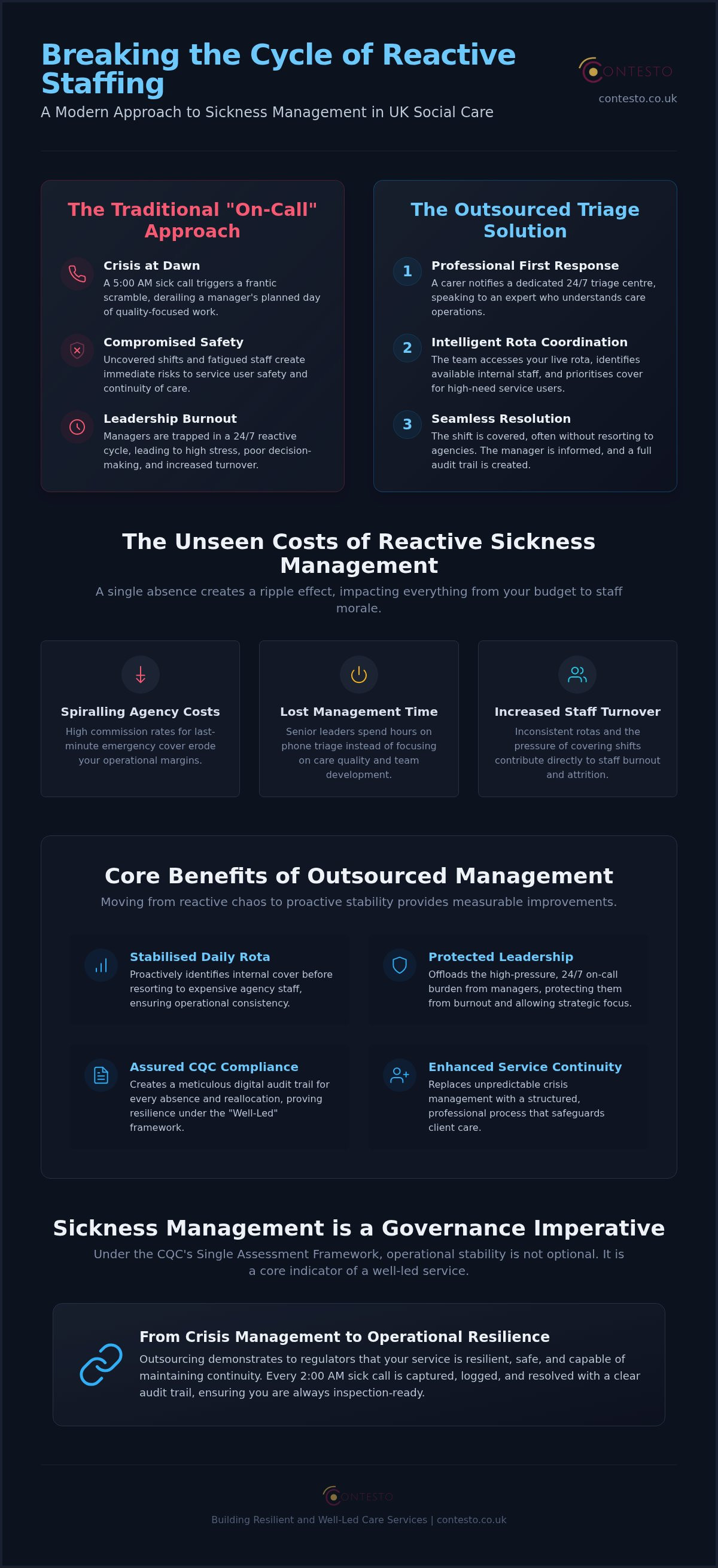
In the UK care sector, a single sick call at 5:00 AM is rarely just an administrative task. With the health and social work sector experiencing a 3.0% absence rate in 2025, these calls represent a significant operational disruption that can derail an entire day's schedule. For many providers, managing this burden falls on the shoulders of already overstretched registered managers. Implementing outsourced staff sickness management for care providers transforms this reactive process into a professional triage system. Instead of a manager waking up to a series of frantic texts, a dedicated partner handles the entire lifecycle of the absence, from the initial notification to identifying a suitable internal replacement.
The ripple effect of unmanaged sickness is profound. When a shift remains uncovered, client safety is compromised and the remaining team faces increased fatigue. Beyond the immediate risk, the financial impact is often underestimated. Relying on emergency agency staff to plug gaps creates significant overheads that erode margins. Common hidden costs include:
High emergency agency commission rates for last-minute cover.
Administrative time spent by senior leads on phone-triage rather than care quality.
Increased turnover of permanent staff due to burnout and inconsistent rotas.
Many organisations lack robust absence management policies that can be executed under pressure, leading to a reliance on the "on-call phone." This traditional approach is a recipe for burnout. Managers are forced to make critical staffing decisions while sleep-deprived, which inevitably leads to errors in coordination.
Why Sickness Management is a Governance Issue
The Care Quality Commission (CQC) increasingly scrutinises operational stability under the "Well-Led" key question. A service that relies on constant emergency cover struggles to demonstrate the consistency required for service users with complex needs. Professional outsourced staff sickness management for care providers ensures that every absence is tracked with a clear audit trail. This level of oversight proves to regulators that your service is resilient, safe, and capable of maintaining continuity regardless of short-term workforce fluctuations. It moves the conversation from crisis management to operational stability.
How Outsourced Sickness Management Functions as an Integrated Solution
Effective outsourced staff sickness management for care providers operates as a seamless extension of your internal team rather than a detached third-party service. When a carer calls the 24/7 triage centre, they don't speak to a generic operator. They reach a professional who understands your specific operational requirements and has direct access to your existing rota software. This integration allows for immediate action, as the triage team can view real-time availability across your entire workforce to identify suitable internal cover before looking elsewhere.
Adherence to your specific company culture and policies is paramount. Whether it's managing the Statutory Sick Pay (SSP) regulations updated in April 2026, which removed the three-day waiting period, or following your bespoke return-to-work protocols, the service is entirely white-labelled. This ensures that the carer’s experience remains consistent with your internal standards, maintaining professional trust whilst offloading the administrative burden from your managers.
The Mechanics of Professional Triage
In a care context, triage is the systematic prioritisation of shift coverage based on the clinical and safety risks associated with specific service users. By adopting a data-driven approach, the triage team evaluates factors such as staff competencies and travel distances to fill gaps efficiently. This methodology ensures that high-priority shifts are secured first, often through internal reallocation which significantly reduces the need for expensive agency intervention. For providers looking to stabilise their workforce, exploring professional operational support can offer a more sustainable path than reactive hiring.
Maintaining the Human Touch
Managing a sick call requires a delicate balance of empathy and professional firmness. Professional partners are trained to handle the tone of these conversations carefully, ensuring carers feel supported in their wellbeing whilst maintaining clear boundaries regarding notification windows and evidence requirements. This objective oversight removes the emotional friction that often occurs when a manager has to negotiate with a staff member they work alongside daily. It ensures that the process is handled with quiet confidence, preserving the relationship between the carer and the local management team.
Maintaining Continuity and CQC Compliance Through Professional Oversight
Regulatory scrutiny in the UK social care sector has shifted towards a more data-driven approach under the CQC Single Assessment Framework. It’s no longer enough to simply fill a gap; you must prove that the process was safe, consistent, and well-governed. Outsourced staff sickness management for care providers provides this necessary layer of transparency. Every 2:00 AM sick call and subsequent internal reallocation is captured in a digital audit trail, ensuring that you are always "Inspection-Ready" even for incidents that occur outside of standard office hours.
Professional oversight also enables sophisticated compliance monitoring. Instead of treating every absence as an isolated event, an outsourced partner tracks frequency and duration across your entire team. This identifies potential burnout or conduct issues before they impact client safety. Having this objective evidence to hand is invaluable during a CQC inspection, as it demonstrates that the provider is actively managing workforce risks rather than just reacting to them. It also ensures that return-to-work interviews are triggered correctly, maintaining a professional standard that protects both the employee and the business.
Evidence for the "Well-Led" KLOE
A "Well-Led" service uses operational data to drive improvement. By utilising outsourced staff sickness management for care providers, you demonstrate a proactive commitment to risk management that regulators highly value. The insights gained from sickness reporting allow for more accurate workforce planning, helping you predict staffing needs and reduce long-term dependency on temporary labour. If you want to move away from chaotic spreadsheets and towards a structured governance model, you can learn more about our compliance monitoring services to see how we support your regulatory standing.
Reducing Manager Burnout and Agency Dependency with Contesto
Manager burnout is often the silent catalyst for leadership turnover in the UK care sector. When a registered manager spends their weekends or early mornings coordinating staff absences, they aren't focusing on service development, clinical oversight, or team mentoring. By utilising outsourced staff sickness management for care providers, you effectively remove the administrative noise that leads to exhaustion. This isn't merely about answering a phone; it's about protecting the mental and operational capacity of your leadership team. When managers feel supported and rested, staff retention improves across the board, creating a more stable environment for both employees and service users.
Contesto operates as a strategic partner, deeply embedded in your operational workflow. Unlike a generic call centre, our team understands the nuance of care coordination, the pressure of maintaining a safe rota, and the importance of compliance. We prioritise internal shift reallocation, which directly addresses the high dependency on expensive emergency agency staff. This proactive approach ensures that agency spend becomes a last resort rather than a default reaction. The result is a significant improvement in your bottom line and a more predictable operational budget that isn't derailed by short-term sickness.
From Reactive Triage to Strategic Growth
Stability is the essential precursor to expansion. As outlined in our roadmap on how to scale a care business uk, a service cannot grow if its foundation is constantly shifting due to staffing crises. Transitioning from reactive management to proactive service development requires a system that handles the unpredictable with quiet confidence. The long-term ROI of operational stability far outweighs the costs of constant crisis management. It provides the headspace needed for registered managers to innovate, improve care quality, and focus on the strategic growth of the business without being tethered to an on-call phone.
Securing the Future of Your Care Operations
The transition from reactive crisis management to a structured, professional oversight model is the hallmark of a resilient care service. By integrating outsourced staff sickness management for care providers, you don't just fill gaps; you protect your leadership from burnout and ensure every shift reallocation is underpinned by CQC-aligned reporting. This strategic shift reduces the financial drain of emergency agency fees and creates the operational headspace needed for long-term growth.
Maintaining service continuity shouldn't come at the cost of your management team's wellbeing. With 24/7 professional triage and white-labelled operational support, you can reclaim your mornings and focus on the high-quality care that defines your business. It's time to move beyond the exhaustion of the on-call phone and embrace a more sustainable way of working.
Book an operational review with Contesto to stabilise your rota today and take the first step towards a more predictable, well-governed future for your care service.
Frequently Asked Questions
What is the difference between a call answering service and outsourced sickness management?
A call answering service simply records a message and passes it on, whereas outsourced staff sickness management for care providers involves taking active responsibility for the shift. This includes triaging the call, checking the rota for internal availability, and reallocating the work according to your specific policies. It's an operational resolution service rather than a passive communication channel, designed to ensure service continuity without manager intervention.
How does an outsourced team know which carers are suitable for a specific shift?
Our team works directly within your existing rota software, allowing us to see real-time staff competencies, geographical locations, and contracted hours. We follow your specific training matrix to ensure that any carer selected for a reallocation has the necessary skills for the service user's needs. This data-driven approach maintains safety and clinical standards by ensuring only appropriately qualified staff are asked to cover critical gaps.
Will my carers be confused if they speak to someone outside our local office?
No, because the service is entirely white-labelled and operates as a seamless extension of your own office. When a carer calls in, they are greeted in your company name by a professional who follows your established protocols. This consistency ensures that the interaction feels familiar and supportive. Most carers appreciate the immediate, professional response they receive, which helps maintain clear boundaries and prevents any operational ambiguity.
Can outsourced sickness management help reduce our reliance on care agencies?
Yes, by prioritising internal shift reallocation before considering external options. Professional outsourced staff sickness management for care providers focuses on identifying available capacity within your permanent workforce that a busy manager might overlook. By systematically exhausting internal options first, you can significantly lower your dependency on expensive emergency agency staff. This proactive coordination helps stabilise your operational budget and keeps care delivery within your own trusted team.
Is outsourced triage compliant with CQC standards for out-of-hours care?
Absolutely, as it provides a robust audit trail that supports the Well-Led and Safe assessment areas. Every sickness call and reallocation is documented, providing clear evidence that you have a proactive system for managing workforce risks. This level of oversight ensures that staffing levels remain safe and that all out-of-hours incidents are handled with the same rigour as daytime operations, meeting the CQC expectations for governance.


Comments