

CQC Inspection Questions: A Strategic Guide for UK Care Managers (2026)
- Mara

- 22 hours ago
- 8 min read
Compliance is not a memory test, yet many managers treat it like one. It's a common anxiety: the fear that a single ill-informed answer to cqc inspection questions from a stressed staff member could undermine months of hard work. You've likely spent late nights worrying whether your team can truly articulate safeguarding processes or if your out-of-hours incident logs would stand up to scrutiny. With the CQC transitioning to sector-specific frameworks in late 2026, the pressure to move beyond reactive habits and into a state of permanent readiness has never been higher.
This guide provides a practical strategy for mastering the enquiries likely to arise under the new KLOEs, ensuring your team is prepared and your evidence is undeniable. You'll learn how to bridge the gap between daily operations, staff competency, and "Outstanding" ratings by creating systems that document safety automatically. We'll explore ways to build a robust evidence trail for the Well-led assessment, giving you the confidence that your service remains compliant, your records are flawless, and your staff remain calm, even as inspectors move toward direct rating judgements.
The 5 Key Questions: Understanding the CQC Assessment Framework
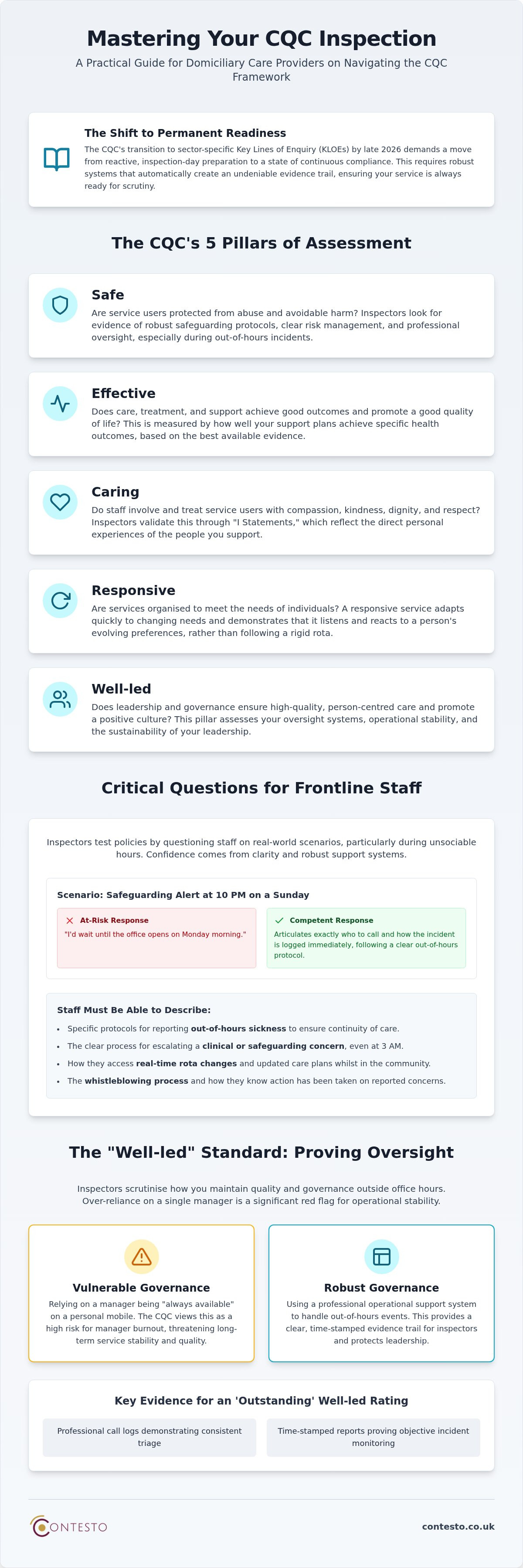
The Care Quality Commission (CQC) evaluates every domiciliary provider against five pillars: Safe, Effective, Caring, Responsive, and Well-led. While these core questions haven't changed, the methodology for answering them has shifted. As the 34 Quality Statements of the previous framework give way to sector-specific Key Lines of Enquiry (KLOEs) in late 2026, inspectors have moved toward a more continuous, digital-first assessment model. This transition means your internal data must be "always-ready" rather than just "inspection-ready" for a scheduled visit.
Inspectors now lean heavily on "I Statements" to verify care quality. These are the specific reflections from service users about their personal experience. If a client doesn't feel their choices are respected, even the most polished paper trail won't secure an "Outstanding" rating. Your team must understand that cqc inspection questions will often be directed toward the people you support, testing whether your policies translate into meaningful results for the individual.
Safe and Effective: The Core of Clinical and Operational Governance
Safety is defined by your ability to prevent avoidable harm through robust safeguarding protocols. Effectiveness is measured by how well your support plans achieve specific health outcomes. When inspectors ask cqc inspection questions related to these areas, they're looking for proof of professional oversight. This is where operational support becomes vital, ensuring that out-of-hours emergencies are handled by trained professionals whilst maintaining a clear evidence trail for future audits.
Caring and Responsive: Measuring the Human Element
These pillars probe the culture of your service. Inspectors look for evidence that staff treat individuals with genuine dignity and respect. A "Responsive" service adapts quickly to changing needs, such as a sudden decline in a client's health. You must demonstrate that your service isn't just a rigid rota, but a flexible support system that listens and reacts to the individual's evolving preferences.
Critical Questions CQC Inspectors Ask Frontline Care Staff
Inspectors don't just want to see your policies; they want to see them in action. When they sit down with your frontline carers, they'll use cqc inspection questions to probe the reality of your service during unsociable hours. A common scenario involves safeguarding at 10 PM on a Sunday. If a carer's response is simply "I'd wait until Monday morning," your rating is at risk. They need to articulate exactly who they would call and how that incident is logged immediately.
Risk management is equally scrutinised. Inspectors will ask how staff access risk assessments whilst working remotely in the community. Staff must prove they can view updated care plans in real-time, especially regarding medication. If a carer discovers a medication error during a late-night visit, they must describe the process for reporting it and ensuring the client's safety without hesitation. This level of readiness often depends on having professional operational support available around the clock to guide them through high-pressure decisions.
Empowering Staff to Speak with Confidence
Confidence comes from clarity. If your staff answer "I just call the manager" for every emergency, it suggests a lack of robust systems and risks manager burnout. During mock interviews, help your team articulate their daily routines using regulatory language. Key points to cover include:
Specific protocols for reporting out-of-hours sickness or no-shows.
The process for escalating a clinical concern or safeguarding alert at 3 AM.
How they access the latest rota changes whilst in the field to ensure continuity of care.
This shows inspectors that you've invested in a system that provides consistent, expert guidance, regardless of the time or day.
Whistleblowing and Incident Reporting
Staff must feel safe reporting concerns without fear of retribution. Inspectors will ask how they report issues and, crucially, how they know action was taken. You must ensure your team can describe the "loop" of reporting: from the initial incident log to the management review and the subsequent changes in practice. This demonstrates a culture of transparency and proves that your service is proactive rather than reactive.
The "Well-led" Standard: Questions for Managers and Providers
The "Well-led" standard is the structural foundation of your rating. During an assessment, cqc inspection questions for managers often pivot from what you do to how you oversee it. Inspectors frequently ask how you maintain visibility of service quality during out-of-hours periods. If your answer relies solely on being "always available" via a personal mobile, you're signalling a vulnerability in leadership sustainability. Inspectors view constant manager on-call as a burnout risk that threatens operational stability and long-term care quality.
Demonstrating Robust Out-of-Hours Governance
To secure a "Good" or "Outstanding" rating, you must provide a clear evidence trail of oversight. Professional call logs and triage reports serve as objective proof that incidents are monitored and resolved according to policy. Linking your rota management to the Well-led rating proves that shift coverage is a strategic priority rather than a reactive scramble. This allows you to show exactly how an out-of-hours incident led to a documented change in policy or training, satisfying the CQC’s requirement for continuous improvement and partnership working.
Managing Staff Sickness and Rota Gaps
Inspectors will scrutinise your agency usage and shift fulfilment rates. They want to see a documented process for emergency shift reallocation that doesn't compromise care quality. Proving you have a system in place to manage staff sickness without direct manager intervention demonstrates a high level of operational maturity. By delegating these pressures, you can focus on the high-level audits and team wellbeing initiatives that inspectors expect to see from a top-tier provider.
If you're looking to strengthen your evidence for the Well-led assessment, our on-call triage and rota management provides the professional oversight and reporting needed to satisfy the most rigorous inspections. This partnership ensures your service remains stable whilst protecting your management team from the strain of constant coordination.
Maintaining Inspection-Readiness Through Operational Stability
True inspection readiness isn't about a frantic week of tidying files before the CQC arrives. It's about building a service that remains operationally stable 365 days a year. By delegating out-of-hours triage, managers can step away from the immediate pressure of filling gaps and focus on the high-level quality audits that prove a service is Well-led. This transition allows you to provide inspectors with clear, time-stamped evidence of how sickness and emergencies were handled, turning what was once a chaotic process into a structured data set that supports your rating.
The Role of Managed Triage in Compliance
Every out-of-hours call is a potential compliance risk. Without professional oversight, a 10 PM safeguarding alert or a 4 AM staff sickness can quickly lead to a missed visit or an unrecorded incident. Managed triage ensures every interaction follows your specific provider policies. This consistency is exactly what inspectors look for when they ask cqc inspection questions about risk management and clinical governance. It demonstrates that your safety protocols aren't just theoretical; they are enforced even when the office is closed, reducing the risk of safeguarding oversights.
Next Steps for Care Managers
Start by conducting an honest gap analysis of your current evidence trail. Ask yourself: where is your documentation weakest? If you can't produce a professional log for a complex incident at 2 AM on a Bank Holiday, you have a compliance gap. Managed rota support helps you utilise internal staff and bank workers more effectively, reducing the agency dependency that often drags down "Effective" ratings.
Consider the business case for outsourced care management as a way to protect your rating and your team's sanity. Building a resilient care business requires shifting from reactive habits to a model where operational support is seen as a direct investment in your CQC success. By professionalising your out-of-hours response, you ensure that your service remains "always-ready" for any assessment.
Building a Legacy of Operational Excellence
The transition to sector-specific frameworks in late 2026 demands a shift from reactive management to a model of permanent readiness. By professionalising your out-of-hours response and ensuring staff are equipped to handle cqc inspection questions with confidence, you move beyond the exhausting cycle of reactive scheduling. Robust governance is no longer just about having the right policies on paper. It's about proving those policies are active every hour of the day. This operational stability is the most direct route to securing a "Good" or "Outstanding" rating.
Delegating the administrative burden of emergency coordination allows you to reclaim your strategic focus and protect your team’s wellbeing. Discover how Contesto’s 24/7 triage and rota management ensures your service is always inspection-ready. Our UK-based care specialists provide the professional oversight and time-stamped evidence required to satisfy the most rigorous assessments. You've built a service dedicated to high-quality care; now is the time to ensure your operational systems reflect that same standard of excellence.
Frequently Asked Questions
How can I prepare my care staff for a CQC inspection?
You should conduct regular mock interviews that focus on scenario-based cqc inspection questions to build team confidence. Ensure your carers can explain specific protocols for safeguarding and medication errors without hesitation. It's helpful to provide them with clear summaries of your out-of-hours escalation processes. This ensures they don't feel isolated when working in the community and can articulate how they're supported during late-night or weekend shifts.
What are the 5 key questions the CQC asks during an inspection?
The five pillars of any assessment are whether your service is Safe, Effective, Caring, Responsive, and Well-led. These categories form the basis of the CQC's judgement on your care quality. Inspectors use these questions to look for evidence that you're meeting fundamental standards. They'll examine everything from your clinical governance and risk assessments to the way you interact with service users and manage your workforce.
What evidence does the CQC look for in the "Well-led" category?
Inspectors look for a clear evidence trail of operational oversight and sustainable leadership. This includes documented quality audits, evidence of improvement after incidents, and robust governance for out-of-hours periods. You must show that your management systems aren't reliant on a single person being constantly available. Providing professional logs of how sickness was handled proves that your service is stable, organised, and professionally managed around the clock.
Can the CQC ask staff about their own wellbeing and workload?
Yes, inspectors frequently interview staff about their workload, training, and overall mental health. They're looking for signs of burnout or excessive pressure, which they link directly to the "Well-led" and "Safe" ratings. If carers report feeling unsupported during out-of-hours shifts or mention frequent rota gaps, it signals a failure in coordination. Protecting your team's wellbeing through professional triage support is a key indicator of a healthy organisational culture.
How does the CQC assess out-of-hours management for home care?
The CQC assesses out-of-hours management by reviewing how you handle emergencies, staff sickness, and no-show alerts when the office is closed. They look for time-stamped incident logs and evidence that professional decisions were made in line with your policies. When answering cqc inspection questions about this area, you should demonstrate that your triage and rota systems provide consistent oversight, ensuring that service users aren't left at risk.


Comments