

Eliminating the Care Manager Administrative Burden: A Strategic Roadmap for 2026
- Mara

- May 5
- 12 min read
Updated: May 12
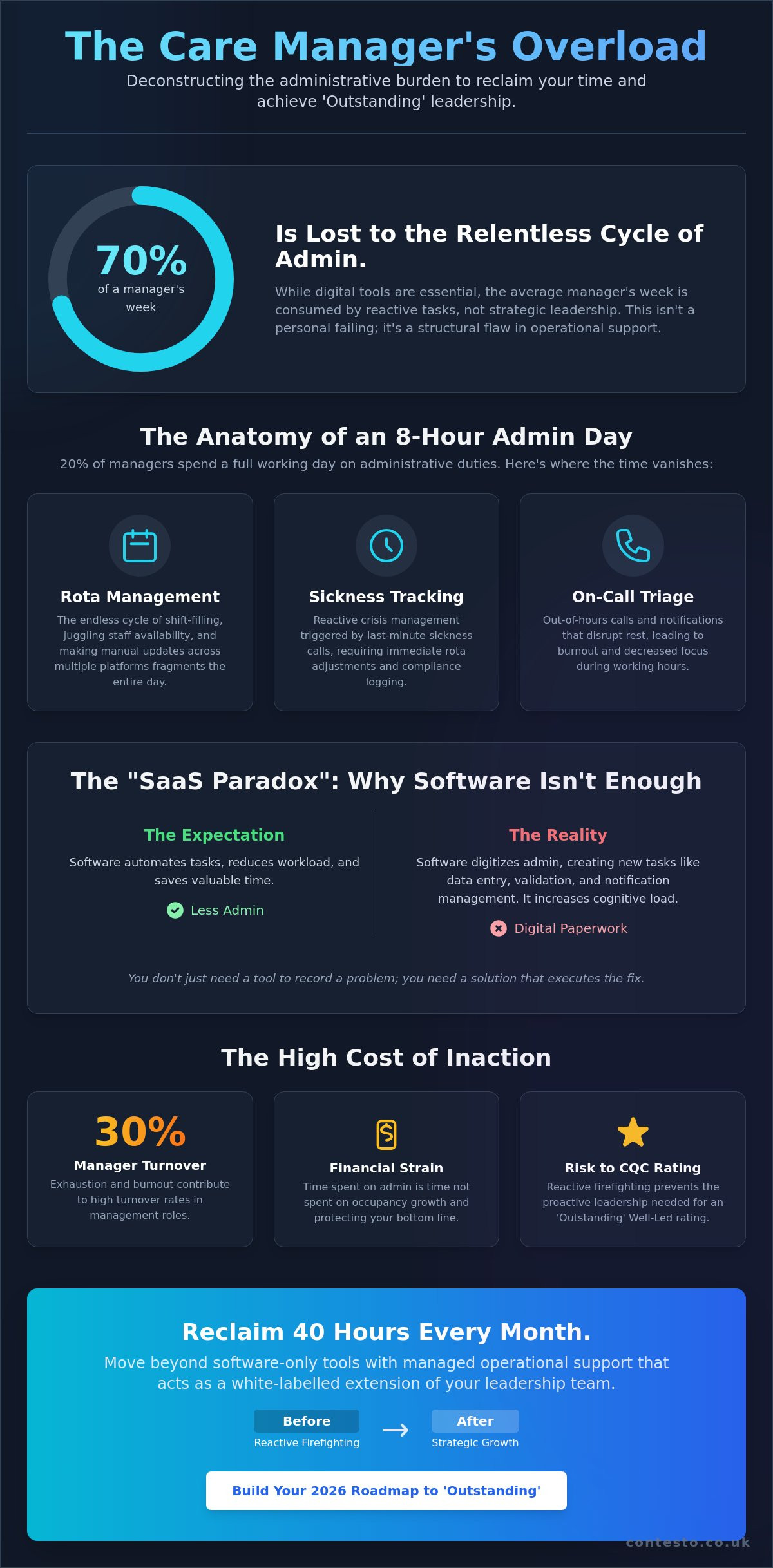
Your care management software isn't actually solving your workload; it’s often just moving the paperwork to a screen. While digital tools are essential, the average manager still loses 70% of their week to the relentless cycle of shift-filling, sickness tracking, and rota juggling. This persistent care manager administrative burden isn't a reflection of your efficiency. It's a structural flaw in how operational support is handled. You’ve likely felt the exhaustion of a 10-hour day followed by a 2 AM sickness call, a reality that contributes to the 30% turnover rate seen in management roles across the sector.
We’re here to show you a more sophisticated path forward. This guide offers a strategic roadmap for 2026, revealing how to reclaim up to 40 hours every month by deconstructing operational friction. You’ll learn how to move beyond the limitations of software-only solutions to achieve an "Outstanding" CQC rating for leadership and restore your work-life balance. We will explore the transition from reactive fire-fighting to strategic growth, ensuring your brand’s narrative is defined by excellence rather than exhaustion.
Key Takeaways
Identify the "SaaS Paradox" where software often increases cognitive load rather than reducing the care manager administrative burden.
Categorize your operational tasks into high-value leadership and low-value admin to refocus your energy on clinical excellence and strategic growth.
Deconstruct the three core drainage points, rota management, sickness tracking, and on-call triage, to reclaim 40 hours of monthly productivity.
Move beyond software-only tools by integrating managed operational support that acts as a sophisticated, white-labelled extension of your leadership team.
Implement a 2026 roadmap designed to achieve "Outstanding" CQC ratings while finally restoring a sustainable work-life balance.
Table of Contents The Anatomy of the Care Manager Administrative Burden in 2026 Why Care Management Software Often Fails to Deliver the Promised 'Time-Saving' Deconstructing the Operational Friction: Rota, Sickness, and On-Call A Strategic Framework for Reducing Administrative Overhead Managed Operational Support: The Contesto Approach to Restoring Leadership Focus
The Anatomy of the Care Manager Administrative Burden in 2026
In the current landscape, "admin" is a deceptive term. It suggests a series of tidy, manageable tasks rather than the reality of operational friction that grinds strategic leadership to a halt. The care manager administrative burden has evolved into a complex web of data entry, compliance tracking, and reactive problem-solving. By 2026, the shift toward integrated care systems and the CQC’s Single Assessment Framework has paradoxically increased desk-time despite the promise of digital efficiency. Data requirements are now more granular, audits are more frequent, and the expectation for real-time evidence has never been higher.
Post-reform mandates have necessitated a level of reporting that many legacy systems wasn't designed to handle. Instead of software simplifying the workflow, it has often added new layers of validation and cross-referencing. This hidden cost of micro-tasks, such as shift reallocations and constant triage calls, fragments the working day until clinical oversight becomes a secondary priority.
The care manager administrative burden is the primary structural barrier preventing providers from achieving the "Well-Led" excellence required by the CQC’s evolving assessment frameworks.
The 8-Hour Admin Day: Where the Time Vanishes
A 2024 survey by Florence revealed that 20% of managers spend between 7 and 8 hours every single day on administrative duties. This isn't high-level strategy; it’s a relentless stream of tasks that fragment your focus. You might start a clinical audit only to be derailed by staff sickness calls, WhatsApp notifications about missing shifts, and urgent updates for Digital Social Care Records (DSCRs). While the foundational principles of Case management (US healthcare system) emphasize coordination and advocacy, the UK reality often reduces the manager to a human switchboard. Common drainage points include:
Manual rota updates across disconnected digital platforms.
Triage of out-of-hours calls that disrupt sleep and daytime focus.
Compliance monitoring that requires manual data cross-referencing.
This fragmentation means the working day is no longer a cohesive unit of time but a series of 10-minute intervals spent firefighting. Admin becomes a euphemism for reactive crisis management, leaving no room for the proactive leadership that defines a high-performing care setting.
The Emotional and Commercial ROI of Reduction
When a manager is trapped in survival mode, the entire business architecture begins to lean. There's a direct, measurable correlation between this administrative weight and the high staff turnover rates plaguing the sector. If you can’t find the time to mentor your team because you’re busy filling a Friday night rota, your best staff will eventually leave. Reducing this burden isn't just about personal comfort; it’s about protecting your bottom line and improving key care home kpis.
Transitioning from reactive crisis management to strategic oversight allows you to focus on occupancy growth, staff development, and long-term compliance sustainability. By reclaiming this time, you move from the role of an administrator to that of a Strategic Architect, building a brand narrative defined by resonance and authenticity rather than exhaustion.
Why Care Management Software Often Fails to Deliver the Promised 'Time-Saving'
The prevailing industry narrative suggests that digital transformation is the ultimate antidote to operational friction. We’re told that if we just invest in the right Care Management System (CMS), the care manager administrative burden will evaporate. Yet, many providers find themselves trapped in a "SaaS Paradox." While software provides a sophisticated digital filing cabinet, it often increases cognitive load by flooding managers with notifications, alerts, and data silos. Buying the best software doesn't eliminate admin; it simply digitizes it. You don't just need a tool to record a problem; you need a solution that executes the fix.
Software is a passive repository. It requires constant, manual feeding to remain accurate, especially when preparing for a CQC inspection. The time spent ensuring every digital record is "audit-ready" can be just as taxing as the paper systems of the past. This structural inefficiency is mirrored in broader healthcare trends. Research into Administrative Waste in US Health Spending suggests that billions are lost to complex billing and clinical documentation that adds little value to the patient experience. In the UK social care sector, this waste manifests as hours spent staring at screens instead of supporting residents.
The Implementation Gap
Most care managers don't spend their time analyzing software-generated insights to improve care quality. Instead, they spend it troubleshooting the software itself. Whether it’s resetting staff passwords, correcting clock-in errors, or trying to bridge the gap between a rota tool and a payroll export, the manager becomes a de facto IT support technician. This burden extends to training, where managers must constantly upskill staff and bank workers on ever-changing digital interfaces. It’s why many leaders realize that software is only half the solution; the real value lies in the human execution behind the interface.
Data Fatigue and Compliance Monitoring
The transition from paper to digital has replaced physical clutter with "digital noise." Notification fatigue is a real threat to safety, where critical alerts are buried under a mountain of routine pings. While platforms collect data, managed teams execute strategy. To break the cycle of burnout, you need a filter between raw data and executive action. A managed operational support team can process these signals, resolving shift gaps and sickness alerts before they ever reach your desk. If you're ready to move beyond the limitations of software alone, exploring bespoke operational support can help restore your focus to high-level clinical leadership.
Deconstructing the Operational Friction: Rota, Sickness, and On-Call
Identifying the structural leaks in a care facility requires more than a cursory glance at a timesheet. It demands an architectural understanding of how time is actually spent. To dismantle the care manager administrative burden, we must address the three primary drainage points: rota management, staff sickness, and the psychological weight of 24/7 on-call duties. These aren't just tasks; they are operational friction points that, when left unmanaged, lead to a slow erosion of leadership focus and service quality.
Sickness management is perhaps the most volatile of these points. A single staff absence at 6:00 AM triggers a domino effect of administrative labor. The manager must verify the absence, cross-reference the rota, contact bank staff, and, if all else fails, negotiate with agencies. This reactive cycle doesn't just fill a gap. It consumes the morning hours that should've been dedicated to clinical oversight or strategic planning, leaving the manager in a state of perpetual catch-up.
The High Cost of Reactive Rota Management
Rota management is often treated as a clerical task, but it’s actually a high-stakes financial exercise. Balancing internal staff availability with bank workers while simultaneously reducing care agency spend requires proactive, meticulous planning. When rotas are managed reactively, providers often fall back on expensive agency labor to ensure regulatory compliance. This isn't just a blow to profit margins. It creates an administrative burden of verifying agency credentials, managing induction protocols on the fly, and ensuring that temporary staff are integrated into the home’s digital record systems.
On-Call Triage: The Invisible Burden
The 24/7 on-call reality is the primary reason for manager burnout and subsequent resignation in the UK care sector. There is a profound difference between simply "answering the phone" and performing professional operational triage. Without a managed support structure, the manager is never truly off-duty. Every vibration of a smartphone represents a potential crisis, preventing the cognitive rest necessary for high-level leadership.
An integrated triage service acts as a sophisticated buffer. By resolving sickness calls and shift gaps through a dedicated support team, the manager is only alerted to high-level clinical emergencies. This preserves service continuity and ensures that the care manager administrative burden doesn't spill over into the manager's personal life, finally making work-life balance a measurable reality rather than a corporate buzzword.
A Strategic Framework for Reducing Administrative Overhead
The elimination of the care manager administrative burden requires more than a reactive mindset; it demands a structured, architectural shift in how work is distributed. To move from survival to strategic growth, providers must adopt a multi-layered framework that prioritises clinical excellence over clerical maintenance. This isn't about working harder. It’s about redesigning the operational flow to ensure that every hour spent by leadership yields a measurable return on investment. A resilient business shouldn't depend on the exhaustion of its leaders.
Our roadmap for 2026 follows a logical trajectory from identification to integration:
Step 1: Audit and Categorise. Document every task performed over a 14-day period. Distinguish between "High-Value Leadership", such as clinical supervision and resident advocacy, and "Low-Value Admin", like shift-filling and sickness logging.
Step 2: Optimise the Tech Stack. Consolidate your platforms to eliminate data silos. If your CMS doesn't communicate with your payroll or rota tool, you're creating manual work that shouldn't exist.
Step 3: Delegate vs. Outsource. Determine which tasks require local, clinical knowledge and which are purely operational.
Step 4: Implement Managed Support. Integrate a sophisticated, white-labelled extension to handle the heavy lifting of out-of-hours triage and rota adjustments.
Categorising Tasks for Maximum Efficiency
Adopting the "Strategic Architect" approach means recognising that your expertise is best used in face-to-face staff mentoring and clinical oversight. Repetitive operational workflows are the primary culprits behind burnout. By utilizing outsourced care management for non-clinical triage, you create the breathing room necessary to develop a "Well-Led" culture. This shift ensures that your presence is felt where it matters most, rather than being tethered to a desk by notification pings.
Building Operational Resilience
True resilience is achieved when a system functions independently of any single individual’s presence. A robust framework relies on a combination of internal bank worker pools and external operational support to ensure service continuity. This approach allows you to remain "inspection-ready" at all times without the need for 60-hour work weeks. When you offload the care manager administrative burden to a dedicated team, you aren't just buying time. You're building a sustainable business model that can scale without compromising quality.
If you're ready to transition from reactive firefighting to proactive leadership, discover how our managed operational support can reclaim your focus and restore your balance.
Managed Operational Support: The Contesto Approach to Restoring Leadership Focus
Contesto operates as a sophisticated, integrated extension of your internal leadership team. We don't sell software; we provide the human intelligence and operational precision required to navigate the 2026 regulatory landscape. Our white-labelled approach ensures that when we handle your out-of-hours triage or sickness calls, the communication remains entirely consistent with your brand’s resonance and authenticity. Your staff and residents experience a seamless service, while you maintain the narrative without absorbing the friction. This partnership allows you to finally shed the care manager administrative burden and transition from a reactive supervisor to a Strategic Architect of care excellence.
By delegating the relentless cycle of shift-filling and on-call management to our specialists, you reclaim the cognitive bandwidth necessary for high-level decision-making. We provide a steady, professional rhythm that mirrors the long-term, compounding nature of the work you perform. Our solutions are bespoke, rejecting one-size-fits-all templates in favor of artisanal support tailored to your specific service identity.
Beyond Agency: Managing Your Internal Resources
We recognize that excessive agency reliance is a primary threat to your ROI and clinical continuity. Our operational support team acts as a meticulous safeguard for your bottom line. We prioritise your own permanent staff and bank workers, following your specific internal policies for every shift reallocation. This isn't just about filling gaps; it’s about strategic resource optimization. Compliance monitoring becomes an automated outcome of our management process, ensuring that every shift meets regulatory standards without requiring a single manual entry from your desk. We handle the data mechanics so you can focus on the art of human-centric care.
Strategic Growth and Multi-Site Scalability
For providers aiming to expand, the administrative weight of a single home can become a ceiling for growth. Managed support is the essential engine for multi-site care home management. By centralising operational friction points like 24/7 triage and rota management, you free up the executive capacity required for acquisitions and service expansion. This structural freedom allows you to build a digital presence and a physical footprint that is resilient, scalable, and deeply invested in quality. When the care manager administrative burden is eliminated, your leadership team can finally focus on the strategic milestones that drive long-term commercial success.
Your brand’s right to be heard in a crowded marketplace starts with a leadership team that has the time to lead. Discover how Contesto can reduce your administrative burden today.
Reclaiming the Strategic Narrative of Care
Transitioning from reactive firefighting to proactive leadership isn't just a preference; it’s a commercial necessity for 2026. The care manager administrative burden is a structural flaw that software alone cannot repair. By auditing your workflows and embracing a managed operational model, you can reclaim up to 40 hours every month. This reclaimed time allows you to refocus on the clinical excellence and staff development that drive an "Outstanding" CQC rating.
The roadmap to operational resilience involves moving beyond the 8-hour admin days highlighted in the 2024 Florence survey. It requires a partner that understands the nuance of your brand. With 24/7 Integrated Triage, meticulous Rota Management, and a commitment to White-Labelled Professionalism, we handle the friction so you can focus on growth.
It's time to stop managing crises and start building a legacy. Architect a more resilient care operation with Contesto and restore the balance your leadership team deserves. Your brand's future depends on the clarity of your vision, not the complexity of your rota.
Frequently Asked Questions
What are the main causes of care manager administrative burden in the UK?
The primary drivers are reactive shift-filling, manual sickness tracking, and the granular data entry required for modern compliance audits. While digital records were intended to streamline workflows, the transition to the CQC’s Single Assessment Framework has increased the volume of evidence managers must produce. This structural friction turns clinical leaders into clerical coordinators, forcing them to prioritise screen-time over resident-facing care.
How many hours do care managers typically spend on admin tasks per week?
Many senior managers report spending upwards of 35 hours every week on non-clinical operational tasks. This effectively consumes a full-time position’s worth of energy on activities like rota adjustments and out-of-hours triage. When these hours are reclaimed, providers often see a direct improvement in leadership quality and staff morale, as managers can finally return to their core clinical responsibilities.
Can software alone solve the administrative burden for care providers?
No, software is a passive tool that requires human intelligence to execute actual solutions. While a platform can flag a gap in the rota, it cannot negotiate with a bank worker or handle a complex sickness call at 2 AM. To truly eliminate the burden, you need a managed layer of support that acts on the data provided by your software to resolve operational friction in real-time.
What is the difference between an admin assistant and managed operational support?
An admin assistant typically handles static clerical tasks during office hours, whereas managed operational support provides 24/7 strategic triage. Managed support acts as a white-labelled extension of your leadership team, capable of making high-level decisions regarding rota management and staff reallocation. It offers a level of professional continuity that a standard clerical role cannot match, especially during out-of-hours periods.
How does reducing admin burden help with CQC compliance?
Reducing the care manager administrative burden provides the necessary breathing room to focus on the "Well-Led" and "Effective" domains of CQC inspections. When a manager isn't tethered to a desk, they can perform more frequent clinical observations, mentor junior staff, and ensure that care plans are living documents. This proactive oversight, which includes managing infection control via mrsatest.co.uk, creates the robust evidence trail required for an "Outstanding" rating.
What happens if a manager is unavailable during an out-of-hours emergency?
Managed triage services ensure that every emergency is resolved according to your specific protocols without requiring the manager's intervention. A dedicated team handles everything from sickness calls to shift gaps, maintaining service continuity 365 days a year. This system protects the manager’s work-life balance while ensuring that the facility remains safe, compliant, and fully staffed at all times.
Is outsourced operational support cost-effective for smaller care homes?
Yes, it’s a strategic investment that reduces the significant costs associated with manager burnout and high agency spend. Smaller providers often lack the budget for a dedicated internal night-admin team, making a managed service a more scalable solution. By optimising internal bank staff usage and resolving sickness efficiently, the service often pays for itself through reduced recruitment and agency fees.
How does managed triage affect the "human touch" of a care service?
It actually enhances the human touch by removing the care manager administrative burden that keeps leaders away from their residents. When the operational friction of rota management is handled by a professional support team, managers can be present on the floor. This allows for more authentic interactions and deeper clinical supervision, which are the true hallmarks of a high-quality, person-centred care environment.


Comments