

How to Create a Care Rota: A 7-Step Strategic Framework for UK Providers
- Mara

- 11 hours ago
- 8 min read
It's 6:00 AM on a Tuesday, and your phone is already vibrating with the third staff sickness notification of the morning. For many UK care providers, this isn't just an occasional headache; it's a daily reality that drains budgets through high agency spend and pushes registered managers toward total burnout. You understand that a stable, familiar team is the backbone of safe care, yet the "rota jigsaw" often feels like an impossible puzzle to solve whilst maintaining CQC Regulation 18 standards. Deciding between care rota management software vs service is a pivotal step in moving from reactive crisis management to proactive oversight.
This guide provides a professional 7-step strategic framework designed to restore operational continuity, ensure compliance, and protect your team's wellbeing. We'll explore how to build a resilient system that requires less daily intervention, reduces expensive agency reliance, and finally allows your management team to reclaim their work-life balance. By the end of this article, you'll have the tools to move beyond the 24/7 on-call cycle and create a more stable, sustainable operation.
The Foundations of a Resilient Care Rota
A care rota is far more than a simple staff timetable; it is the operational pulse of your service. It ensures that the right skills reach the right person at the right time, every single day. Establishing the Foundations of a Resilient Care Rota is essential for maintaining safety and continuity. When scheduling fails, the ripple effect reaches every corner of the business, from client safety to the hidden costs of carer churn. High turnover is often a symptom of poor rota planning, where staff feel undervalued or overstretched by inconsistent shifts.
The Care Quality Commission (CQC) views your rota as direct evidence of governance. Under the "Safe" and "Well-Led" domains, providers must demonstrate that staffing levels are sufficient and managed with foresight. A chaotic rota suggests poor leadership, whereas a stable one signals a well-managed service. When evaluating care rota management software vs service, the goal is always to move from reactive patches to a stable, long-term strategy that protects your operational resilience.
Regulatory Requirements and UK Standards
UK providers must navigate the Working Time Regulations (1998), ensuring staff don't exceed the 48-hour weekly limit without an explicit opt-out. Mandatory rest periods of 11 consecutive hours in every 24 are non-negotiable for safety. The CQC assesses these staffing levels as proof that your leadership can meet client needs reliably whilst protecting staff wellbeing. Failure to document these rest periods or working hours can lead to significant compliance risks during inspections.
The Problem with Manual Scheduling
Relying on spreadsheets often creates compliance blind spots. It's easy to double-book a carer or overlook a training expiry date amongst the noise of daily changes. The administrative burden of manual updates is immense, especially when managing active care delivery. This friction leads many to weigh up the benefits of care rota management software vs service to find a more sustainable path. Manual systems frequently result in:
Increased risk of missed visits or late arrivals
Accidental breaches of the Working Time Regulations
Manager fatigue from constant manual adjustments and phone calls
Inconsistent care for clients with complex needs
Ultimately, manual systems lack the resilience needed to protect your service from unexpected disruptions, such as sudden sickness or emergency leave.
A 7-Step Framework for Constructing Your Care Rota
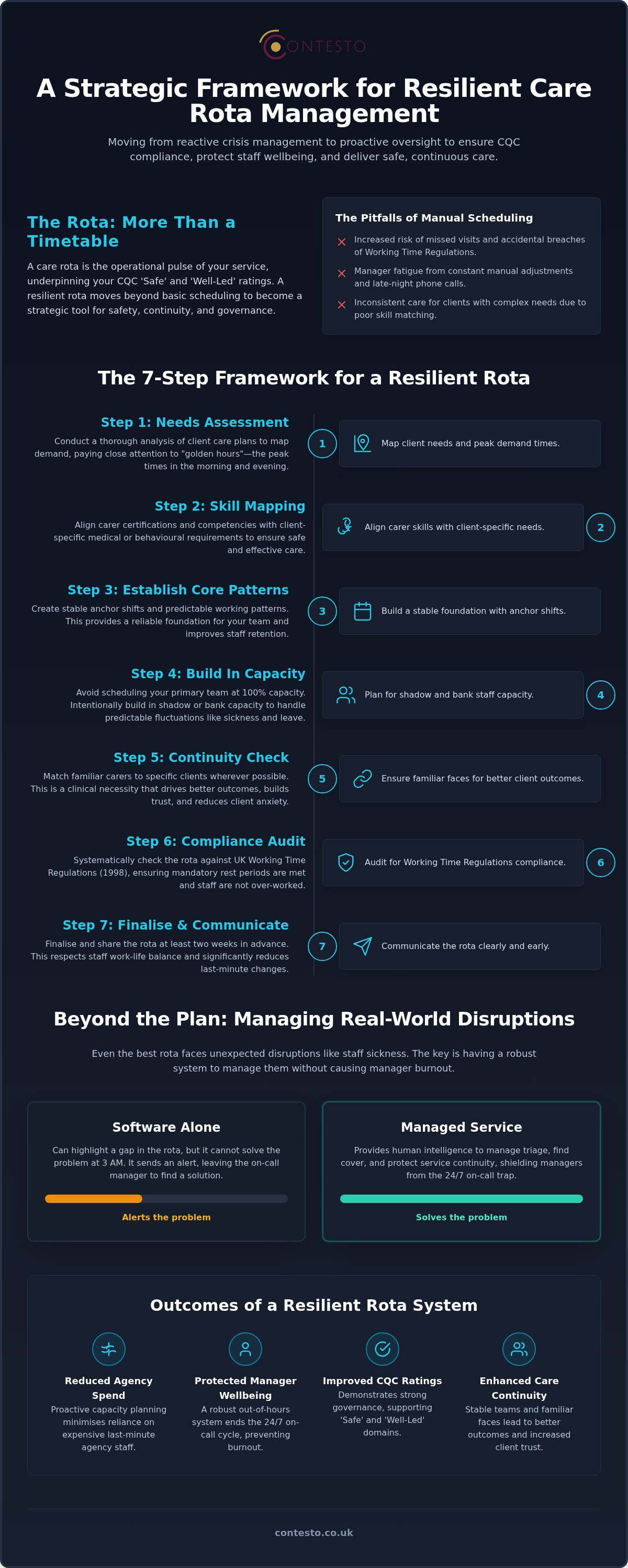
Constructing a rota is a strategic exercise in risk management. You should start by conducting a thorough needs assessment based on client care plans and "golden hours", those peak times in the morning and evening when demand is highest. Once demand is mapped, you must address Step 2: skill mapping. Skill mapping is the process of aligning carer certifications with client-specific medical or behavioural needs. This ensures your most complex clients aren't left with staff who lack the specific competencies required for their care.
Step 3 involves establishing core patterns and anchor shifts to provide a stable foundation for your team. Don't aim for 100% capacity in your primary team; Step 4 requires building in shadow or bank capacity to handle predictable fluctuations in demand. The debate over care rota management software vs service often centres on who handles these manual adjustments when the "perfect" plan meets the reality of staff sickness.
Ensuring Continuity and Compliance
Step 5 is a continuity check. Matching familiar faces to specific clients isn't just a staff preference; it's a clinical necessity that drives better outcomes and builds trust. You must then perform Step 6: a compliance audit. This ensures you meet regulatory requirements for staffing, specifically regarding the Working Time Regulations (WTR) and contracted hours to avoid overworking your team.
Communication and Finalisation
Finally, Step 7 requires you to finalise and communicate the rota at least two weeks in advance. This supports staff work-life balance and significantly reduces the likelihood of last-minute drop-outs. If the administrative weight of these seven steps feels overwhelming, exploring managed operational support can help you maintain this framework without sacrificing your own wellbeing.
Beyond the Grid: Managing Real-World Disruptions
Even the most meticulous 7-step framework is just a plan until the first sickness alert arrives. Real-world disruptions, such as car breakdowns or family emergencies, don't wait for office hours. This is where the choice between care rota management software vs service becomes critical. Software can highlight a gap, but it doesn't solve the problem at 3 AM. Effective managing staff sickness in care requires more than a digital alert; it needs immediate action to protect service continuity.
Without a robust out-of-hours triage process, managers fall into the "on-call trap". They remain tethered to their phones 24/7, unable to truly disconnect. This constant state of high alert is a primary driver of manager burnout in the UK care sector. A strategic out-of-hours solution acts as a shield, filtering minor issues and only escalating genuine emergencies to the leadership team.
The True Cost of Agency Dependency
Last-minute gaps often lead to a frantic reliance on staffing agencies. This isn't just an administrative failure; it's a financial one. Agency spend can quickly erode profit margins, especially as local authority funding remains tight. Beyond the cost, agency staff often lack the familiarity required for high-quality, person-centred care. This disruption lowers client satisfaction and can lead to safeguarding risks if temporary staff aren't fully briefed on a client's specific needs.
Protecting Manager Wellbeing
The psychological toll of being permanently "on duty" cannot be understated. To successfully scale a care business in the UK, you must decouple growth from the manager's administrative burden. If every new client or staff member adds to the manager's out-of-hours workload, the service will eventually buckle. Protecting your leadership team from operational fatigue is a commercial necessity, ensuring they have the mental capacity to focus on long-term governance and quality of care.
If you're struggling to balance the books whilst maintaining safe staffing levels, managed rota support can provide the stability your team needs.
Strategic Oversight: Moving from Fire-fighting to Operational Stability
Software is an essential tool, yet it's only half the solution for a busy UK care provider. A platform can track hours and alert you to gaps, but it doesn't have the human intelligence required to negotiate with a carer, re-prioritise visits, or manage staff anxiety during a sudden shortage. The choice between care rota management software vs service often comes down to who is responsible for the exceptions. Managed support provides the white-labelled operational layer that maintains service continuity whilst your management team sleeps. This ensures that client safety is never compromised by a lack of oversight.
How Managed Rota Support Works
Managed rota support functions as an integrated extension of your office. When sickness is reported, the team handles reallocations in real-time according to your specific provider policies. This removes the immediate administrative burden from the registered manager, allowing them to focus on high-level governance and ensuring the service is always inspection-ready. Instead of waking up to a list of uncovered calls, leadership receives a summary of resolved issues. It's a professional approach that ensures compliance with CQC safe staffing standards without requiring 24/7 manager intervention.
Achieving Long-Term Operational Resilience
True stability comes from moving beyond reactive fire-fighting. Achieving long-term operational resilience requires a shift toward proactive workforce management. This is where Contesto acts as an integrated extension of your team. We handle the complex, minute-by-minute adjustments that keep your rota intact, allowing you to focus on growth and quality. It's about building a service that doesn't just survive the night but thrives through consistent, reliable leadership. By handing over the bleep, you reclaim the mental space needed to lead your business with confidence.
Reclaiming Operational Control
Mastering care scheduling requires a blend of rigid frameworks and fluid responsiveness. A resilient rota isn't just about filling slots; it's about aligning staff competencies with client needs whilst maintaining strict CQC standards. When you weigh up care rota management software vs service, remember that technology provides the map, but a managed service provides the driver. By integrating expert support, you can insulate your management team from the relentless pressure of out-of-hours triage and last-minute sickness.
Building a sustainable operation means moving beyond the reactive cycle of agency reliance and manager burnout. With 24/7 On-Call Triage and CQC Compliance Monitoring, you can ensure your service remains safe and stable. This approach leads to reduced agency dependency and a healthier work-life balance for your leadership team. Discover how Contesto’s managed rota support can protect your business and your team. It's time to move past reactive scheduling and start leading your service toward a more predictable, profitable future.
Frequently Asked Questions
What are the legal requirements for care rotas in the UK?
Legal requirements for care rotas centre on the Working Time Regulations 1998 and CQC Regulation 18. You must ensure staff don't exceed an average 48-hour week unless they opt out and receive 11 hours of daily rest. Additionally, providers are legally required to keep staffing records for six years. Your rota serves as primary evidence that you have sufficient numbers of suitably qualified staff to meet client needs safely.
How far in advance should a care rota be published?
Most high-performing UK providers publish their rotas at least two to four weeks in advance. While there is no specific legal timeframe, early publication is essential for supporting staff work-life balance and reducing last-minute drop-outs. Giving carers visibility of their shifts allows them to plan personal commitments, which directly improves retention. This foresight also provides management with a clear window to identify and fill gaps before they become emergencies.
How can I reduce my care agency spend through better rota planning?
Reducing agency spend requires a shift from reactive filling to strategic workforce optimisation. By using bank staff and establishing core shift patterns, you can minimise the gaps that usually lead to high-cost agency calls. When choosing between care rota management software vs service, many providers find that managed support is more effective at utilising internal capacity. This approach ensures your own team is prioritised before turning to expensive external providers.
What is the best way to handle last-minute staff sickness in care?
The most effective way to handle last-minute sickness is through a robust out-of-hours triage process. This ensures that sickness reports are managed immediately by a coordinator who can reallocate shifts according to your specific policies. Relying on managed support rather than a manager's phone prevents burnout and ensures service continuity. This system allows for real-time adjustments that keep the service safe whilst protecting the leadership team from 24/7 operational pressure.
How does the CQC assess rota management during an inspection?
The CQC assesses rota management under the Safe and Well-Led domains to ensure your service is consistently and safely staffed. Inspectors look for evidence of competent leadership, such as how you manage sickness and whether staff have the right skill mix for their clients. They will review your records to check for compliance with the Working Time Regulations. A well-organised rota demonstrates strong governance and a commitment to both client safety and staff wellbeing.


Comments