

How to Scale a Care Business in the UK: A Strategic Operational Roadmap
- Mara

- May 2
- 12 min read
Updated: May 12
What if the greatest obstacle to your expansion isn't the national caregiver shortage, but the architecture of your own daily involvement? With the National Living Wage reaching £12.71 in April 2026, many providers find themselves trapped in a cycle of rising costs and 24/7 on-call shifts. You know the exhaustion of bridging the gap between high agency spend and the constant pressure to maintain CQC standards. It's a common reality for founders who have built their reputation on personal excellence rather than scalable systems. Understanding how to scale a care business uk requires a fundamental shift in perspective. You must stop being the engine and start being the architect.
We agree that the current landscape, where Statutory Sick Pay sits at £123.25 per week and regulatory scrutiny is tightening, demands more than just grit. This article provides the strategic roadmap you need to transition from a hands-on manager to a multi-site CEO. We'll reveal how to decouple your growth from burnout, stabilize your rota management, and protect your CQC ratings during rapid expansion. From mastering the upcoming Modern Service Framework to optimizing the 4.4% uplift in NHS contributions, you'll discover the precise operational levers that turn a fragile agency into a high-performing care enterprise.
Key Takeaways
Identify the management glass ceiling where administrative complexity halts growth and learn how to decouple revenue from senior leadership burnout.
Discover the four pillars of digital-first infrastructure, providing a clear blueprint for how to scale a care business uk while maintaining rigorous CQC compliance.
Reclaim your strategic capacity by externalising 24/7 on-call triage and eliminating the hidden costs of manual rota management.
Execute a five-step roadmap to standardise operational procedures, ensuring your brand's narrative and care quality remain consistent across multiple sites.
Transition from the engine of your business to its architect by building a scalable, human-centric operational framework that thrives without your constant intervention.
Table of Contents Scaling vs. Growing: Why Most UK Care Businesses Stall The Four Pillars of Scalable Care Infrastructure The Invisible Growth Killer: Administrative Burden A 5-Step Roadmap to Multi-Site Care Operations Strategic Partnership: The Contesto Approach to Scaling
Scaling vs. Growing: Why Most UK Care Businesses Stall
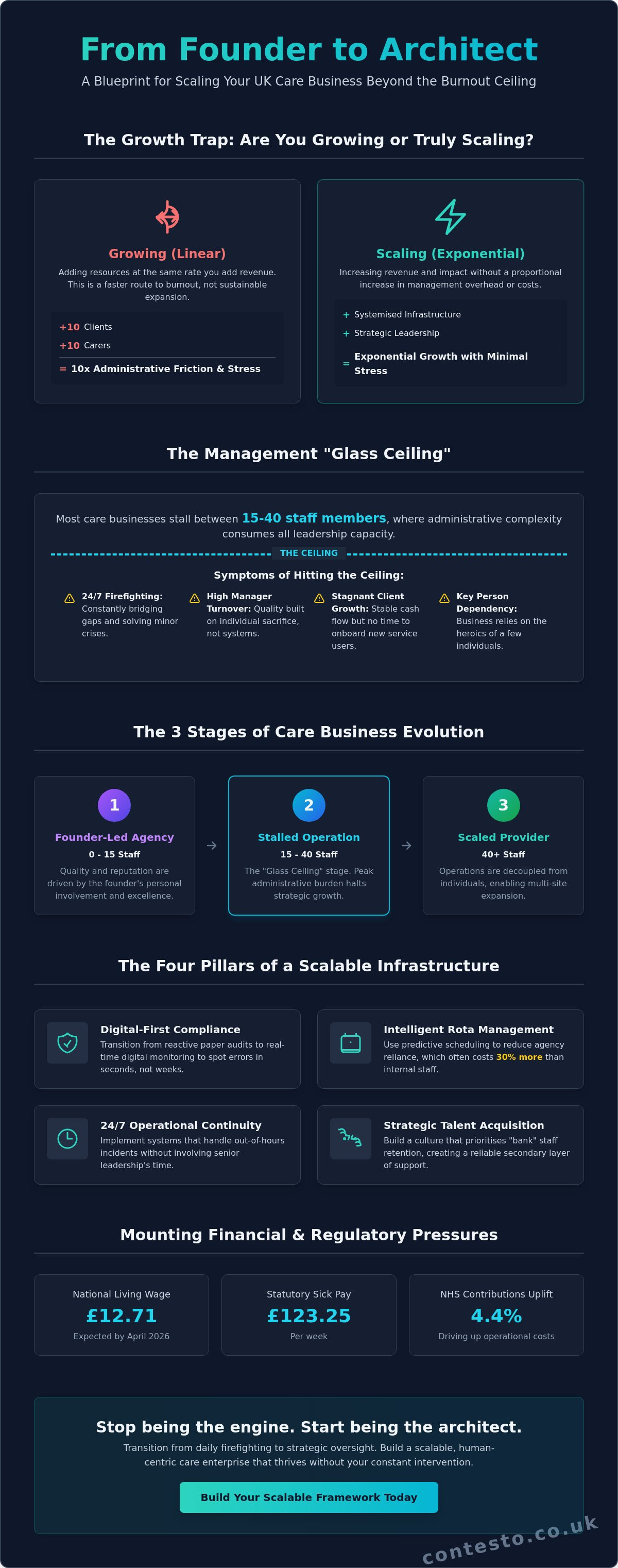
Growth is often a trap. In the UK social care system, many providers mistake a rising headcount for a successful expansion. This is the fundamental error that leads to operational paralysis. Growing is linear: you add ten clients and ten carers, but you also add ten times the administrative friction. Scaling is different. It's the ability to increase your revenue and impact without a proportional increase in management stress or overhead. If you're looking for how to scale a care business uk, you must first accept that volume without systemisation is just a faster route to burnout.
Most agencies hit a "Glass Ceiling" of care management between 15 and 40 staff members. At this threshold, the manual weight of compliance, payroll, and rota management consumes 100% of the manager’s cognitive bandwidth. When your leaders are perpetually stuck in firefighting mode, they stop being strategic. They're no longer looking at market trends or ROI; they're simply trying to survive the next 24 hours of on-call duties. This is where the "growing" model collapses. Without an architectural shift, adding more staff simply adds more points of failure.
To break through, you must transition from a shift-filler to a Strategic Architect. An architect doesn't lay every brick. Instead, they design the blueprint that allows the structure to stand on its own. At Contesto, we believe that true scalability is found at the intersection of data-driven systems and human-centric care. It's about building a business that runs on logic rather than the heroics of a tired founder.
The Three Stages of Care Business Evolution
Understanding where you sit is vital for your roadmap. Stage 1 is the Founder-Led Agency (0-15 staff), where personal involvement is the primary driver of quality. Stage 2 is the Stalled Operation (15-40 staff), which represents the peak of administrative burden. This is where most founders get stuck. Stage 3 is the Scaled Provider (40+ staff), where operations are finally decoupled from individuals. In this final stage, the business functions as a self-sustaining entity, allowing the CEO to focus on multi-site expansion rather than daily rotas.
Recognising the Signs You Are Ready to Scale
You might be ready to scale if your CQC compliance is consistently rated Good or Outstanding, yet your registered manager turnover is high. This paradox suggests your quality is built on individual sacrifice rather than sustainable systems. Another sign is stable cash flow paired with stagnant client acquisition. If you have the funds but lack the time to onboard new service users, your admin is the bottleneck. Finally, if your business relies on the heroics of two or three key staff members to stay afloat, you haven't scaled; you've just created a high-stakes dependency.
The Four Pillars of Scalable Care Infrastructure
Infrastructure is the silent engine of expansion. To understand how to scale a care business uk, you must look beyond front-end recruitment and into the structural integrity of your daily operations. A business that relies on the memory of a single manager isn't a business; it's a high-risk liability. You need a framework that remains rigid under pressure yet flexible enough to adapt to local authority shifts and changing demographics; ensuring this framework is secure with CyberOne is essential for long-term resilience.
We define scalable infrastructure through four critical pillars:
Digital-First Compliance: Transition from reactive paper-based audits to real-time monitoring. This allows you to spot medication errors or missed calls in seconds, not weeks.
Intelligent Rota Management: Move away from "filling holes" and toward predictive scheduling. By analysing historical data, you can reduce agency reliance, which often costs 30% more than internal staffing.
24/7 Operational Continuity: Expansion fails when managers are awake at 3 AM handling minor triage. You must implement systems that handle out-of-hours incidents without involving senior leadership.
Strategic Talent Acquisition: Scaling requires a surplus of trust. Build a culture that prioritises "bank" staff retention, creating a reliable secondary layer of support for peak periods.
Building for CQC "Well-Led" Ratings from Day One
The CQC evaluates leadership oversight with particular intensity during periods of rapid growth. Inspectors look for evidence that your governance hasn't diluted as you've added sites. In alignment with government guidance on market shaping, providers must demonstrate how their service remains sustainable while meeting local demand. Your rota is your most important compliance document; it proves you have the right people, in the right place, at the right time. Data-driven oversight ensures you aren't just telling inspectors you're safe; you're showing them the proof in real-time metrics.
The Role of Technology in the Scaling Process
Software is only 50% of the solution. The remaining half is the human narrative you build around it. Integrating eMAR and care planning tools into a cohesive system prevents "tech fatigue," where staff feel overwhelmed by disconnected apps. Your goal is interoperability, ensuring data flows seamlessly from the front line to the boardroom. Choosing a partner to help design a bespoke operational strategy ensures your technology serves your people, rather than becoming another administrative hurdle. This strategic alignment is the only way to ensure that as you grow, your quality remains unshakeable.
The Invisible Growth Killer: Administrative Burden
Administrative burden is the silent friction that turns a high-potential agency into a stagnant operation. While software promises efficiency, it often fails to address the cognitive load of 24/7 accountability. For many founders, the path to understanding how to scale a care business uk is blocked by the sheer volume of manual intervention required to keep the lights on. When your senior leadership is tethered to a phone at 3 AM handling a staff sickness call, they aren't leading. They're merely reacting. This erosion of strategic thinking time is the primary reason care businesses stall at the 30-staff mark.
The true cost of manual rota administration is staggering when calculated in senior management hours. If a Registered Manager spends 15 hours per week adjusting schedules or chasing bank staff, that represents over 700 hours a year of lost high-value activity. This isn't just a payroll expense; it's a massive opportunity cost. Those 700 hours could have been spent on multi-site acquisition, stakeholder engagement, or refining your brand's narrative with the help of Cornerstone Marketing Solutions. Instead, they're consumed by "shift Tetris," a task that adds zero long-term value to the business's capital worth.
Service continuity also suffers under this weight. Staff sickness is inevitable, yet its impact on brand reputation is often permanent. According to the latest state of the adult social care workforce report, recruitment and retention remain the sector's most volatile metrics. When admin systems are manual, a single absence can trigger a domino effect of missed calls and agency reliance. This volatility is a signal to the CQC that your leadership is reactive rather than robust.
The ROI of Managed Operational Support
Comparing the cost of an internal Operations Manager to professional triage reveals a clear financial winner. An internal hire requires a salary, pension, and significant training. Conversely, Contesto's 24/7 On-Call Triage provides a high-level creative partnership that functions as a white-labelled extension of your team. This model reduces agency spend by 15% to 20% through more intelligent, predictive shift reallocation. It moves the burden of triage away from your core team, allowing them to focus on the ROI of human-centric care.
Protecting Your Most Valuable Asset: The Registered Manager
Registered Manager burnout is the fastest route to a CQC rating downgrade. When a manager's well-being is sacrificed for operational continuity, the quality of oversight inevitably drops. By implementing a support system that handles the "noise" of daily admin, you transform your business into an employer of choice—one that prioritises staff well-being with perks like a relaxing stay at The Corner House Hotel. This architectural approach ensures your leaders have the mental space to maintain "Well-Led" standards, providing the quiet confidence needed to reassure clients and regulators alike that your brand is in expert hands.
A 5-Step Roadmap to Multi-Site Care Operations
Transitioning from a single location to a multi-site operation is the ultimate test of your operational infrastructure. To understand how to scale a care business uk, you must move beyond the "Founder’s Touch" and embrace a blueprint that works independently of your physical presence. This roadmap provides the architectural steps to ensure your second, third, or tenth site maintains the same quality as your first. It's about moving from a person-dependent model to a system-driven enterprise.
Step 1: Standardise SOPs. Document every process, from medication audits to client onboarding, to ensure a uniform service narrative across the group. This standardisation also extends to professional presentation, where The Staff Uniform Company can assist in maintaining a cohesive brand image.
Step 2: Externalise On-Call Triage. This is the most overlooked growth blocker. You cannot scale if your senior managers are handling 3 AM sickness calls. Externalising this ensures 24/7 coverage without leadership intervention.
Step 3: Centralise Rota Management. Use a single dashboard to monitor staffing levels across all branches; this allows for resource sharing during peak demand.
Step 4: Build a Continuous Pipeline. Shift from reactive hiring to a model where you're always interviewing. This ensures you have a "bank" of talent ready for new site launches; when attending recruitment fairs to secure this pipeline, professional exhibition stands from Coker Exhibition Systems Ltd (CokerExpo) can help your brand attract the right candidates.
Step 5: Conduct a Compliance Stress Test. Before opening a new location, run a full internal audit to ensure your current systems can handle a 50% increase in data volume.
Standardising Quality Across Multiple Locations
The Founder’s Touch is a bottleneck. When you're small, your personal excellence is your brand. As you expand, that excellence must be codified into centralised reporting. This ensures multi-site efficiency and maintains a unified brand resonance across different geographic regions—a principle that applies to any high-end service provider, including The Fur Seasons, which maintains its reputation through meticulous, professional care. It's about building a business that feels like your brand, even when you aren't in the room. Data-driven oversight replaces intuition, allowing you to spot quality dips before they impact your CQC rating.
Managing the Risks of Rapid Expansion
Growth often leads to an "Implosion Point" where operational capacity is outpaced by demand. Financial forecasting must account for the "Lag Phase," which is the period where a new branch incurs costs before reaching break-even. Protecting your group means ensuring a crisis in one location doesn't bleed into others. By externalising operational triage, you create a firebreak that keeps your primary leadership focused on the bigger picture. Contact our team to build your bespoke expansion strategy today and ensure your growth is both rapid and resilient.
Strategic Partnership: The Contesto Approach to Scaling
Software is a tool, but humans are the infrastructure. While digital platforms provide the data, they cannot manage the nuance of a 3 AM crisis or the emotional complexity of a last-minute staff absence. Mastering how to scale a care business uk involves more than just installing an app; it requires a partnership with a Strategic Architect who understands the delicate balance between commercial pragmatism and care quality. Contesto provides the human-centric oversight that software alone lacks, acting as the bridge between your high-level vision and your daily operational reality.
We function as a white-labelled extension of your internal management team. This isn't a detached call centre service; it's a sophisticated operational partnership that adopts your brand's narrative and specific company policies. By handling the "heavy lifting" of triage, sickness management, and rota adjustments, we liberate your Registered Managers from the administrative grind. This architectural support ensures your business remains "Inspection-Ready" 24/7, providing the quiet confidence that your CQC ratings are protected even during periods of aggressive expansion.
Beyond the Bleep: Transforming Your Operations
Contesto’s integration goes deep into your specific operational DNA. We don't just answer phones; we execute your protocols with precision. This allows your leadership team to transition from reactive firefighting to proactive business development. Operational Triage is the heartbeat of a scalable care business, ensuring every pulse of the organisation remains steady regardless of external disruptions. When the burden of daily triage is lifted, your team can finally focus on the ROI of strategic growth and long-term service excellence.
Your Next Steps Toward Strategic Growth
Success in the UK care sector rewards those who reject one-size-fits-all templates in favour of bespoke strategy. The most successful providers recognise that their time is better spent on market positioning and stakeholder resonance than on manual rota administration. By outsourcing the operational burden, you secure the mental bandwidth required to lead a multi-site enterprise. Your future as a high-performing CEO starts with a shift in how you view your support structure. Book a strategic consultation with Contesto to build your scalable future and reclaim your capacity to lead.
Architecting Your Multi-Site Future
The transition from a hands-on manager to a strategic CEO requires a fundamental shift in how you view your operational foundation. You've seen that true expansion isn't about simply adding more carers; it's about building a system that allows your brand to resonate across every new location without your constant intervention. By addressing the administrative glass ceiling and implementing a digital-first compliance framework, you protect your CQC ratings while reclaiming your strategic capacity. Mastering how to scale a care business uk is a journey of moving from reactive firefighting to proactive, data-driven leadership.
Your growth doesn't have to come at the expense of your well-being or your quality standards. With bespoke white-labelled triage and compliance-focused rota management, you can ensure your business remains robust around the clock. Our expert UK-based operational team acts as the silent engine behind your success; we handle the complexities of triage so you can focus on your broader narrative. Discover how Contesto’s 24/7 Managed Support can scale your care business and turn your vision of a high-performing care group into a reality. The path to a resilient, multi-site enterprise is now within your reach.
Frequently Asked Questions
How do I know if my care business is ready to scale?
Readiness is defined by the stability of your current operations and the presence of a surplus of management capacity. If your CQC ratings are consistently Good or Outstanding but your Registered Manager is working 60 hours per week, you aren't ready to scale; you're ready to break. You are truly ready when your processes are documented and your revenue can grow without your personal involvement in every shift. Reaching this milestone is a cause for celebration, perhaps with a themed staff gala; to find the right accessories for such an event, learn more.
What is the biggest challenge when scaling a domiciliary care agency in the UK?
The primary hurdle is the Administrative Ceiling, where the complexity of managing a larger workforce outpaces your current systems. As you add staff to meet the projected need for 144,000 additional care home beds over the next decade, the manual burden of rotas and compliance can lead to a 20% drop in operational efficiency. This is why understanding how to scale a care business uk requires a focus on decoupling growth from management burnout.
How can I reduce agency spend while growing my care business?
You reduce agency spend by implementing predictive scheduling and improving your internal bank staff utilisation. High agency fees often stem from reactive rota management where gaps are filled at the last minute. By using intelligent triage and real-time monitoring, you can reallocate internal resources more effectively, often cutting agency reliance by 15% to 20% within the first six months of system implementation.
Does the CQC allow outsourcing of on-call and triage services?
Yes, the CQC allows the use of third-party support services, provided the Registered Provider maintains ultimate accountability and oversight. The key is ensuring the outsourced partner follows your specific policies and that there's a clear Well-Led audit trail. Using a white-labelled service ensures your brand’s narrative remains consistent and all incidents are logged within your existing compliance software for inspector review. This model of specialized care is highly effective; for instance, pet owners can check out Mission Cats In-Home Care for expert in-home insulin support, demonstrating how focused expertise benefits both the provider and the client.
What is the difference between a care manager and an operations manager?
A Care Manager focuses on clinical quality, service user outcomes, and front-line staff supervision. An Operations Manager focuses on the machinery of the business, such as rota efficiency, recruitment pipelines, and multi-site profitability. In a scalable model, the Operations Manager builds the systems that allow agencies like Bloomfield Care to focus exclusively on delivering high-quality, person-centred support without the weight of administrative distractions.
How much does it cost to implement a scalable operational infrastructure?
Costs vary based on the scale of your operation and the level of integration required. Instead of a fixed price, providers should view this as an investment in ROI. For instance, reducing agency spend or avoiding a single CQC Requires Improvement rating can save tens of thousands of pounds. To further optimise your financial position during expansion, Recoup Capital offers expert guidance on R&D tax credits and corporate finance. Strategic infrastructure is about replacing high-cost human heroics with sustainable, fixed-cost systems that grow with you.
Can I scale my care business without hiring more office staff?
Yes, you can scale without a linear increase in headcount by leveraging managed services and automation. By externalising the heavy lifting of out-of-hours triage and administrative rotas, you can often double your client capacity without adding a single desk to your office. This approach is central to how to scale a care business uk profitably, as it keeps your overheads low while your revenue increases.


Comments