

Safeguarding Risks with Temporary Agency Staff: An Operational Guide for Care Managers
- Mara

- May 22
- 10 min read
It is 3:00 AM on a Sunday, and an agency worker you met for five minutes during a handover is now the primary point of contact for your most vulnerable residents. You know that maintaining a full rota often requires these last-minute bookings, but the lack of personal familiarity creates a persistent, quiet anxiety. It is a common pressure; you want to trust every professional in your building, yet you cannot ignore the inherent safeguarding risks with temporary agency staff that arise when oversight is stretched thin.
Securing your service requires more than just a signed timesheet. This guide identifies the hidden vulnerabilities created by agency reliance and explains how to build a robust oversight framework that protects both your residents and your CQC rating. We will examine practical strategies for continuous vetting, better out-of-hours control, and the operational systems needed to keep your service safe, compliant, and well-led. By moving from reactive management to strategic governance, you can ensure that quality of care remains consistent, regardless of who is on the shift.
Key Takeaways
Recognise that standard DBS checks are merely a baseline and learn to identify "disguised compliance" where temporary workers follow rules but miss subtle resident needs.
Mitigate the specific safeguarding risks with temporary agency staff by implementing internal verification protocols that exceed basic agency-supplied documentation.
Establish a "Gold Standard" induction process, including mandatory shadowing, to align temporary staff with your specific resident care standards and safety culture.
Strengthen out-of-hours oversight with robust handover procedures, ensuring critical resident information is never lost during night shift transitions.
Shift from reactive staffing to proactive rota management to minimise the operational dependency on last-minute bookings and secure your CQC rating.
Table of Contents
The Invisible Vulnerabilities: Identifying Safeguarding Risks with Temporary Agency Staff
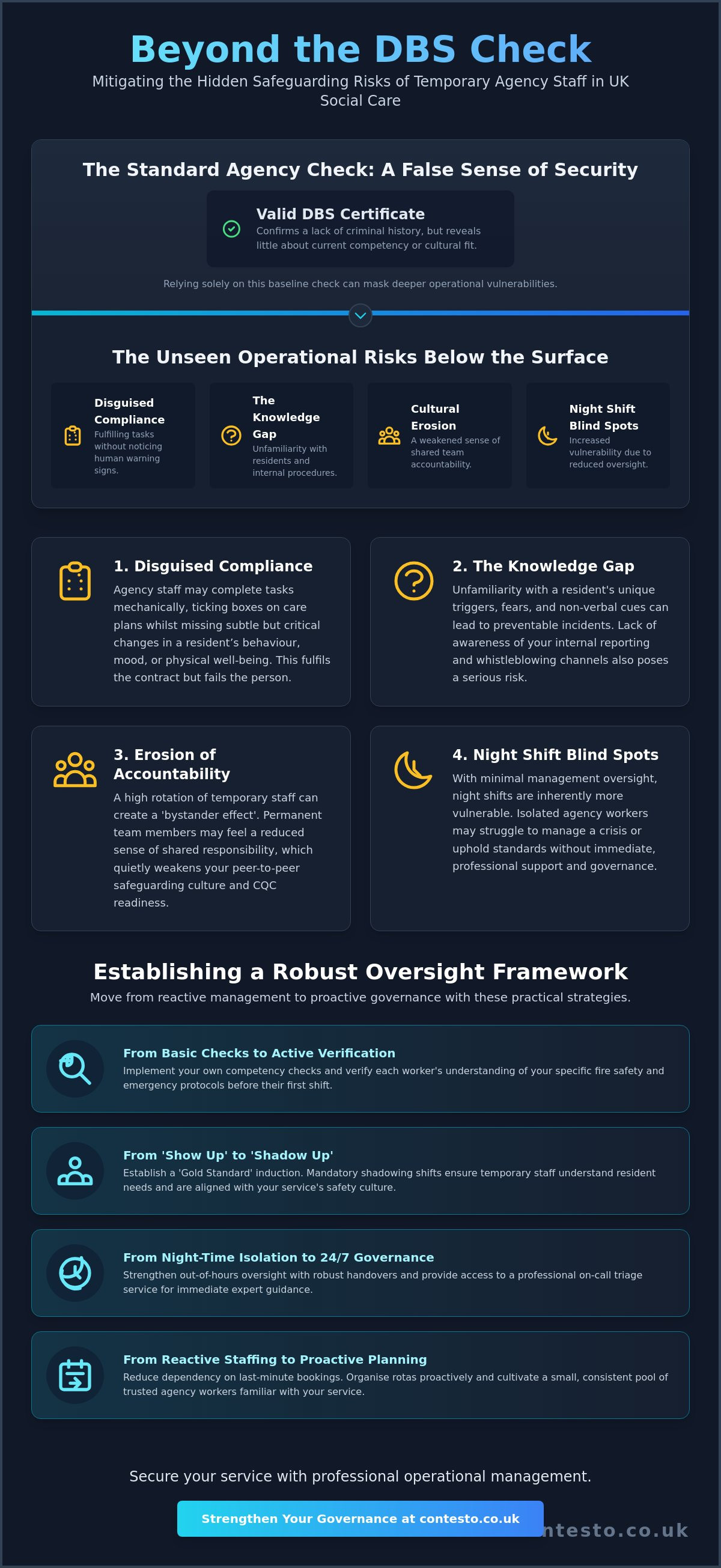
Effective Safeguarding in a care environment is far more than a clinical checklist of valid DBS certificates and training dates. It is an active, daily vigilance that relies on knowing a resident's baseline behaviour so well that even subtle shifts are caught. When you rely on external providers, the safeguarding risks with temporary agency staff often manifest as "disguised compliance." A worker might complete every task on the care plan, ticking boxes for personal care and nutrition, yet fail to notice a resident with dementia is uncharacteristically withdrawn or hasn't had a bowel movement in three days. This mechanical approach to care fulfills the contract but misses the human warning signs.
High agency dependency can quietly erode the internal safeguarding culture of your permanent team. If your core staff see a revolving door of new faces, they may stop feeling a sense of shared responsibility for the floor. This inconsistency is particularly dangerous for residents with complex communication needs who rely on staff knowing their specific non-verbal cues. Without that continuity, the risk of neglect or misunderstood distress increases significantly, placing both the resident and your CQC rating under pressure.
The Knowledge Gap: Why Unfamiliarity is a Safeguarding Risk
Unfamiliarity creates operational blind spots. An agency worker might be technically proficient in manual handling but unaware of a specific resident's fear of the hoist or a particular trigger that leads to distressed behaviour. This lack of nuance leads to incidents that are often recorded as "unavoidable" when they were actually preventable. Without a deep understanding of your local reporting software and specific whistleblowing channels, temporary staff may inadvertently bypass critical safeguarding procedures simply because they don't know the specific internal protocols for your service.
The Cultural Risk: Erosion of Accountability
When a care floor is staffed by a high density of agency workers, the "bystander effect" often takes hold. Permanent staff might assume that someone else has checked a skin integrity issue or that the agency nurse has completed the medication audit. This diffusion of responsibility makes it difficult to maintain the CQC "Safe" KLOE. Peer-to-peer reporting, a vital component of a healthy culture, often vanishes when staff don't know their colleagues' names, let alone their professional habits. This creates a vacuum where poor practice can go unchallenged.
Beyond the DBS Check: Cultural and Procedural Safeguarding Gaps
Relying solely on a folder of agency-vetted documents creates a false sense of security. While a DBS check confirms a lack of criminal history, it doesn't guarantee current competency or cultural alignment with your service's values. Managers must remember that Protecting Temporary Workers and the residents they serve is a shared responsibility, requiring internal verification of skills before a shift begins. Blindly trusting an agency's compliance file without checking a worker's understanding of your specific fire safety or emergency protocols is an operational gamble that can leave your service vulnerable.
There is also a notable deficit in "professional curiosity" among short-term staff. Permanent employees often notice when a resident’s mood shifts slightly, but an agency worker might view a resident's withdrawal as simply "a quiet day." This lack of investigative depth is one of the primary safeguarding risks with temporary agency staff. When combined with poorly managed staff sickness, where last-minute gaps are filled by whoever is available, the resulting pressure on ratios can lead to rushed, unsafe care that bypasses your standard governance.
The Hidden Risks of the Night Shift
Night shifts are inherently more vulnerable because management oversight is typically absent. In the quiet hours, the lack of a visible authority figure can lead to a relaxation of standards or, worse, unobserved misconduct. Without a senior manager on-site, agency staff may feel isolated or overwhelmed when facing a crisis. Implementing a professional 24/7 on-call triage service provides a necessary layer of governance, ensuring that temporary workers have immediate access to expert guidance when a safeguarding concern arises in the middle of the night. This safety net reduces the burden on your permanent managers while maintaining strict operational control.
Communication Failures and Handovers
Verbal-only handovers are a significant point of failure in the care cycle. Information about a resident's escalating agitation or a specific fall risk often gets lost in translation between shifts, especially when the recipient is unfamiliar with the service. Agency staff must have immediate, secure access to digital care records rather than relying on snippets of conversation. An effective handover is the bridge between theoretical safety and practical protection. Without written, accessible risk assessments, a temporary worker is essentially working in the dark, increasing the safeguarding risks with temporary agency staff during every shift transition.
Establishing a Robust Oversight Framework for Agency Integration
Registered Managers often feel they must choose between filling a rota gap and maintaining absolute safety. This is a false choice. A robust framework allows you to manage safeguarding risks with temporary agency staff by treating them as integrated team members rather than temporary stop-gaps. The goal is to move from passive acceptance of agency-vetted profiles to active, internal validation of their performance on your floor. Oversight isn't just about checking a badge; it's about ensuring every person in your building operates to your specific standards.
A "Gold Standard" for integration starts with a non-negotiable shadowing period. Even the most experienced agency nurse won't know the specific layout of your dementia wing or the subtle ways a resident expresses discomfort. This shadowing isn't a lack of trust; it's a verification of competence. Aligning your internal protocols with NHS England Safeguarding Guidance ensures that every worker, regardless of their employer, understands their personal accountability within your specific service. When everyone follows the same playbook, the safeguarding risks with temporary agency staff are significantly reduced.
A 5-Step Induction Checklist for Temporary Workers
A structured induction shouldn't take hours, but it must be methodical. Every new worker should complete these steps before their first solo interaction with a resident:
Immediate orientation of the physical environment, including emergency exits, call-bell systems, and clinical waste points.
Direct review of high-risk care plans, specifically focusing on residents with complex behavioural triggers or specific choking risks.
Clarification of the local reporting lines and the specific steps required to raise a safeguarding concern within your organisation.
Verification of competency with specific equipment used in your home, such as particular hoist models or digital medication records.
Introduction to the senior member of staff responsible for their oversight and support during that specific shift.
Monitoring Behaviour and Performance in Real-Time
Oversight shouldn't stop once the induction is signed. Managers need to implement regular "walk-arounds" and spot checks, especially during agency-heavy periods like weekends or night shifts. Gathering feedback from residents and their families about their interactions with temporary staff provides an invaluable perspective that paperwork cannot capture. To maintain this level of scrutiny without manager burnout, many providers use professional operational support to monitor shift attendance and compliance metrics in real-time. This allows the Registered Manager to focus on clinical quality while the system flags potential gaps in the rota before they become safeguarding incidents.
Mitigating Risk Through Professional Operational Management
Professional managers understand that while agency staff are a necessary resource, they should never be the foundation of a care service. Transitioning from a reactive, shift-by-shift survival mode to a managed staffing strategy is the most effective way to reduce safeguarding risks with temporary agency staff. By prioritising a "Bank-first" approach, you ensure that even your temporary workers have a baseline level of familiarity with your residents, your culture, and your specific safety protocols. Continuity is the enemy of risk; the more a worker knows a resident, the less likely they are to miss a critical change in health or behaviour.
Building a robust internal bank requires an investment in culture, but the payoff is operational stability. Unlike external agency staff, bank workers are often former employees or locals who have undergone your specific induction and understand your reporting lines. This internal knowledge significantly lowers the likelihood of communication breakdowns that lead to safeguarding incidents. It allows your permanent team to work alongside people they trust, restoring the peer-to-peer accountability that is often lost in high-agency environments.
Reducing Agency Dependency to Improve Safety
Careful rota management is a safety mechanism. When rotas are planned with foresight, the need for high-risk, last-minute agency bookings evaporates. This stability creates a calmer environment for residents and reduces the pressure on permanent staff who often bear the burden of supervising unfamiliar colleagues. Understanding how to scale a care business UK requires a focus on this operational stability. A staff-first culture doesn't just improve retention; it builds a protective barrier around your residents by ensuring that care is delivered by people who are invested in the home’s long-term success. Fewer strangers in the building means fewer opportunities for safeguarding gaps to go unnoticed.
The Contesto Approach: 24/7 Oversight and Triage
Operational gaps don't just happen during office hours. Safeguarding oversight must be a 24/7 commitment. At Contesto, our approach to operational support includes 24/7 on-call triage and sickness management, providing a safety net that never sleeps. We ensure that when a staff member calls in sick at 4:00 AM, the replacement process follows your specific safety standards and compliance policies. Our team manages the immediate crisis, ensuring that any reallocation of staff maintains safe ratios and skill mixes. By removing the administrative weight of emergency cover from your Registered Managers, we allow them to focus on high-level governance and clinical quality. This strategic partnership ensures that your service remains safe, well-led, and fully compliant, even when the unexpected happens.
Securing Your Service Through Strategic Oversight
Managing a care service in the UK requires a shift from reactive problem-solving to a model of continuous governance. By moving beyond basic document checks and implementing structured inductions, shadowing, and real-time monitoring, you transform temporary workers from a potential liability into a reliable resource. We have explored how proactive rota planning and the development of internal bank staff can significantly reduce the safeguarding risks with temporary agency staff, ensuring that your CQC "Safe" and "Well-Led" ratings remain protected even during high-pressure periods.
Maintaining this level of scrutiny doesn't have to lead to manager burnout. Discover how Contesto’s 24/7 On-Call Triage protects your service continuity and safeguarding standards. Our expert UK-based triage teams provide professional management of staff sickness and rota gaps, ensuring all shift reallocations align with your specific safety standards and CQC requirements. This operational support allows you to focus on high-level governance while we handle the complexities of out-of-hours coordination.
With the right operational framework in place, you can lead with confidence, knowing your residents are protected by a system designed for resilience and consistency.
Frequently Asked Questions
What are the most common safeguarding risks when using agency staff in care homes?
The most frequent risks involve a lack of familiarity with resident-specific triggers and "disguised compliance," where tasks are ticked off without genuine clinical engagement. These safeguarding risks with temporary agency staff often lead to missed signs of distress or misunderstood behaviours, particularly in residents with dementia. Communication gaps during verbal handovers also create vulnerabilities where critical risk information isn't passed on correctly.
How can I check if an agency worker is properly trained for safeguarding?
You should request a validated training matrix from the agency and verify that the worker has completed the updated Care Certificate (March 2025) and the Oliver McGowan Mandatory Training. It's also best practice to perform a brief verbal competency check during their initial induction. Asking a worker how they'd handle a specific safeguarding scenario in your home confirms they can apply their training to your local environment.
Does the CQC penalise care providers for using too much agency staff?
The CQC doesn't penalise for the use of agency staff itself, but they will assess how you manage those staff under Regulation 18. Their priority is ensuring that all workers, regardless of their contract type, are competent, properly supervised, and safe. If high agency reliance leads to inconsistent care or a lack of oversight, it'll likely result in a lower rating for the "Safe" and "Well-Led" KLOEs.
What should be included in an agency staff induction for safeguarding purposes?
An induction must prioritise your local reporting lines, whistleblowing policy, and the location of emergency equipment. It's essential to provide a briefing on residents with high-risk care plans, such as those with specific choking risks or complex behavioural needs. Temporary staff must also know exactly how to access your digital care records and who the designated safeguarding lead is for that specific shift.
How can I monitor the quality of care provided by agency staff during the night?
Monitoring night-shift quality relies on regular audits of digital care logs and gathering feedback from residents who are awake. You can check for patterns of "batch-recording," where care entries are made all at once rather than in real-time. Implementing a 24/7 on-call triage service also ensures that agency workers have a senior point of contact to report concerns or seek guidance during the most vulnerable hours.
What is the best way to handle a safeguarding concern involving a temporary worker?
You must follow your standard safeguarding policy by immediately removing the worker from duty to ensure resident safety. Once the immediate risk is managed, you're required to notify your local authority safeguarding team and the CQC. It's also vital to inform the staffing agency so they can conduct their own investigation and ensure the worker isn't placed in other vulnerable settings whilst the case is reviewed.


Comments