

Strategic Outsourced Operational Support for UK Care Providers
- Mara

- Aug 11
- 8 min read
Updated: 1 day ago
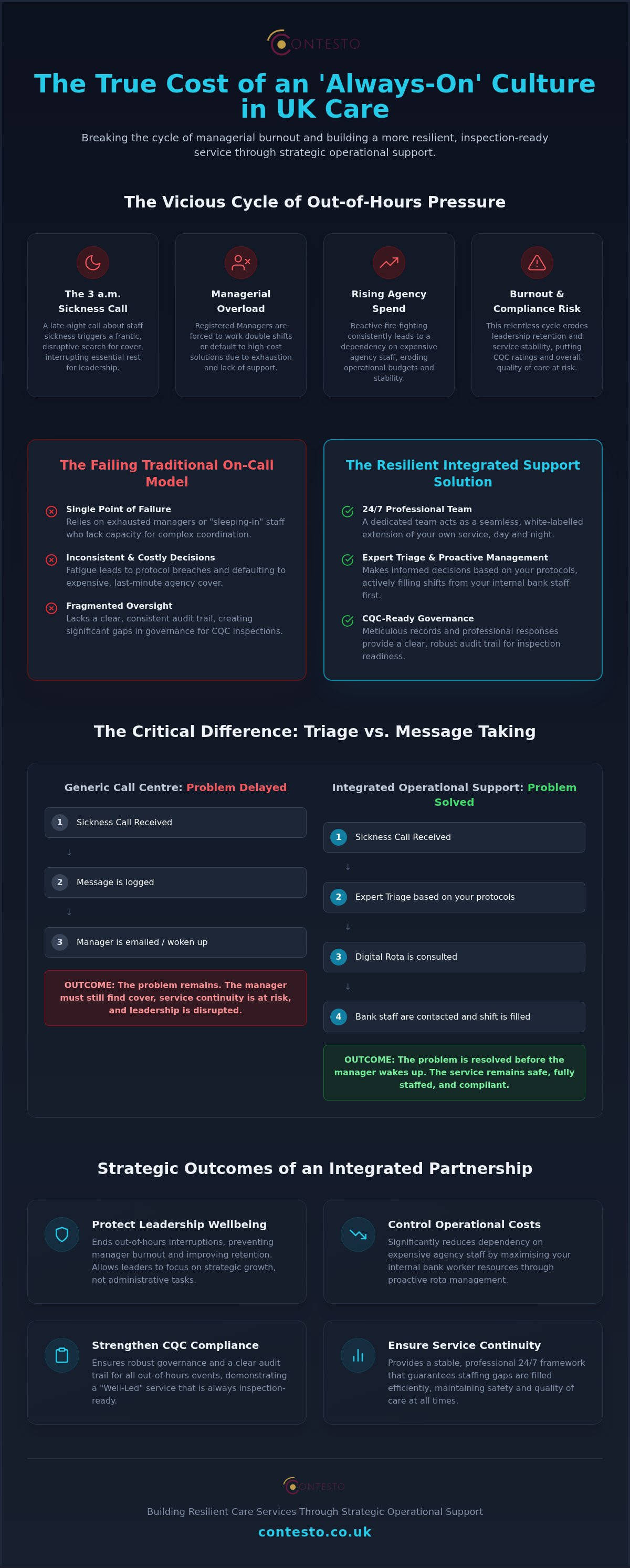
If your Registered Manager is still answering the phone at 3 a.m. to handle a staff sickness, your service isn't just under pressure; it's at risk of systemic burnout. It's a familiar cycle where a late-night call leads to a frantic search for cover, often resulting in expensive agency spend or a manager working a double shift just to maintain basic safety. We understand that the weight of CQC compliance and the constant need for service continuity can make it feel impossible to switch off. Integrating professional outsourced operational support for care providers offers a way to break this cycle, providing a stable, 24/7 framework that protects your leadership team.
In this article, you'll discover how to alleviate the administrative burden on managers whilst maintaining rigorous standards and reducing your dependency on high-cost agency staff. We will explore the mechanics of professional triage, the benefits of proactive rota management, and how a strategic operational partnership ensures your service remains inspection-ready, even during the most challenging shifts. By moving away from reactive firefighting, you can build a more resilient organisation that prioritises both staff wellbeing and commercial stability.
The Hidden Cost of the Always-On Culture in UK Care
Registered Managers in the UK are often trapped in a cycle of perpetual availability, where the administrative burden of out-of-hours coordination stifles professional development. When a manager is woken at 3 a.m. to resolve a staffing gap, the immediate cost is sleep, but the long-term cost is the erosion of service stability and leadership retention. This constant state of fire-fighting sickness and shift gaps prevents providers from focusing on growth or quality improvement. Adopting Business process outsourcing (BPO) through dedicated outsourced operational support for care providers is a strategic integration that functions as a seamless extension of your team, providing professional triage rather than just a basic call-handling service.
Why Traditional On-Call Models are Failing Care Providers
Relying on "sleeping-in" staff or rotating on-call duties amongst exhausted managers creates a single point of failure. Tired personnel are more likely to make inconsistent decisions, often opting for high-cost agency cover because they lack the capacity to follow complex internal rota protocols. This model doesn't just lead to burnout; it drives up operational costs and creates a fragmented approach to workforce management that lacks the precision required in modern social care.
The Link Between Operational Stability and CQC Ratings
A provider's ability to maintain oversight at all times is central to the CQC’s "Well-Led" key question. Robust systems ensure that every out-of-hours incident is met with a professional response and a clear audit trail. This level of governance is vital during inspections, as it demonstrates that the service has the resilience to manage staff sickness and service continuity without compromising safety or quality. Professional outsourced operational support for care providers through Contesto ensures that these records are meticulous, accurate, and always ready for review.
What Does Integrated Operational Support Actually Look Like?
Integrated support functions as a white-labelled extension of your own office. It isn't a detached third-party service; it's a seamless part of your team that answers calls in your brand name. When outsourced operational support for care providers is truly integrated, the support team knows your staff, your service users, and your specific protocols. They don't just take messages; they act on them using the same logic your own managers would apply.
Consider a 3 a.m. sickness call. A generic call centre would simply log the absence and email the manager. In contrast, an integrated team acknowledges the sickness, immediately consults your digital rota, and begins contacting bank staff based on your priority list. They resolve the gap before your manager even wakes up. This ensures service continuity without a single interruption to leadership sleep, keeping the service safe and compliant while everyone else rests.
Triage vs. Message Taking: The Critical Difference
Expert triage involves making informed decisions based on clinical and operational intelligence. This distinction is vital given the current research on England's social care crisis, which highlights how systemic pressures require more than just superficial fixes. Effective outsourced operational support for care providers solves problems at the source. Message taking merely delays the inevitable workload for your Registered Manager, whereas triage removes the problem entirely.
Rota Management as a Cost-Saving Strategy
Active coordination of bank workers is the most effective way to reduce dependency on expensive external agencies. By managing your existing care coordination software and digital platforms, an operational partner can maximise your internal resources and ensure shift coverage whilst protecting your margins. If you are looking to stabilise your out-of-hours costs, exploring integrated operational solutions can provide the necessary oversight and financial control.
Evaluating a Strategic Partner for Your Care Operations
Choosing a partner for outsourced operational support for care providers isn't merely an administrative decision; it's a clinical and operational safeguard. Generic call centres often lack the nuance required to navigate UK safeguarding laws or the complexities of the Care Act 2014. A strategic partner must demonstrate a deep understanding of the UK care landscape, ensuring their 24/7 availability is backed by rigorous handover processes that leave no room for error. When your operational support is truly integrated, it feels like an internal department that knows your staff and service users by name, rather than a detached third party.
Key Questions to Ask a Potential Operational Partner
What are your specific protocols for escalating safeguarding concerns during out-of-hours shifts?
How do you ensure your team stays updated on current CQC regulations and local authority requirements?
Can you provide a clear audit trail for every triage decision made on our behalf?
How do you manage the transition of information during shift handovers to ensure total continuity?
The Importance of Policy Adherence and Customisation
A bespoke framework is essential because no two care providers operate in exactly the same way. Your partner should mirror your internal culture, making decisions exactly as your Registered Manager would. This level of customisation ensures that staff sickness management and shift reallocations follow your specific hierarchy of preference for bank staff, protecting your margins and service quality. Regular compliance monitoring then validates that these high standards are maintained, providing the evidence needed for CQC inspections whilst allowing you to focus on long-term objectives. You can learn more about how operational support frees you to focus on growth through our dedicated roadmap. If you're ready to stabilise your service, explore our operational support packages today to see the difference professional integration makes.
Transitioning from Fire-fighting to Strategic Growth
Care leaders often spend a disproportionate amount of time solving the same repetitive operational issues. By delegating this administrative burden, you reclaim the capacity needed for business development and service innovation. Implementing outsourced operational support for care providers isn't just about filling shift gaps; it's about shifting your leadership focus from survival to expansion. This transition allows for a more stable commercial outlook, where staff retention improves because the workplace culture is no longer defined by constant emergency responses. As your organisation grows, maintaining compliance with complex employment regulations is also vital; scaliify provides specialised expertise in minimising the risks associated with bogus self-employment across Europe.
The Onboarding Process: Ensuring a Seamless Handover
A successful integration begins with a deep dive into your existing digital workflows and policy documents. We map out your preferred bank staff, escalation routes, and specific service user requirements to ensure the external triage team operates as a mirror of your internal office. This preparation builds the quiet confidence that comes from knowing your operations are handled 24/7, allowing your Registered Manager to leave the office without the dread of a midnight phone call. It's a structured phase that ensures continuity remains unbroken during the handover.
Measuring Success: KPIs for Operational Support
To quantify the impact of outsourced operational support for care providers, we focus on hard metrics that reflect service health. Key indicators include a reduction in unfilled shift percentages and a significant drop in manager out-of-hours interruptions. Over time, these improvements translate into lower agency dependency and a more engaged, less exhausted workforce. If you're ready to evaluate your current efficiency, you can book a consultation with Contesto to identify where operational gaps are costing you the most. The end result is a care business that is always inspection-ready, operationally resilient, and prepared for sustainable growth.
Securing the Future of Your Care Operations
Building a resilient care service requires moving beyond the exhaustion of constant out-of-hours interruptions. We've explored how outsourced operational support for care providers acts as a strategic stabiliser, replacing reactive fire-fighting with a structured, 24/7 framework. By integrating expert triage and proactive rota management, you don't just fill shift gaps; you protect your managers from burnout and ensure your service remains consistently inspection-ready, even during periods of high staff sickness.
A white-labelled partnership ensures your brand's reputation is upheld whilst significantly reducing your dependency on high-cost agencies. This strategic shift allows your leadership team to reclaim their time, focusing instead on sustainable growth, staff retention, and clinical excellence. If you're ready to move from a state of constant alert to a model of operational stability, discover how Contesto can transform your care operations. Protecting your managers' wellbeing and ensuring your service is operationally resilient is the most effective way to secure a reliable, long-term future. Be encouraged that a more balanced way of working is entirely within reach.
Frequently Asked Questions
How does outsourced on-call triage differ from a standard answering service?
Answering services only capture data, while expert on-call triage actively resolves operational issues. When a carer calls in sick, a triage team doesn't just record the message; they consult your rota and contact available bank staff to fill the gap. This active problem-solving ensures that service continuity is maintained without requiring a manager's intervention, effectively removing the administrative burden from your leadership team during out-of-hours periods.
Can an external team really manage my staff sickness and rotas effectively?
An integrated team manages sickness and rotas by working directly within your existing care management software. By following your specific hierarchy of preferred staff and bank workers, the support team ensures that shift reallocations are handled exactly as your internal office would. This level of outsourced operational support for care providers reduces agency dependency by prioritising your own workforce before escalating to external providers.
Will outsourcing my operational support affect my CQC rating?
Professional operational support typically has a positive impact on your CQC rating, particularly within the "Well-Led" key question. It demonstrates that your service has robust governance and a stable framework for 24/7 oversight. Inspectors look for clear audit trails and consistent decision-making; having a professional team handle triage ensures that every incident is documented and resolved according to your high standards of safety and care.
How do you ensure the support team follows our specific care policies?
Policy adherence is guaranteed through a meticulous onboarding process where your unique protocols are mapped into a bespoke decision-making framework. The support team operates as a white-labelled extension of your office, meaning they use your brand name and follow your specific safeguarding and emergency escalation procedures. This ensures that every decision made aligns perfectly with your internal culture and regulatory obligations, maintaining total operational continuity.
Is outsourced operational support suitable for small domiciliary care providers?
Small domiciliary care providers often find outsourced operational support for care providers particularly valuable as it removes the heavy on-call burden from a limited management team. Instead of a Registered Manager being on-call every night, they can rely on a professional triage service to handle routine sickness and coordination. This model provides the operational resilience of a much larger organisation whilst remaining a cost-effective alternative to hiring additional office-based staff. For those looking to expand their network further, 78+ Services offers a directory of professionals across various sectors to help smaller providers scale efficiently.


Comments